Choosing the right analytics platform can make or break your startup’s growth trajectory. With limited budgets, lean teams, and the pressure to iterate quickly, early-stage companies need tools that deliver actionable insights without the complexity and cost of enterprise solutions. The analytics landscape in 2026 is more fragmented than ever, with specialized tools competing across product analytics, web analytics, behavior analytics, privacy-focused alternatives, and customer data platforms.
We have evaluated nine leading analytics platforms specifically through the lens of startup needs: ease of setup, affordability, feature depth, integration capabilities, and scalability. Our assessment covers both quantitative analytics tools that track metrics and conversions, and qualitative tools that reveal why users behave the way they do. Whether you are a pre-revenue startup building your MVP or a funded company optimizing for product-led growth, this guide will help you build an analytics stack that matches your stage and goals.
An important emerging consideration for startups in 2026 is AI search visibility. As users increasingly discover products through AI-powered search engines like ChatGPT, Perplexity, and Claude, traditional web analytics alone may not capture the full picture of how users find your product. Several tools in this guide have begun addressing this shift, and understanding how your analytics tools handle AI-driven traffic sources is increasingly critical for accurate marketing attribution.
9 Best Analytics Tools for Startups
The table below provides a high-level overview of all nine tools, including their primary use case, pricing, and our overall rating. Detailed reviews for each tool follow in the next section.
| Tool | Overview | Best For | Pricing | Rating |
| Google Analytics 4 | Next-gen event-based analytics with AI insights across the Google ecosystem | Free comprehensive web and app analytics | Free (360 enterprise version available) | 4.5/5 |
| Mixpanel | Deep product analytics with event tracking, funnels, and cohort analysis | Product usage and retention tracking | Free up to 1M events/mo; Growth from $24/mo | 4.5/5 |
| Amplitude | Behavioral analytics with user journey mapping and experimentation | Product-led growth optimization | Free Starter plan; Growth from $49/mo | 4.3/5 |
| PostHog | Open-source all-in-one: analytics, replay, flags, and experiments | Developer-first startups wanting data ownership | Free (generous limits); Pay-as-you-go from $0 | 4.4/5 |
| Hotjar | Visual behavior analytics with heatmaps, recordings, and surveys | UX research and page optimization | Free (200K sessions/mo); Growth from $49/mo | 4.2/5 |
| Heap | Automatic event capture with retroactive analysis capabilities | Teams wanting analytics without event planning | Free up to 10K sessions/mo; Growth from ~$3,600/yr | 4.0/5 |
| Plausible Analytics | Privacy-first lightweight web analytics, GDPR compliant without cookies | Privacy-focused website analytics | Growth from $19/mo (based on page views) | 4.3/5 |
| Kissmetrics | Person-centric analytics connecting user behavior to revenue outcomes | Revenue attribution and conversion optimization | Silver from $199/mo; Gold from $499/mo | 3.8/5 |
| Segment | Customer data platform unifying data across 300+ tool integrations | Multi-tool data unification | Free (1K visitors/mo); Team from $120/mo | 4.1/5 |
Detailed Tool Reviews
1. Google Analytics 4
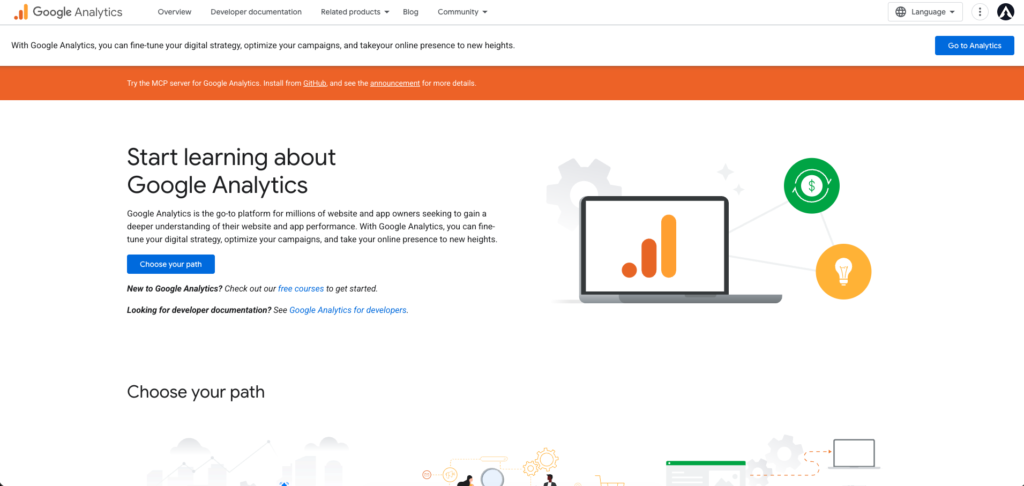
The industry-standard free analytics platform that powers data-driven decisions for startups of every size.
Google Analytics 4 (GA4) represents the next generation of Google’s analytics platform, built on an event-based data model that tracks users across websites and apps. For startups, GA4 offers an unbeatable value proposition: enterprise-grade analytics capabilities at absolutely no cost. The platform leverages machine learning to surface predictive insights, identify trends, and forecast user behavior without requiring a data science team.
GA4 integrates seamlessly with the broader Google ecosystem, including Google Ads, Search Console, BigQuery, and Looker Studio. Its cross-platform tracking capabilities allow startups to monitor user journeys across web and mobile, providing a holistic view of engagement. The enhanced measurement features automatically track events like scrolls, outbound clicks, file downloads, and video engagement without additional code. While the interface has a steeper learning curve than some alternatives, the depth of insight available for free makes it an essential foundation for any startup analytics stack.
Main Uses
- Website and app traffic analysis
- Cross-platform user journey tracking
- Conversion and e-commerce tracking
- Marketing campaign attribution and ROI measurement
Key Features
- Event-based tracking model with automatic measurement
- AI-powered predictive metrics and anomaly detection
- Cross-device and cross-platform user tracking
- Free BigQuery export for advanced data analysis
- Enhanced e-commerce and conversion reporting
Pricing: Free (360 enterprise version available)
Rating: 4.5/5
Strengths
- Completely free with enterprise-grade features
- Seamless Google Ads and Search Console integration
- Powerful machine learning-driven insights
- Unlimited data collection for most startups
Limitations
- Steep learning curve for non-technical users
- A complex interface can overwhelm small teams
- Limited real-time reporting compared to paid tools
- Data sampling can occur with large datasets on the free tier
2. Mixpanel
Deep product analytics that help startups understand exactly how users interact with their product.
Mixpanel is a product analytics platform built around event-based tracking, enabling startups to move beyond vanity metrics and understand how users actually engage with their products. The platform excels at answering critical product questions: which features drive retention, where users drop off in key funnels, and what behaviors predict long-term engagement. Its real-time data processing means product teams can see the impact of changes immediately.
What makes Mixpanel particularly valuable for startups is its generous free tier offering up to one million events per month, enough for most early-stage products to operate without any cost. The platform’s cohort analysis, retention reports, and funnel visualization tools provide the depth of insight that product-led growth companies need to iterate quickly. Mixpanel also offers a startup program providing free access to advanced features for qualifying companies, making it an excellent choice for funded startups focused on product-market fit. The Growth plan starts at approximately $24 per month for additional event volume beyond the free tier.
Main Uses
- Product usage and feature adoption tracking
- Funnel analysis and conversion optimization
- User retention and cohort analysis
- A/B testing and experiment measurement
Key Features
- Event-based tracking with unlimited user seats
- Advanced funnel analysis and retention reports
- Behavioral cohort analysis and segmentation
- Session replay for qualitative user insights
- AI-powered insights and trend detection
Pricing: Free up to 1M events/mo; Growth from $24/mo
Rating: 4.5/5
Strengths
- Generous free tier with 1M monthly events
- Powerful product analytics and retention tracking
- Startup program with extended free access
- Real-time data processing and reporting
Limitations
- Steep learning curve for non-technical teams
- Costs can escalate quickly at higher event volumes
- Requires technical implementation and event planning
- Group analytics for B2B is a paid add-on
3. Amplitude
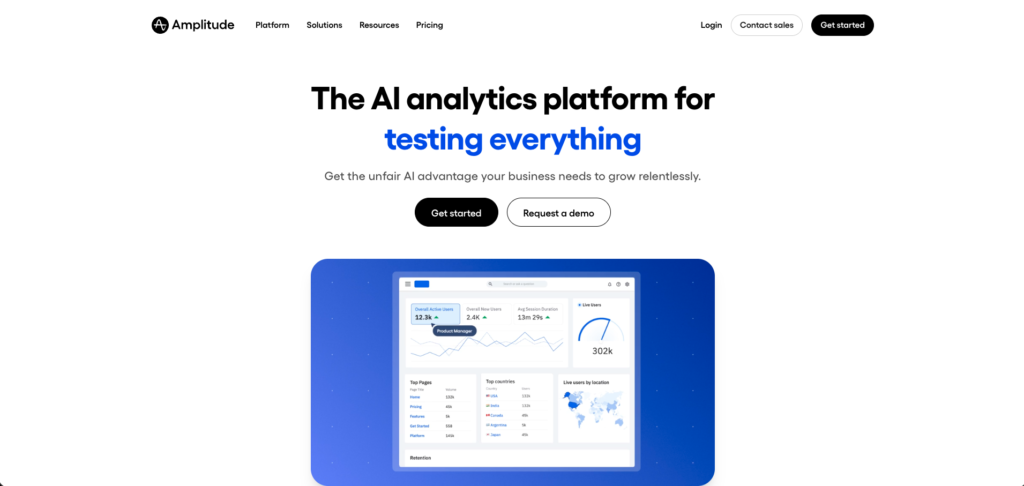
Enterprise-grade product analytics with a generous free tier designed for data-driven startup teams.
Amplitude has established itself as one of the leading product analytics platforms, trusted by companies like DoorDash, Atlassian, and Canva. For startups, Amplitude offers sophisticated behavioral analytics that help product teams understand user journeys, optimize engagement, and drive retention. The platform’s strength lies in its ability to surface deep behavioral insights through cohort analysis, user journey mapping, and advanced segmentation without requiring SQL expertise.
The Starter plan provides a generous free tier suitable for early-stage startups, while the Growth plan, starting at $49 per month, unlocks advanced features like behavioral cohorts, predictive analytics, and unlimited saved charts. Amplitude’s Experiment product enables startups to run rigorous A/B tests directly integrated with their analytics data. The platform also offers strong integration capabilities with over 100 pre-built connectors, making it easy to connect with data warehouses, marketing tools, and customer engagement platforms. For startups building digital products, Amplitude provides the analytical depth needed to make confident product decisions.
Main Uses
- Behavioral analytics and user journey mapping
- Product-led growth optimization
- Feature adoption and engagement tracking
- Experiment design and A/B test analysis
Key Features
- Behavioral cohort analysis with visual clarity
- User journey mapping across touchpoints
- Built-in experimentation and A/B testing
- Predictive analytics powered by machine learning
- 100+ pre-built integrations and data warehouse sync
Pricing: Free Starter plan; Growth from $49/mo
Rating: 4.3/5
Strengths
- Sophisticated behavioral analytics capabilities
- Strong free tier for early-stage startups
- Excellent visual reporting and dashboards
- Robust integration ecosystem
Limitations
- Advanced features are locked behind paid plans
- Can be complex for teams without analytics experience
- Enterprise pricing requires sales engagement
- Primarily suited for digital product analytics
4. PostHog
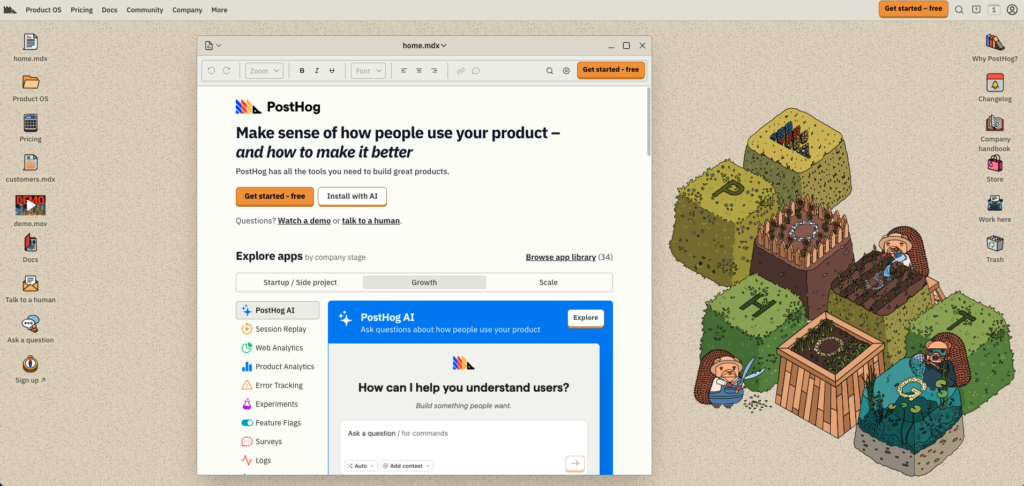
The open-source all-in-one product analytics suite that gives startups complete data ownership and control.
PostHog stands out in the analytics landscape as an open-source platform that combines product analytics, session replay, feature flags, A/B testing, and surveys into a single integrated suite. For startups that value data ownership and want to avoid vendor lock-in, PostHog offers the rare combination of enterprise-grade capabilities with complete transparency. The platform can be self-hosted for full data control or used via their cloud offering with generous free tiers.
PostHog’s free tier includes one million analytics events, 5,000 session replay recordings, one million feature flag requests, and 1,500 survey responses per month, making it one of the most generous free offerings in the market. The usage-based pricing model means startups only pay for what they use beyond these limits, with volume discounts as usage increases. With unlimited team seats on all plans and no per-user pricing, PostHog eliminates the concern of costs scaling with team size. The platform is particularly popular with developer-first startups who appreciate the open-source ethos, comprehensive API access, and the ability to self-host for complete data sovereignty.
Main Uses
- Product analytics with event tracking
- Session replay and user behavior visualization
- Feature flag management and controlled rollouts
- A/B testing and experimentation
Key Features
- Open-source with a self-hosting option
- All-in-one: analytics, replay, flags, surveys, and experiments
- Generous free tier across all product modules
- Usage-based pricing with spending caps
- Unlimited team seats on all plans
Pricing: Free (generous limits); Pay-as-you-go from $0
Rating: 4.4/5
Strengths
- Open-source with a complete data ownership option
- All-in-one platform eliminates multi-tool complexity
- Extremely generous free tier for startups
- No per-seat pricing encourages team-wide adoption
Limitations
- Self-hosting requires DevOps resources
- More suited for product and engineering teams than marketing
- Add-on costs can grow at scale for session replay
- Interface can feel complex for non-technical users
5. Hotjar
Visual behavior analytics that show startups exactly what users do, think, and feel on their website.
Hotjar brings a uniquely visual approach to analytics by combining heatmaps, session recordings, surveys, and feedback tools into an intuitive platform. While quantitative analytics tools tell startups what is happening, Hotjar reveals why it is happening by showing exactly how users interact with each page. This qualitative insight layer is invaluable for startups optimizing their landing pages, onboarding flows, and conversion funnels, as it reveals friction points that traditional analytics miss entirely.
The platform offers a free tier with up to 200,000 sessions per month, making it accessible for early-stage startups. The Growth plan starts at $49 per month with annual billing and includes advanced features like AI-powered behavior analysis, funnel visualization, and advanced filtering. Hotjar integrates with popular tools, including Google Analytics, Slack, HubSpot, and Segment. Following its acquisition by Contentsquare, Hotjar continues to evolve with enhanced capabilities while maintaining the simplicity that made it popular. For startups with limited UX research budgets, Hotjar provides the closest thing to watching users interact with your product in real time.
Main Uses
- Heatmap analysis for page optimization
- Session recording and user behavior replay
- User feedback collection through surveys and polls
- Conversion funnel visualization and drop-off analysis
Key Features
- Click, move, and scroll heatmaps
- Session recordings with rage click detection
- On-site surveys and feedback widgets
- AI-powered behavior insights (Sense)
- Funnel analysis and conversion tracking
Pricing: Free (200K sessions/mo); Growth from $49/mo
Rating: 4.2/5
Strengths
- Highly visual and intuitive for all team members
- Excellent for UX research on a startup budget
- Easy setup with minimal technical requirements
- Powerful combination of qualitative and feedback tools
Limitations
- Not a full quantitative analytics replacement
- Advanced features reserved for higher-tier plans
- Session recording sampling on high-traffic sites
- Primarily focused on the web, with limited mobile app support
6. Heap
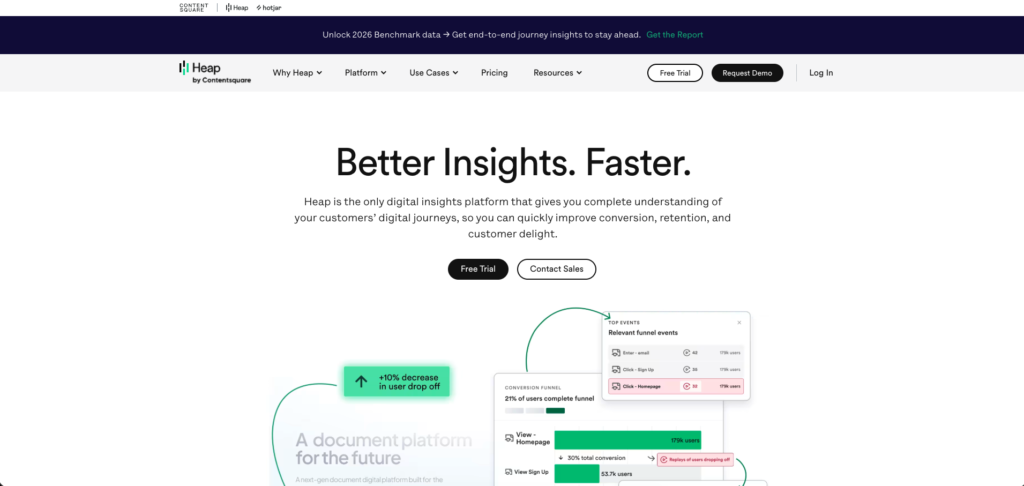
Automatic event capture that tracks everything so startups can analyze user behavior retroactively without planning.
Heap takes a fundamentally different approach to analytics by automatically capturing every user interaction, including clicks, form submissions, page views, and mouse movements, without requiring any manual event tracking setup. This autocapture philosophy is particularly powerful for startups where product priorities shift rapidly, and retroactive analysis of past user behavior can reveal insights that were not anticipated when the product was built. Teams can define events after the fact rather than predicting what needs tracking in advance.
The platform offers a free tier for up to 10,000 monthly sessions with core analytics capabilities and six months of data retention. The Growth plan starts at approximately $3,600 per year, targeting growing teams that need advanced features like unlimited data history, custom properties, and more sophisticated segmentation. Heap’s visual user journey mapping helps startups identify unexpected user paths and conversion bottlenecks, while its digital insights engine uses machine learning to automatically surface areas of friction and opportunity. For startups that move fast and want comprehensive data without the overhead of meticulously planning event taxonomies, Heap provides a compelling approach.
Main Uses
- Retroactive user behavior analysis
- Conversion funnel optimization
- User journey mapping and path analysis
- Digital experience improvement
Key Features
- Automatic event capture without manual instrumentation
- Retroactive analysis on historical data
- Visual user journey and path mapping
- AI-powered digital insights engine
- Session replay integrated with analytics
Pricing: Free up to 10K sessions/mo; Growth from ~$3,600/yr
Rating: 4.0/5
Strengths
- No manual event tracking required
- Powerful retroactive analysis capabilities
- Reduces the engineering time spent on instrumentation
- AI-driven insight discovery
Limitations
- Growth and enterprise pricing can be steep for early startups
- Comprehensive auto-capture can create data overwhelm
- Custom enterprise pricing lacks transparency
- Can require significant storage for autocaptured data
7. Plausible Analytics
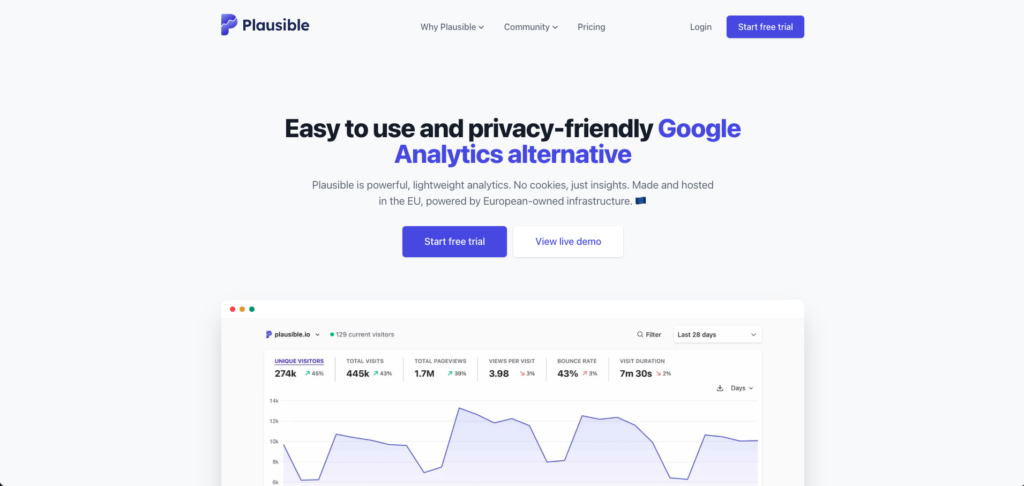
Lightweight, privacy-first web analytics that give startups essential insights without cookies or complexity.
Plausible Analytics offers a refreshingly simple alternative to the complexity of traditional analytics platforms. Built with privacy at its core, Plausible is fully GDPR, CCPA, and PECR compliant without requiring cookie consent banners, making it ideal for privacy-conscious startups operating across regulatory environments. The entire analytics script is 75 times smaller than Google Analytics, meaning it has virtually no impact on page load speed, a critical factor for startup conversion rates.
All essential metrics are displayed on a single, clean dashboard, including visitor counts, page views, bounce rates, visit duration, top pages, traffic sources, geographic distribution, and device breakdowns. Plausible also tracks AI-generated traffic from tools like ChatGPT, Perplexity, and Claude, helping startups understand how AI search is driving visitors to their site. The Growth plan starts at $19 per month for up to 100,000 page views, scaling based on traffic volume. As an open-source tool with European hosting, Plausible appeals to startups that want to respect user privacy while still gathering actionable website insights. Over 16,000 paying customers, including teams at Hugging Face and Basecamp, trust Plausible as their primary analytics solution.
Main Uses
- Privacy-compliant website traffic analytics
- Marketing campaign and UTM tracking
- Referral and traffic source analysis
- AI search traffic monitoring
Key Features
- Cookie-free, GDPR-compliant by default
- Lightweight script with minimal performance impact
- AI traffic source detection (ChatGPT, Claude, Perplexity)
- Single-page dashboard with essential metrics
- Open-source with a self-hosting option
Pricing: Growth from $19/mo (based on page views)
Rating: 4.3/5
Strengths
- No cookie banners required for compliance
- Ultra-lightweight with no page speed impact
- Beautifully simple single-page dashboard
- EU-hosted with complete data privacy
Limitations
- Limited advanced analytics compared to GA4 or Mixpanel
- No product analytics or event-level depth
- Paid-only with no free tier (30-day trial available)
- Not suited for complex multi-step funnel analysis
8. Kissmetrics
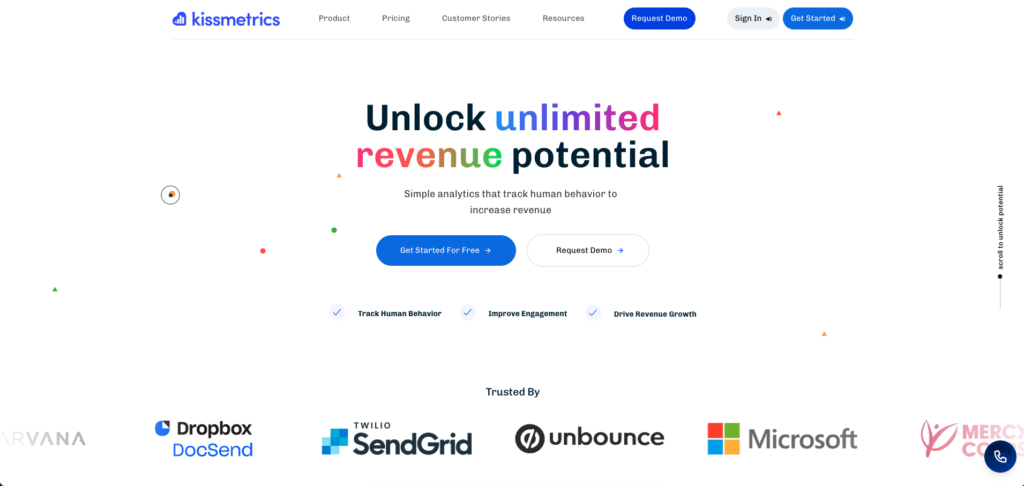
Customer journey analytics that connect marketing efforts to revenue and help startups optimize their conversion paths.
Kissmetrics focuses on connecting individual user behavior to revenue outcomes, helping startups understand which marketing channels, campaigns, and product interactions drive actual paying customers. Unlike session-based analytics tools, Kissmetrics tracks individual users across their entire lifecycle, from first visit through conversion and beyond. This person-centric approach provides startups with clear visibility into customer acquisition costs, lifetime value, and the specific touchpoints that influence purchasing decisions.
The platform excels at conversion funnel analysis, cohort-based retention tracking, and marketing attribution, making it particularly valuable for SaaS startups and ecommerce businesses focused on revenue optimization. Kissmetrics offers plans starting with Silver at $199 per month for basic analytics and tracking, Gold at $499 per month with additional A/B testing and advanced reporting, and Platinum with custom enterprise pricing. While the entry price is higher than some competitors’, the revenue-focused analytics provide direct ROI visibility for startups that have achieved product-market fit and are optimizing their growth engine. The platform integrates with popular marketing and sales tools, including Shopify, WooCommerce, Salesforce, and various email marketing platforms.
Main Uses
- Customer journey and lifecycle analytics
- Revenue attribution and marketing ROI tracking
- Conversion funnel optimization
- Cohort-based retention and churn analysis
Key Features
- Person-centric tracking across the full lifecycle
- Revenue attribution for marketing channels
- A/B testing with conversion impact analysis
- Cohort reports and retention tracking
- E-commerce and SaaS-specific analytics dashboards
Pricing: Silver from $199/mo; Gold from $499/mo
Rating: 3.8/5
Strengths
- Direct connection between user behavior and revenue
- Excellent marketing attribution capabilities
- Strong focus on conversion optimization
- Purpose-built for SaaS and ecommerce businesses
Limitations
- Higher entry price point than most competitors
- Interface can feel dated compared to modern alternatives
- Smaller integration ecosystem than larger platforms
- Steeper learning curve for full feature utilization
9. Segment
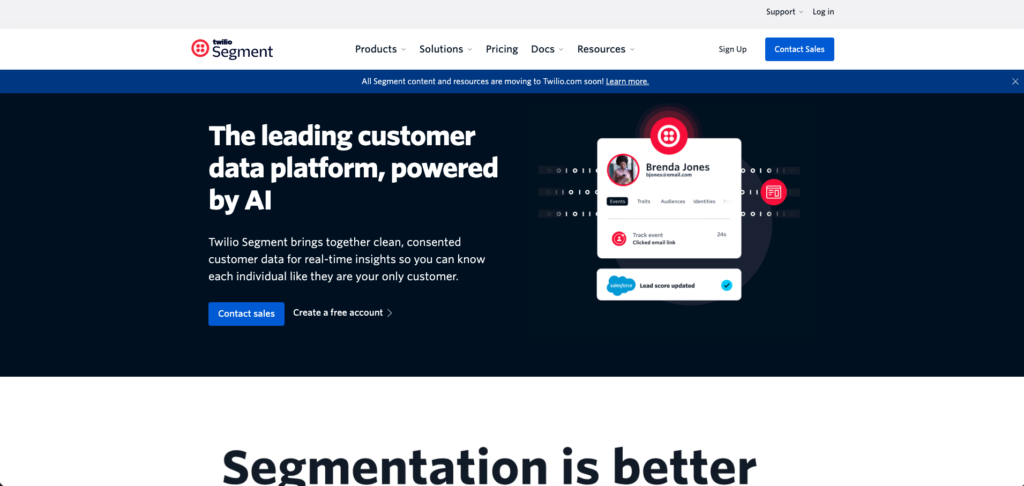
The customer data platform that unifies all your analytics data and eliminates silos across your startup’s tool stack.
Segment operates as a customer data platform (CDP) rather than a traditional analytics tool, serving as the central hub that collects, cleans, and routes user data to every other tool in your marketing and analytics stack. For startups using multiple tools for analytics, marketing automation, customer support, and advertising, Segment eliminates the need to implement separate tracking code for each platform. A single Segment integration sends data to over 300 pre-built destinations, drastically reducing engineering overhead.
The free tier supports up to 1,000 visitors per month with two data sources, suitable for very early-stage startups validating their data infrastructure approach. The Team plan starts at $120 per month with support for 10,000 visitors and unlimited sources. Segment’s real-time data streaming ensures that all connected tools receive consistent, up-to-date customer profiles. The platform’s identity resolution capabilities merge user data across devices and sessions, creating unified customer profiles that power personalized experiences. For startups planning to scale their analytics and marketing tool stack, investing in Segment early can prevent the costly data silos and inconsistent tracking that plague rapidly growing companies.
Main Uses
- Customer data unification across tools
- Multi-platform analytics data routing
- Identity resolution and user profile merging
- Data governance and privacy compliance
Key Features
- 300+ pre-built tool integrations
- Real-time data streaming and routing
- Identity resolution across devices and sessions
- Data governance and consent management
- Protocols for data quality enforcement
Pricing: Free (1K visitors/mo); Team from $120/mo
Rating: 4.1/5
Strengths
- Eliminates data silos across your entire tool stack
- Reduces engineering time for multi-tool implementation
- Comprehensive third-party connector library
- Strong data governance and quality controls
Limitations
- Can be expensive as visitor volume grows
- Complex initial setup requires technical expertise
- The free tier is very limited for meaningful testing
- Adds a dependency layer between you and your tools
Decision Framework: Which Tool Is Right for Your Startup?
Selecting the right analytics tools depends on your startup’s stage, technical capabilities, budget, and primary goals. The following framework maps common startup scenarios to recommended tool combinations, helping you build an analytics stack that grows with your business.
| Startup Stage / Need | Recommended Tool(s) | Why It Fits |
| Pre-revenue / MVP stage | Google Analytics 4 + PostHog Free | Zero cost with comprehensive quantitative and product analytics coverage |
| Product-led growth focus | Mixpanel or Amplitude | Deep funnel, retention, and cohort analysis to optimize product engagement |
| UX optimization priority | Hotjar + Google Analytics 4 | Visual behavior insights paired with quantitative data for a full picture |
| Privacy-first / EU market | Plausible Analytics | GDPR compliant without cookies, lightweight, EU-hosted data processing |
| Developer-first team | PostHog (self-hosted) | Open-source, full data ownership, built-in feature flags, and experiments |
| Scaling with multiple tools | Segment + Mixpanel or Amplitude | Unified data layer prevents silos as your analytics stack grows |
| Revenue and conversion focus | Kissmetrics | Person-centric tracking that connects user behavior directly to revenue |
| Fast-moving team, no time for setup | Heap | Autocapture everything now, define and analyze events retroactively later |
A common and cost-effective approach for most startups is to layer tools strategically. Start with Google Analytics 4 as your free foundation for web and marketing analytics. Add a product analytics tool like Mixpanel, Amplitude, or PostHog once your product has active users and you need to understand engagement patterns. Incorporate Hotjar for specific UX optimization projects. Consider Plausible if privacy compliance is a priority for your market. Only invest in Segment once your tool stack exceeds three or four integrated tools and data consistency becomes a concern.
Frequently Asked Questions
What is the best free analytics tool for startups?
Google Analytics 4 remains the most comprehensive free analytics solution, offering enterprise-grade features including AI-powered insights, cross-platform tracking, and BigQuery integration at no cost. For product analytics specifically, both Mixpanel (1M free events) and PostHog (1M free events plus session replay, feature flags, and surveys) offer generous free tiers that can serve early-stage startups without any financial commitment.
Should startups use Google Analytics or a product analytics tool like Mixpanel?
Most successful startups use both. Google Analytics 4 excels at website traffic analysis, marketing attribution, and campaign performance, while product analytics tools like Mixpanel and Amplitude provide deeper insight into how users engage with your product, including feature adoption, retention cohorts, and funnel conversion. GA4 tells you how users arrive; product analytics tools tell you what they do after they arrive.
How much should a startup budget for analytics tools?
Early-stage startups can build a robust analytics stack for free using Google Analytics 4 combined with PostHog or Mixpanel free tiers. As you scale past product-market fit, budget $50 to $500 per month for paid analytics features. Funded startups optimizing for growth typically spend $200 to $2,000 per month across their analytics stack, depending on data volume and tool complexity.
Is PostHog a good alternative to Mixpanel and Amplitude?
PostHog is an excellent alternative, particularly for developer-first startups that value open-source transparency and data ownership. It combines product analytics with session replay, feature flags, and A/B testing in a single platform, potentially replacing multiple tools. PostHog is typically 50 to 75 percent cheaper than Mixpanel or Amplitude at equivalent scale, though non-technical teams may find Mixpanel or Amplitude more intuitive.
Do startups need a customer data platform like Segment?
Not initially, but as your tool stack grows beyond three or four tools, a CDP like Segment becomes increasingly valuable. Implementing Segment early prevents data silos and reduces the engineering overhead of maintaining separate tracking implementations for each tool. If you plan to scale aggressively and use multiple marketing, analytics, and engagement tools, investing in Segment can save significant time and ensure data consistency.
What analytics tools help track AI search visibility?
Plausible Analytics has built-in AI traffic source detection that identifies visitors arriving from ChatGPT, Perplexity, Claude, and other AI tools. Google Analytics 4 can also track AI referral traffic through custom channel groupings. For broader AI search visibility monitoring, including tracking brand mentions and citations across AI platforms, specialized tools like those covered on angleout.io complement traditional analytics with AI-specific monitoring capabilities.
Conclusion
The analytics tool landscape for startups in 2026 offers more capabilities at a lower cost than ever before. Generous free tiers from Google Analytics 4, Mixpanel, PostHog, and Hotjar mean that early-stage startups can build a comprehensive analytics stack without any financial investment. As your startup grows, the key is choosing tools that align with your specific needs rather than defaulting to the most popular option.
For most startups, a layered approach works best. Google Analytics 4 provides the free foundational layer for website and marketing analytics. A product analytics tool like Mixpanel, Amplitude, or PostHog adds depth for understanding user engagement and retention. Qualitative tools like Hotjar reveal the human stories behind the numbers. Privacy-focused alternatives like Plausible address growing regulatory requirements. And customer data platforms like Segment ensure clean, consistent data as your tool stack expands.
The most important factor is not choosing the perfect tool, but choosing a tool and actually using it. Data-driven startups consistently outperform those making decisions based on intuition alone. Start with the free tiers available to you, build the habit of checking your analytics regularly, and upgrade your tools as your data needs evolve alongside your growth. The insights waiting in your analytics data could be the difference between your startup’s next pivot and its next milestone.