
A comprehensive comparison of hosted, open-source, and headless ecommerce platforms – ranked by SEO capability, flexibility, and value for online stores in 2026.
Why Your E-commerce Platform Choice Defines Your SEO Ceiling
In 2026, organic search remains the highest-ROI customer acquisition channel for online stores. But SEO performance doesn’t start with keywords or content – it starts with your platform. The ecommerce platform you choose determines how fast your pages load, how search engines crawl and index your site, how much control you have over URLs and metadata, and whether you can implement advanced technical SEO without hiring a developer.
With global retail ecommerce sales projected to reach $8.1 trillion in 2026 and over 2.86 billion people shopping online, the competition for organic visibility has never been fiercer. Paid acquisition costs continue to climb. The brands that invest in SEO at the platform level build sustainable, compounding traffic that reduces dependence on ad spend.
This guide evaluates 11 ecommerce platforms across three categories: hosted SaaS solutions (Shopify, BigCommerce, Wix, Squarespace, Volusion, Shift4Shop), open-source platforms (WooCommerce, Adobe Commerce, PrestaShop, OpenCart), and visual/headless builders (Webflow). Each platform is assessed on mobile optimization, site speed, URL and metadata control, blogging capabilities, indexing controls, and readiness for AI-powered search.
11 Best E-commerce Platforms for SEO in 2026
| Platform | Overview | Best For | Pricing |
| Shopify | All-in-one hosted platform with 8,000+ apps and mobile-first themes | Small to mid-sized stores wanting a fast launch and scalability | $39–$399/mo (Plus from $2,300/mo) |
| WooCommerce | Open-source WordPress plugin with full SEO flexibility via Yoast/Rank Math | Content-driven stores needing total customization | Free plugin; hosting $4–$50+/mo |
| BigCommerce | Hosted platform with advanced built-in SEO controls and 0% transaction fees | Growing brands wanting technical SEO without heavy dev work | $29–$299/mo (Enterprise: custom) |
| Adobe Commerce | Enterprise-grade open-source platform (Magento) with deep SEO architecture | Large enterprises with complex catalogs and global operations | Open Source: free; Commerce: $22K+/yr |
| Wix | Drag-and-drop builder with improved SEO tools and AI content generation | Small businesses and beginners prioritize ease of use | $17–$159/mo |
| Squarespace | Design-first builder with clean URLs, built-in blog, and SSL included | Creative brands and small stores that value aesthetics | $16–$99/mo |
| Volusion | Simple hosted platform with basic SEO tools and mobile-responsive themes | Small to mid-sized stores with straightforward SEO needs | $35–$299/mo |
| PrestaShop | Open-source platform with 300K+ stores and strong international SEO | European and international merchants with dev resources | Free core; modules $50–$300+ |
| OpenCart | Lightweight open-source platform with multi-store management | Budget-conscious stores with technical skills | Free; hosting + extensions extra |
| Shift4Shop | Feature-rich hosted platform with built-in SEO suite and free US plan | US-based merchants want $0 software costs with full features | Free (US/Shift4); $29–$229/mo otherwise |
| Webflow | Visual CMS with clean semantic code and headless commerce capabilities | Design agencies and brands wanting pixel-perfect SEO control | $29–$212/mo (ecommerce plans) |
1. Shopify

The all-in-one commerce platform that makes selling simple and SEO accessible.
Shopify powers over four million businesses worldwide and remains the go-to hosted e-commerce platform for brands that want speed, stability, and a massive app ecosystem. Its SEO capabilities have matured significantly: mobile-optimized themes load fast by default, every plan includes SSL, and the built-in blog editor supports content marketing without third-party tools. While URL structures include fixed paths like /products/ and /collections/, the vast app marketplace (including tools like ConvertMate, SEO Manager, and Plug in SEO) fills any gaps. Shopify Sidekick AI now assists with product descriptions and store optimization, and Shopify Markets simplifies international SEO with multi-language and multi-currency support.
Main Uses
- Launching and scaling online stores with minimal technical overhead
- Content marketing via the integrated blog editor
- Omnichannel selling across social media, marketplaces, and POS
- International SEO with Shopify Markets (multi-language, multi-currency)
Key Features
- Mobile-First Themes → All themes are responsive and optimized for Core Web Vitals, giving you a head start on mobile-first indexing.
- 8,000+ App Ecosystem → Extend SEO with dedicated apps for structured data, image optimization, meta tag automation, and internal linking.
- Built-in Blogging → Native blog editor for publishing SEO-optimized content that drives top-of-funnel organic traffic.
- Shopify Sidekick AI → AI-powered assistant that helps generate product descriptions, suggest SEO improvements, and automate store tasks.
- SSL on All Plans → HTTPS included out of the box across every pricing tier, boosting trust signals and rankings.
Pricing
Basic: $39/mo | Grow: $105/mo | Advanced: $399/mo | Plus: from $2,300/mo. Annual billing saves 25%. All plans include unlimited products, SSL, and blogging.
Try it here: https://www.shopify.com.
2. WooCommerce
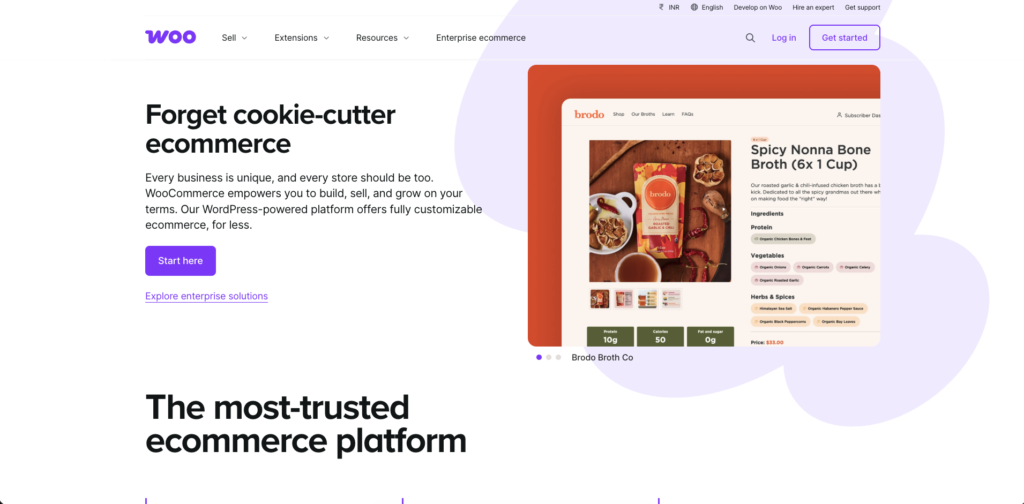
Full WordPress power meets ecommerce flexibility – the SEO-first builder’s dream.
WooCommerce is the world’s most popular open-source e-commerce plugin, powering over 36% of all online stores. Built on WordPress, it inherits the CMS’s legendary content management and SEO infrastructure. Paired with plugins like Yoast SEO or Rank Math, you get granular control over every meta tag, canonical URL, schema markup, breadcrumb, and sitemap. The native WordPress blog is best-in-class for content marketing, and the open-source architecture means zero limits on customization. The trade-off: you manage your own hosting, security patches, and performance optimization.
Main Uses
- Content-driven stores where blogging and SEO are primary growth channels
- Highly customized storefronts with unique design and functionality needs
- Developers and agencies building bespoke ecommerce experiences
- Stores that need a complete URL structure and metadata control
Key Features
- WordPress SEO Plugin Ecosystem → Yoast SEO, Rank Math, and All in One SEO give you unmatched on-page optimization, schema markup, XML sitemaps, and redirect management.
- Total URL and Metadata Control → Customize every URL slug, page title, meta description, canonical tag, and robots directive without restrictions.
- Best-in-Class Blogging → WordPress was built for content. No other e-commerce platform matches its blogging capabilities for SEO-driven organic growth.
- Open-Source Flexibility → Modify any aspect of your store’s code, design, and architecture. No platform lock-in.
- 55,000+ Plugins → Extend functionality with caching, CDN integration, image optimization, lazy loading, and advanced analytics.
Pricing
WooCommerce plugin: Free. WordPress hosting: $4–$50+/mo depending on provider and traffic. Premium themes: $50–$200 one-time. SEO plugins: free tiers available; pro versions $99–$199/yr.
Try it here: https://woocommerce.com.
3. BigCommerce
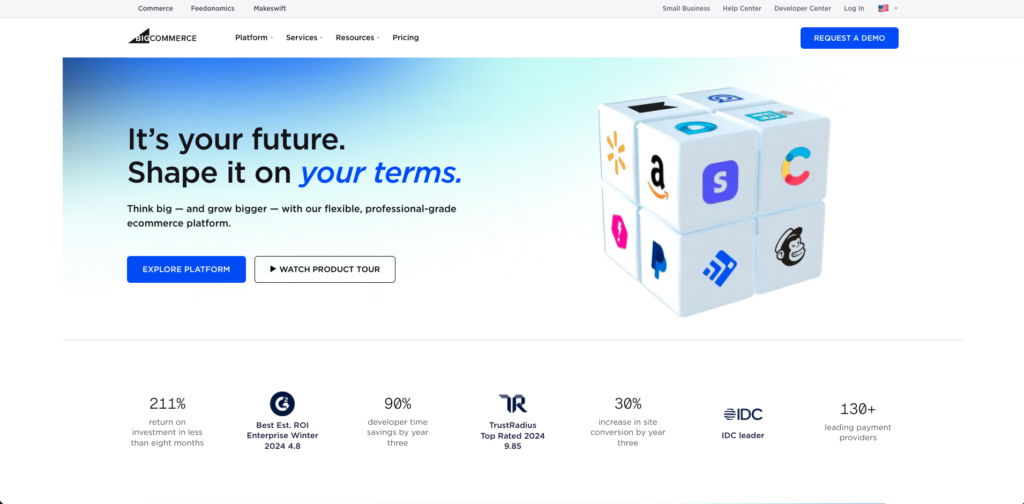
Enterprise SEO power in a hosted package – no apps required for the fundamentals.
BigCommerce stands out for packing advanced SEO controls into its core platform, reducing dependence on third-party apps. You get full robots.txt editing, automatic sitemap generation, customizable URLs without forced prefixes, built-in AMP pages for mobile speed, and native structured data support. The platform handles hosting and security, so you focus on optimization rather than infrastructure. BigCommerce also charges 0% transaction fees on all plans, making it cost-effective as revenue scales. Its headless commerce capabilities via API allow brands to pair BigCommerce’s backend with custom frontends for maximum SEO flexibility.
Main Uses
- Growing brands that want robust SEO without building from scratch
- Stores that need clean, customizable URL structures and canonical management
- Multi-channel sellers (Amazon, eBay, Google Shopping, Facebook, Instagram)
- Businesses wanting 0% transaction fees to protect margins
Key Features
- Granular SEO Controls → Full robots.txt editing, automatic XML sitemaps, customizable canonical URLs, and 301 redirect management – all built in.
- Clean URL Structures → Unlike Shopify, BigCommerce allows fully customizable URLs without mandatory path prefixes like /products/ or /collections/.
- Built-in AMP Support → Accelerated Mobile Pages improve mobile load times and can boost rankings in mobile search results.
- 0% Transaction Fees → No additional platform fees on any plan, regardless of which payment gateway you use.
- Headless Commerce Ready → Use BigCommerce as the backend engine while building a custom frontend with Next.js, Gatsby, or any framework for SEO-optimized page speed.
Pricing
Standard: $29/mo | Plus: $79/mo | Pro: $299/mo | Enterprise: custom pricing. 15-day free trial available. No transaction fees on any plan.
Try it here: https://www.bigcommerce.com.
4. Adobe Commerce (Magento)
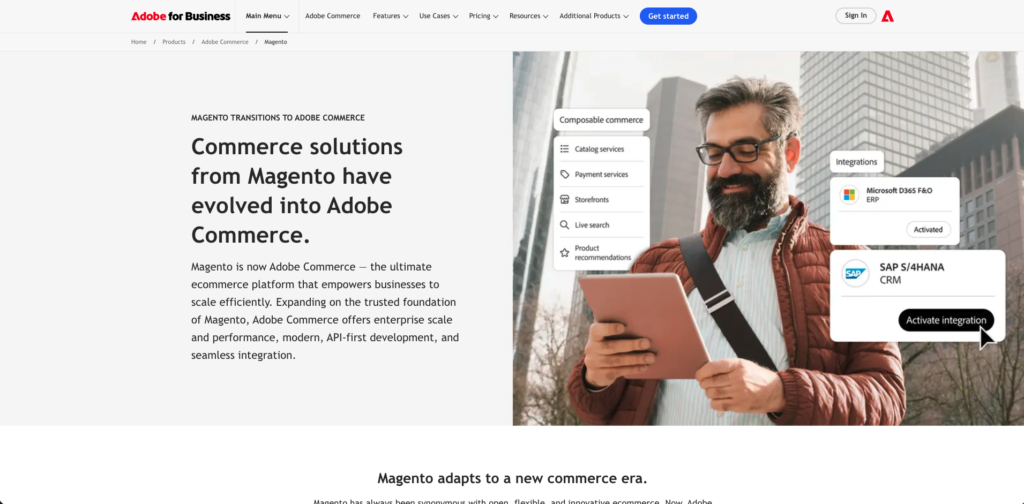
Enterprise-grade architecture for brands that demand total SEO control at a global scale.
Adobe Commerce, built on the Magento open-source foundation, is the heavyweight champion for large enterprises with complex SEO needs. It offers complete control over site architecture, indexing, canonical tag management, schema markup, and multi-store configurations across different languages and regions. The platform handles massive product catalogs (100K+ SKUs) and supports advanced features like layered navigation, SEO, faceted search optimization, and automated URL rewrites. The catch: implementation costs are high, and you need a dedicated development team or agency. But for global brands managing multiple storefronts, the SEO flexibility is unmatched.
Main Uses
- Large enterprises managing complex, multi-region product catalogs
- Global brands needing multi-store, multi-language SEO architecture
- Businesses requiring advanced indexing, canonical, and schema management
- Companies with dedicated dev teams that need complete platform control
Key Features
- Enterprise SEO Architecture → Advanced indexing controls, canonical tag management, XML sitemap configuration, and meta robots directives across unlimited pages and categories.
- Multi-Store, Multi-Language → Run multiple storefronts from a single backend with unique URLs, hreflang tags, and localized SEO settings for each market.
- Advanced Schema Markup → Native support for product, review, FAQ, and organization schema – plus the flexibility to add custom structured data types.
- Magento Extensions Ecosystem → Thousands of extensions from MageFan, Amasty, and others for SEO-specific enhancements like rich snippets, image optimization, and page speed.
- Layered Navigation SEO → Control how filtered/faceted pages are crawled, indexed, and canonicalized to prevent duplicate content from product filters.
Pricing
Magento Open Source: free (self-hosted). Adobe Commerce: starts at ~$22,000/yr for small businesses; enterprise pricing scales with GMV and features. Implementation costs: $20K–$100K+ depending on complexity.
Try it here: https://business.adobe.com/products/magento/magento-commerce.html.
5. Wix
The beginner-friendly builder that’s grown real SEO muscles.
Wix has shed its reputation as an SEO-limited platform. In 2026, it offers customizable meta tags, clean URL structures, automatic XML sitemaps, built-in SSL, structured data support, and a dedicated SEO Wiz tool that creates personalized optimization plans for your store. The drag-and-drop editor makes setup effortless, and Wix’s AI tools now generate product descriptions and site content. Mobile performance has improved dramatically with optimized rendering and fast load times. However, Wix still has limitations for large catalogs and advanced technical SEO – making it best suited for smaller operations.
Main Uses
- Small businesses and solopreneurs launching their first online store
- Service-based businesses adding ecommerce functionality
- Stores with smaller product catalogs (under 500 products)
- Non-technical users who need SEO guidance built into the platform
Key Features
- SEO Wiz → Step-by-step personalized SEO plan that walks beginners through optimizing titles, descriptions, alt text, and site structure.
- Customizable Meta Tags & URLs → Edit page titles, meta descriptions, URL slugs, and image alt text for every product and page.
- Built-in Structured Data → Automatic schema markup for products, breadcrumbs, and business information to enhance search result appearance.
- Wix AI Content Tools → Generate product descriptions, blog posts, and marketing copy using built-in AI, saving time on content creation.
- Mobile-Optimized Templates → All templates are responsive by default, meeting Google’s mobile-first indexing requirements.
Pricing
Light: $17/mo | Core: $29/mo | Business: $36/mo | Business Elite: $159/mo. E-commerce features are available on Business plans and above. 14-day money-back guarantee.
Try it here: https://www.wix.com.
6. Squarespace

Where stunning design meets structured SEO – beautiful stores that actually rank.
Squarespace combines award-winning design templates with solid foundational SEO. Every site gets clean URLs, automatic XML sitemaps, SSL certificates, and built-in blogging. The platform now includes Squarespace AI for content generation, and its SEO tools cover meta tags, alt text, 301 redirects, and page descriptions. Over 100 mobile-responsive templates ensure your store looks polished on any device. The trade-off is limited backend customization – you can’t edit robots.txt directly or implement advanced technical SEO without workarounds. Best for creative brands, photographers, artists, and small stores where design is a competitive advantage.
Main Uses
- Creative professionals and design-forward brands
- Small businesses want a polished online presence with minimal effort
- Stores selling curated, limited catalogs where visual presentation matters
- Service-based businesses combining booking, ecommerce, and content
Key Features
- 100+ Professional Templates → All templates are mobile-responsive and designed for visual impact, meeting Google’s UX and mobile-first standards.
- Built-in Blog Editor → Publish SEO-optimized content with categories, tags, and RSS feeds to drive organic traffic and build topical authority.
- Clean URL Structure → Automatic clean, readable URLs without complex parameters, plus easy 301 redirect management for site migrations.
- Squarespace AI → Generate product descriptions, page copy, and blog content using built-in AI tools to accelerate content production.
- SSL Included on All Plans → Free SSL certificates on every plan ensure secure browsing and contribute to search ranking signals.
Pricing
Basic: $16/mo | Core: $23/mo | Plus: $39/mo | Advanced: $99/mo (billed annually). E-commerce features on Core and above. 14-day free trial.
Try it here: https://www.squarespace.com.
7. Volusion
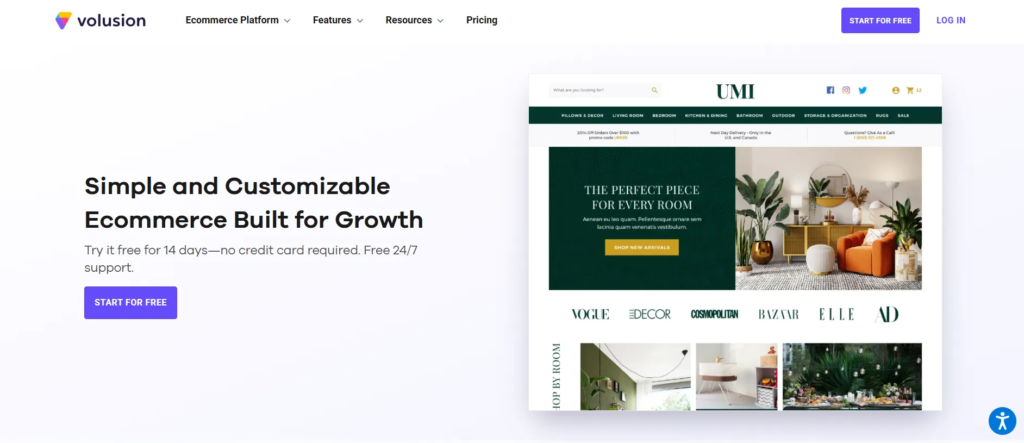
Straightforward e-commerce with the basics covered – simple SEO for simple stores.
Volusion has been around since 1999 and serves small to mid-sized merchants who want a no-frills hosted e-commerce experience. It includes basic SEO tools: editable meta tags, 301 redirects, mobile-responsive themes, and clean product URLs. However, Volusion notably lacks a built-in blog, which is a significant limitation for content-driven SEO strategies. The platform’s simplicity is its strength for merchants with straightforward product catalogs who don’t need advanced technical SEO. Recent updates have improved site speed and mobile performance, but it still lags behind Shopify and BigCommerce in SEO feature depth.
Main Uses
- Small stores with straightforward product catalogs
- Merchants who want basic SEO without complexity
- Businesses that don’t rely on content marketing for traffic
Key Features
- Editable Meta Tags → Customize page titles, meta descriptions, and header tags for products and categories.
- 301 Redirects → Easy redirect management to preserve SEO equity during URL changes or site restructuring.
- Mobile-Responsive Themes → All themes are mobile-optimized for Google’s mobile-first indexing requirements.
- Built-in Analytics → Track traffic, conversions, and sales performance from within the dashboard.
- SSL Included → Free SSL certificate on all plans for secure customer transactions and SEO benefits.
Pricing
Personal: $35/mo | Professional: $79/mo | Business: $299/mo. 14-day free trial. No built-in blog on any plan.
Try it here: https://www.volusion.com.
8. PrestaShop
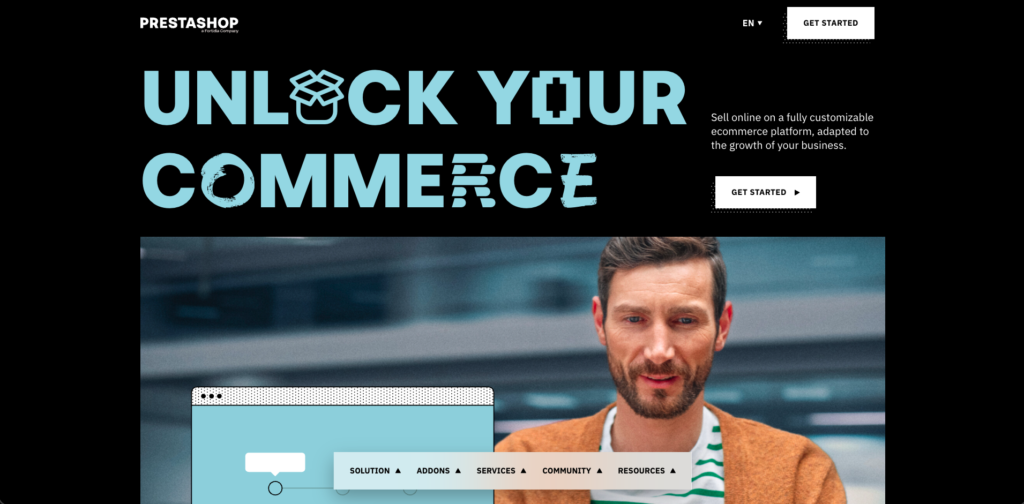
Open-source ecommerce built for international sellers who want granular SEO control.
PrestaShop powers over 300,000 online stores globally, with particular strength in Europe and international markets. As an open-source platform, it offers deep customization of URL structures, metadata, canonical tags, and hreflang attributes for multi-language stores. The PrestaShop Addons marketplace includes dedicated SEO modules for schema markup, image optimization, and advanced sitemap generation. The platform supports over 75 languages and 100 currencies natively, making it a strong choice for cross-border ecommerce. Like WooCommerce, you’ll need to handle hosting, security, and maintenance yourself or hire a developer.
Main Uses
- European and international merchants targeting multiple markets
- Stores needing multi-language and multi-currency SEO out of the box
- Developers comfortable with open-source PHP customization
- Budget-conscious businesses that want a free core platform
Key Features
- Multi-Language SEO → Native support for 75+ languages with proper hreflang implementation, localized URLs, and translated metadata for international search visibility.
- Customizable URL Structure → Full control over URL patterns, including SEO-friendly product and category URLs with clean slugs.
- SEO Modules Marketplace → Dedicated modules for advanced XML sitemaps, rich snippets, structured data, image ALT automation, and page speed optimization.
- Open-Source Flexibility → Modify any aspect of the platform’s PHP codebase to implement custom SEO logic, redirects, or schema types.
- 300,000+ Active Stores → Large community with extensive documentation, forums, and developer resources for troubleshooting and optimization.
Pricing
PrestaShop core: free to download. Hosting: $5–$200+/mo. Premium themes: $60–$300. SEO modules: $50–$300+, depending on functionality. Agency setup: $2,000–$15,000.
Try it here: https://www.prestashop.com.
9. OpenCart
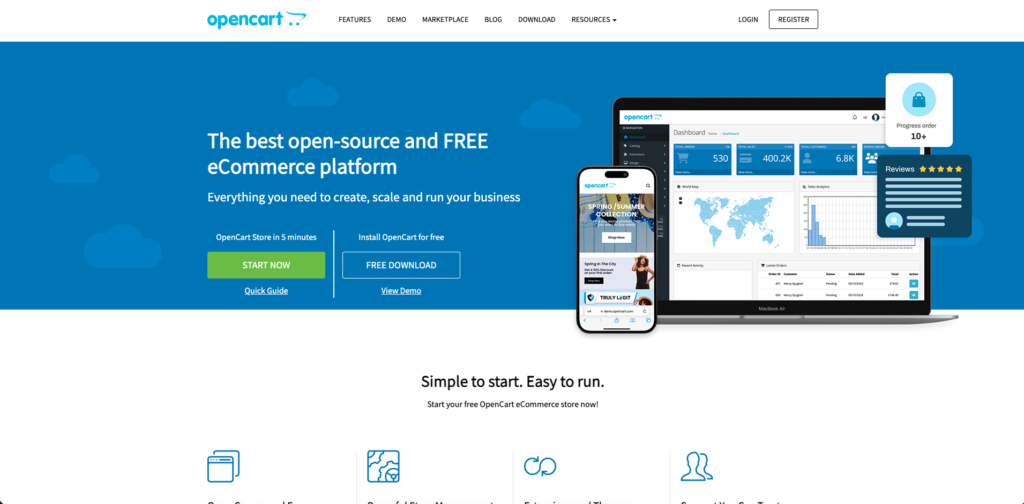
Lightweight open-source power for stores that want maximum control on a minimal budget.
OpenCart is a free, open-source e-commerce platform built in PHP that excels at multi-store management from a single admin dashboard. Its SEO features include customizable URLs, meta tags, and basic sitemap generation, with over 13,000 extensions available for advanced functionality. The admin panel is more accessible than Magento’s, making it a middle ground between WooCommerce’s flexibility and simpler hosted platforms. However, OpenCart requires technical knowledge for setup and maintenance, and its default SEO capabilities are basic – you’ll need extensions for structured data, advanced sitemaps, and image optimization.
Main Uses
- Budget-conscious merchants who want a free platform with room to grow
- Multi-store operators managing several brands from one dashboard
- Developers who want a lighter alternative to Magento
- International sellers needing multi-language and multi-currency support
Key Features
- Multi-Store Management → Manage multiple online stores with different themes, products, and settings from a single admin panel.
- 13,000+ Extensions → Marketplace includes SEO extensions for structured data, advanced sitemaps, URL optimization, and page speed improvements.
- Customizable SEO URLs → Create clean, keyword-rich URLs for products, categories, and information pages.
- Multi-Language Support → Built-in support for multiple languages and currencies without additional plugins.
- Lightweight Architecture → Smaller codebase than Magento means faster setup and lower hosting requirements for basic stores.
Pricing
OpenCart core: free. Hosting: $5–$200+/mo. Premium themes: $30–$100. Extensions: $15–$300+. Estimated annual total: $500–$2,000+, depending on store complexity.
Try it here: https://www.opencart.com
10. Shift4Shop
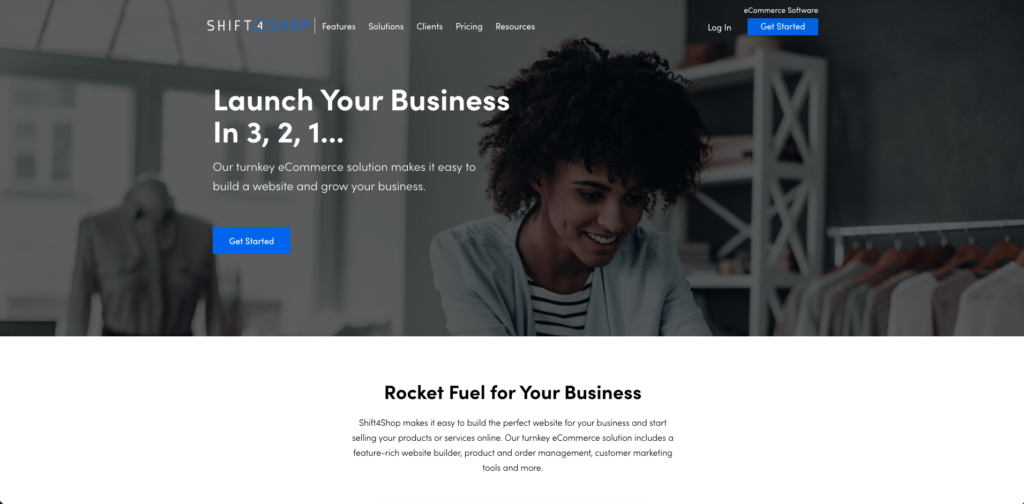
Full-featured ecommerce with a built-in SEO suite – and a free plan for US merchants.
Shift4Shop (formerly 3dcart) is a hosted e-commerce platform that claims to be the most search engine-friendly builder on the market. Its standout feature: US-based merchants using Shift4 Payments get full platform access for free – no monthly software fees. The platform includes a comprehensive SEO toolkit: customizable meta tags, clean URL structures, automatic 301 redirects, robots.txt control, canonical tags, and built-in structured data. It also includes blog functionality, email marketing tools, and CRM – features that typically require separate apps on competing platforms. The Google AMP-powered Core Templating Engine delivers fast mobile experiences.
Main Uses
- US-based merchants wanting $0 platform costs with full SEO features
- Small to mid-sized stores that want built-in tools instead of paying for apps
- Businesses looking for an integrated blog, email marketing, and CRM
- Merchants who want strong SEO out of the box without plugins
Key Features
- Free for US Merchants → Full platform access at $0/mo when using Shift4 Payments – no feature restrictions, no upgrade tiers required.
- Complete SEO Suite → Customizable meta tags, clean URLs, robots.txt editing, canonical tags, 301 redirects, and automatic XML sitemaps – all built in.
- Core Templating Engine → Google AMP-powered templates deliver fast mobile load times and comply with Core Web Vitals standards.
- Built-in Blog & Marketing → Integrated blog editor, email marketing, newsletters, and CRM tools without third-party app costs.
- PCI-Certified Hosting → One of the few Visa PCI-certified hosted ecommerce platforms, providing enterprise-grade security included in every plan.
Pricing
Free for US merchants using Shift4 Payments. International or non-Shift4 plans: $29–$229/mo. All plans include unlimited products, bandwidth, and the full SEO toolkit.
Try it here: https://www.shift4shop.com
11. Webflow
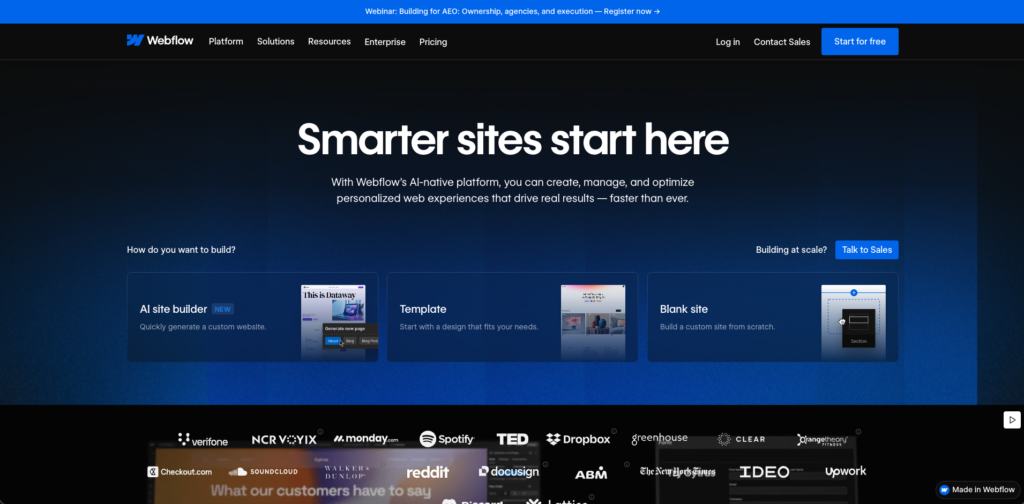
Pixel-perfect visual design meets clean semantic code – where SEO and aesthetics coexist.
Webflow occupies a unique position: it’s a visual web design tool that generates clean, semantic HTML and CSS – unlike other drag-and-drop builders that produce bloated code. For SEO-focused brands, this means fast page loads, proper heading hierarchy, and structured markup without the typical builder overhead. Webflow’s CMS allows custom content structures, dynamic collections, and flexible URL patterns. Its ecommerce capabilities (launched as Webflow Ecommerce) support product pages, checkout, and inventory management, while the underlying code remains lightweight and crawlable. The trade-off: e-commerce features are less mature than those of Shopify or BigCommerce, and transaction fees apply.
Main Uses
- Design agencies and brands wanting complete visual and SEO control
- Content-heavy stores where editorial design drives conversions
- Businesses moving to headless or API-first commerce architectures
- Teams that need clean code output for maximum Core Web Vitals performance
Key Features
- Clean Semantic Code → Webflow outputs clean HTML, CSS, and JavaScript without the bloated markup typical of drag-and-drop builders, improving crawlability and page speed.
- Visual CMS with SEO Control → Custom content structures, dynamic collections, and full control over meta tags, Open Graph data, and canonical URLs through a visual interface.
- Custom URL Patterns → Define URL structures for any content type without platform-imposed prefixes, giving you complete control over your site’s information architecture.
- Fast Page Performance → Built on AWS and Fastly CDN with automatic image optimization, lazy loading, and minification for excellent Core Web Vitals scores.
- Headless Commerce Ready → Use Webflow as a frontend connected to headless commerce backends for maximum flexibility in store architecture and SEO control.
Pricing
CMS: $29/mo | Business: $49/mo | Ecommerce Standard: $42/mo | Ecommerce Plus: $84/mo | Ecommerce Advanced: $212/mo. 2% transaction fee on Standard; 0% on Advanced.
Try it here: https://webflow.com.
How to Choose the Right E-commerce Platform for SEO
Use this decision framework to match your business profile with the platform that best supports your SEO strategy. The right platform depends on where you are today and where you’re headed.
| Factor | Your Situation | Best Platform Fit |
| Business Size | Solo/startup (< 100 products) | Wix, Squarespace, Shift4Shop |
| Business Size | Growing mid-market (100–5K products) | Shopify, BigCommerce, WooCommerce |
| Business Size | Enterprise (5K+ SKUs, multi-store) | Adobe Commerce, BigCommerce Enterprise, Webflow |
| Technical Resources | No developer needs simplicity | Shopify, Wix, Squarespace |
| Technical Resources | Some technical skills or agency support | WooCommerce, BigCommerce, PrestaShop |
| Technical Resources | Full dev team available | Adobe Commerce, OpenCart, Webflow |
| Budget | Under $50/mo | WooCommerce, OpenCart, Shift4Shop (free US) |
| Budget | $50–$200/mo | Shopify, BigCommerce, Squarespace |
| Budget | $200+/mo or enterprise | Adobe Commerce, Shopify Plus, Webflow |
| SEO Priority | Content marketing and blogging | WooCommerce, Shopify, Squarespace |
| SEO Priority | Technical SEO control | BigCommerce, Adobe Commerce, Webflow |
| SEO Priority | International / multi-language SEO | PrestaShop, Adobe Commerce, BigCommerce |
| Growth Strategy | Omnichannel (social + marketplace) | Shopify, BigCommerce |
| Growth Strategy | Headless / API-first architecture | Webflow, Adobe Commerce, BigCommerce |
| Growth Strategy | Content-led organic growth | WooCommerce, Shopify, Squarespace |
What Makes E-commerce Content Rank in 2026
Choosing the right platform sets the foundation, but ranking in 2026 requires understanding what search engines and AI answer engines actually prioritize when surfacing ecommerce content.
- Page Experience Signals → Core Web Vitals (LCP, INP, CLS) directly influence rankings. Platforms with fast hosting, CDN integration, and optimized templates give you a structural advantage before you write a single word of content.
- Product Schema Markup → Structured data for products, reviews, pricing, availability, and FAQ schema helps search engines understand and display your content as rich results, increasing click-through rates.
- Content Depth and Topical Authority → Stores that publish comprehensive buying guides, comparison articles, and category-level content build topical authority that lifts the entire domain’s rankings, not just individual pages.
- Internal Linking Architecture → How your products, categories, and content pages link to each other determines how search engines discover, crawl, and assign authority across your site. Flat, well-linked architectures outperform deep, siloed structures.
- Mobile-First Experience → Google indexes and ranks the mobile version of your site. Platforms that prioritize responsive design, fast mobile rendering, and streamlined mobile checkout directly improve your search performance.
- AI Search Readiness → With AI-powered search engines like Google AI Overviews, ChatGPT, and Perplexity increasingly driving product discovery, your platform needs clean semantic markup, fast load times, and authoritative content that LLMs can reference and cite.
Frequently Asked Questions
Which e-commerce platform is best for SEO in 2026?
It depends on your needs. WooCommerce offers the most SEO flexibility for content-driven stores, Shopify provides the best balance of ease and capability, and BigCommerce excels at built-in technical SEO without relying on apps.
Can I do SEO on Wix or Squarespace?
Yes. Both platforms now offer solid foundational SEO tools, including customizable meta tags, clean URLs, SSL, and sitemaps. They work well for smaller stores but may limit advanced technical SEO for larger operations.
Is WooCommerce really free?
The WooCommerce plugin is free, but you’ll pay for WordPress hosting ($4–50+/mo), a domain, SSL (often included with hosting), and any premium themes or plugins. Total cost varies from $100 to $2,000+ per year.
What makes Shift4Shop different from other hosted platforms?
Shift4Shop offers its full-featured platform for free to US merchants using Shift4 Payments. This includes SEO tools, a blog, CRM, and email marketing that competitors charge extra for through apps.
Should I choose a hosted or open-source e-commerce platform for SEO?
Hosted platforms (Shopify, BigCommerce) handle infrastructure, so you focus on SEO strategy. Open-source platforms (WooCommerce, Magento, PrestaShop) offer more SEO control but require technical maintenance. Choose based on your team’s capabilities.
What’s Best For you
There is no single best e-commerce platform for SEO. The right choice depends on three factors: your business size, your technical resources, and your growth ambitions.
For most small to mid-sized businesses launching in 2026, Shopify offers the strongest combination of ease, speed, and SEO capability. If content marketing is your primary growth lever, WooCommerce gives you unmatched flexibility on the WordPress foundation. BigCommerce delivers advanced SEO controls without the complexity of open-source maintenance. And for large enterprises with global ambitions, Adobe Commerce remains the most powerful (and most demanding) option.
The emerging platforms deserve attention, too. Webflow appeals to design-led brands that want clean code and visual control. Shift4Shop’s free-for-US model makes it a compelling entry point. And PrestaShop’s international DNA makes it a natural fit for cross-border sellers.
Whatever you choose, remember: your platform is the foundation, not the strategy. The brands that win in organic search are the ones that combine the right infrastructure with consistent content creation, technical optimization, and a clear understanding of how both traditional search engines and AI answer engines surface and recommend products.
Start with the platform that matches where you are today – and choose one that won’t hold you back as you scale.
