
Most roundups of Google ranking software list 10 to 14 tools. That is too many to act on. At Angleout, we track rankings for 30+ B2B SaaS companies, and we keep coming back to the same five.
This guide covers those five. For each one you get what it does well, where it falls short, and what it actually costs in 2026. We checked every price on the vendor’s own pricing page in November 2026.
Quick picks
- Best free option: Google Search Console
- Best all-in-one suite: Semrush
- Best for backlinks plus rankings: Ahrefs
- Best value for agencies and growing teams: SE Ranking
- Best dedicated rank tracker at scale: AccuRanker
What Google ranking software does
Google ranking software records where your pages appear in Google for the keywords you care about, and tracks how those positions change over time. Good tools check from a neutral location and device, because your own browser shows personalized results.
The category splits three ways:
- Free first-party data: Google Search Console shows average positions from Google itself, but only for your own site.
- All-in-one SEO suites: Semrush, Ahrefs and SE Ranking bundle rank tracking with keyword research, site audits and backlink data.
- Dedicated rank trackers: AccuRanker does one job, tracking large keyword sets accurately and fast.
In 2026 there is a fourth layer. Buyers now ask ChatGPT, Perplexity and Google’s AI Overviews before they click a blue link. Most leading tools now track AI visibility too, so we note that for each pick.
How we picked these 5 tools
We judged each tool on the criteria that matter when you report rankings to a SaaS founder every month:
- Accuracy: do positions match what we see in a clean, location-set search?
- Update frequency: daily tracking is the standard; weekly is too slow for most campaigns.
- Keyword allowance for the price: most tools charge per tracked keyword, so this decides real cost.
- Depth beyond rankings: competitor tracking, SERP features, reporting and AI visibility.
- Ease of reporting: can a client read the output without a walkthrough?
Best Google ranking software compared
| # | Tool | Best for | Starting price | Keywords (entry plan) | Updates | Free option |
|---|---|---|---|---|---|---|
| 1 | Google Search Console | Free first-party data | Free | All queries for your site | Daily 1 to 2 day lag | Yes |
| 2 | Semrush | All-in-one suite | $139/mo$117.33/mo annual | 500 | Daily | Free plan + 7-day trial |
| 3 | Ahrefs | Backlinks + rankings | $129/moLite plan | 750 | Weekly | Ahrefs Free (limited) |
| 4 | SE Ranking | Value for agencies | $129/mo$103.20/mo annual | 2,000 | Daily | 14-day trial |
| 5 | AccuRanker | Large keyword sets | €229/moProfessional | 2,000 | Daily | Demo on request |
Prices checked on each vendor’s pricing page in November 2026. Ahrefs also lists a $29/mo Starter plan without published rank tracking limits.
Prices checked on each vendor’s pricing page in November 2026. Ahrefs also lists a $29/mo Starter plan, but its rank tracking limits are not published.
The 5 best Google ranking software tools in 2026
1. Google Search Console: best free Google ranking software
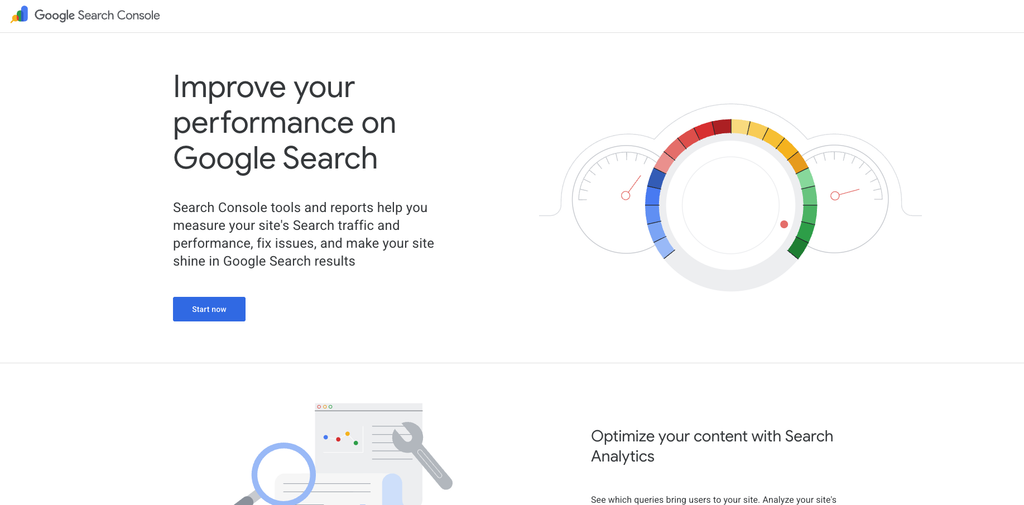
Google Search Console (GSC) is the only ranking tool that uses Google’s own data. It shows clicks, impressions, CTR and average position for every query your site appears for. It is free, and it is where every SEO audit we run starts.
The catch: GSC reports an average position across all searches, locations and devices. It does not give you a clean daily spot check for a target keyword. It also only works for sites you own, so you cannot see competitors.
Key features
- Clicks, impressions, CTR and average position per query and page
- Country, device and search appearance filters
- Indexing, Core Web Vitals and manual action reports
- 16 months of performance history
Pros
- Free, and the data comes straight from Google
- Shows every query you rank for, including ones you never thought to track
- Impressions reveal new rankings before they drive clicks
Cons
- Averages, not exact positions for a set location
- No competitor data
- Data lags by one to two days
Pricing: Free.
Best for: every site. Use it as your baseline even if you pay for another tool.
2. Semrush: best all-in-one SEO suite
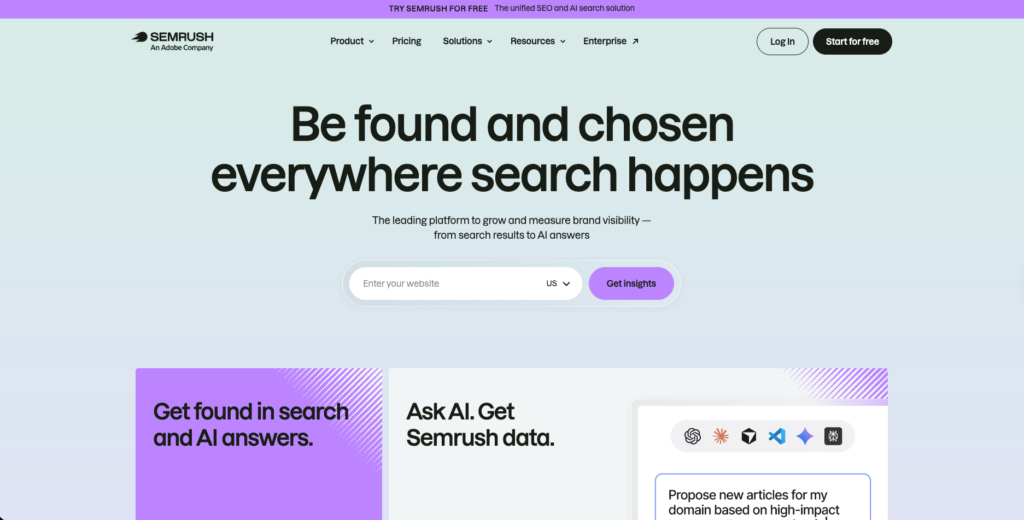
Semrush is the suite most B2B SaaS marketing teams already own. Its Position Tracking tool checks rankings daily and sits next to keyword research, site audits, backlink analysis and content tools. You can track by country, city or ZIP code, and compare against competitors in the same view.
In 2026 Semrush folded AI visibility into its plans. The Starter plan and above track your brand across Google, ChatGPT, Perplexity and Gemini, with a set number of prompts tracked daily.
Key features
- Daily rank tracking with location and device targeting
- Visibility score, share of voice and SERP feature tracking
- Competitor ranking comparison
- AI visibility tracking (50 prompts daily on Starter, 100 on Pro+)
- Keyword research, audits and backlinks in the same login
Pros
- One tool covers almost every SEO task
- Large keyword database for research beyond tracking
- Free plan and a 7-day trial on paid plans
Cons
- 500 tracked keywords on the entry plan fills up fast
- Costs climb once you add users and add-ons
Pricing: SEO plan $139/mo ($117.33/mo billed annually) with 500 keywords tracked daily. Starter $199/mo, Pro+ $299/mo with 1,500 keywords. Advanced and Enterprise are custom.
Best for: in-house teams that want rankings, research, and audits in one place.
3. Ahrefs: best for backlinks plus rank tracking
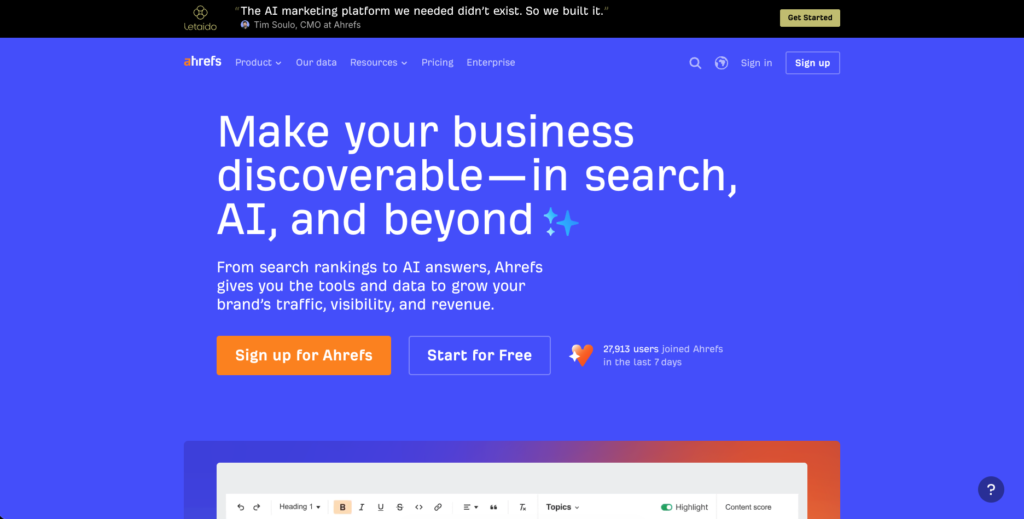
Ahrefs is known for its backlink index, and that is still the main reason to buy it. Rank Tracker pairs your positions with estimated traffic, SERP features, and competitor movement, so you can see why a page moved, not just that it did.
The limitation is frequency. Rank Tracker updates weekly on every plan listed on the pricing page. That is fine for long-term trend reporting, but slow if you are watching a launch or recovering from an update.
Key features
See what Reddit & SEO can do for your pipeline — grab a time
A 30-minute working session. We'll map your top intent gaps and where the pipeline is leaking. No pitch deck.
- Rank Tracker with SERP feature and traffic estimates
- Industry-leading backlink data in Site Explorer
- Keywords Explorer, Content Gap and Site Audit
- Brand Radar for AI visibility (paid add-on)
Pros
- Best-in-class backlink data to explain ranking changes
- Clean, fast interface
- Ahrefs Free gives limited Site Explorer and Site Audit access
Cons
- Weekly rank updates
- AI tracking (Brand Radar) starts at $199/mo on top of your plan
Pricing: Lite $129/mo with 750 tracked keywords. Standard $249/mo (2,000 keywords), Advanced $449/mo (5,000 keywords). Enterprise is custom. A $29/mo Starter plan exists for lighter use.
Best for: teams where link building drives growth and backlink context matters as much as positions.
4. SE Ranking: best value for agencies and growing teams
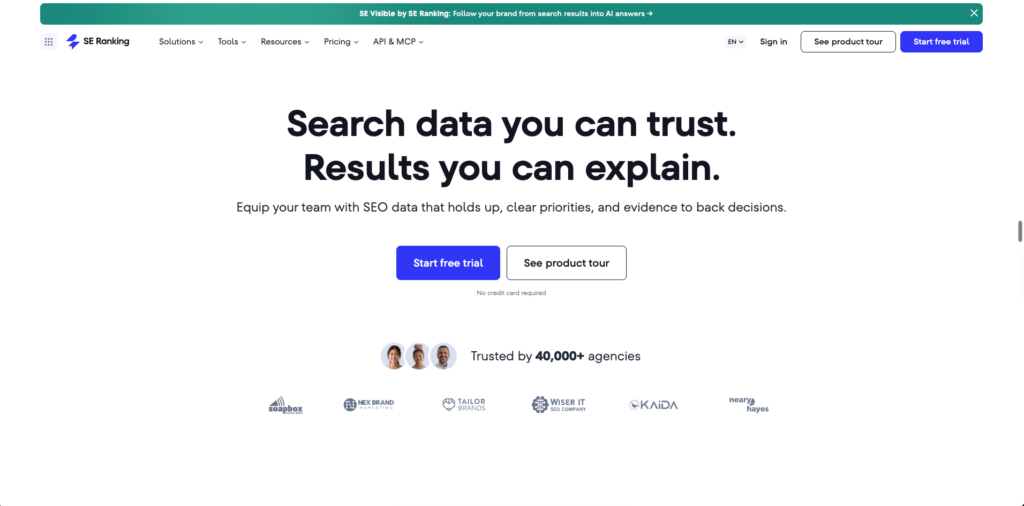
SE Ranking gives you the most tracked keywords for the money in this list. Its Core plan tracks 2,000 keywords daily for less than Semrush charges for 500. It also covers audits, keyword research, competitor research and white-label reporting, which is why many small agencies run on it.
AI tracking is built in at a basic level: Core and Growth include 25 AI prompts daily across 5 AI engines, with a larger AI Visibility add-on if you need more.
Key features
- Daily rank tracking across Google, Bing and Yahoo
- Competitor and SERP feature monitoring
- White-label client reports
- 25 AI prompts tracked daily across 5 AI engines
Pros
- High keyword allowance for the price
- 14-day free trial
- Agency-friendly reporting
Cons
- Smaller keyword and backlink databases than Semrush or Ahrefs
- Bigger AI tracking needs mean a separate add-on from $71/mo
Pricing: Core $129/mo ($103.20/mo billed annually) with 2,000 keywords tracked daily. Growth $279/mo ($223.20/mo annually) with 5,000 keywords. Enterprise is custom.
Best for: agencies and growing SaaS teams tracking many keywords on a budget.
5. AccuRanker: best dedicated rank tracker at scale
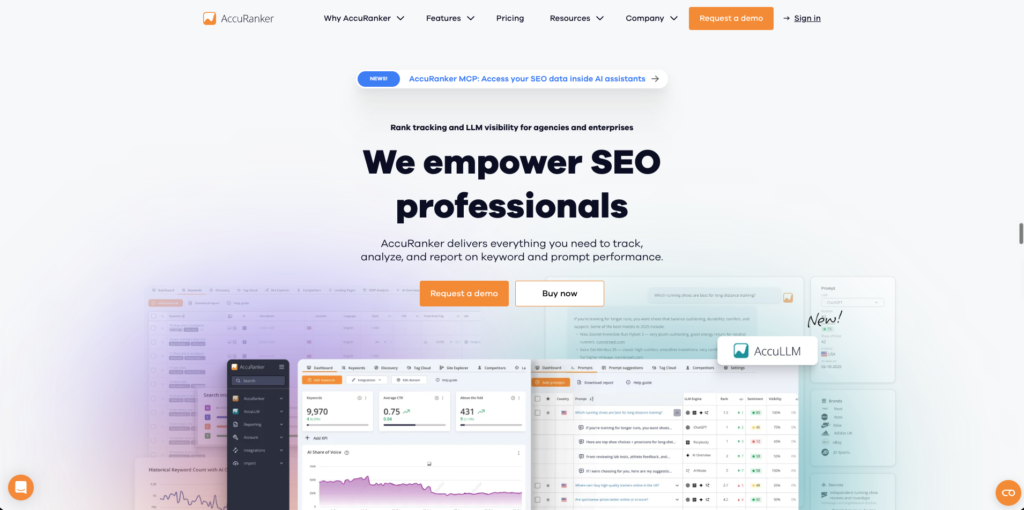
AccuRanker only does rank tracking, and it does it fast. You get daily updates, on-demand refreshes, deep keyword tagging and a Google Search Console sync that pulls in real click data next to tracked positions. It is the tool we would pick for an enterprise site tracking thousands of keywords across markets.
It is not a suite. You still need another tool for keyword research, audits and backlinks.
Key features
- Daily tracking with on-demand refresh
- Keyword tagging, segmentation and share of voice
- Google Search Console and Google Analytics integration
- AccuLLM for AI model tracking
Pros
- Fast and accurate at high keyword volumes
- Flexible segmentation for large sites and multiple markets
- Strong API for custom dashboards
Cons
- Expensive for small keyword sets
- No free trial listed, only a demo
- Needs to be paired with a separate SEO suite
Pricing: Professional from €229/mo (2,000 to 5,000 keywords). Expert from €809/mo (10,000 to 20,000 keywords). Enterprise is custom. Annual billing saves up to 15%.
Best for: enterprise teams and agencies tracking large keyword sets across many locations.
How to choose the right Google ranking software
Start with these four questions. The answers usually narrow the list to one or two tools.
- Do you need a suite or just a tracker? If you already pay for Semrush or Ahrefs, use their tracker before buying another. If rankings are all you need at scale, a dedicated tracker like AccuRanker is cleaner.
- How many keywords will you really track? Multiply keywords by locations and devices. 200 keywords tracked on desktop and mobile in 3 countries is 1,200 tracked keywords, not 200.
- How often do you need updates? Daily is the default. Weekly (Ahrefs) works for monthly reporting, not for launches or algorithm updates.
- Do AI answers matter to your buyers? For B2B SaaS, they usually do. Check how many AI prompts each plan tracks and which engines it covers.
The stack we run at Angleout
For most B2B SaaS clients we use Google Search Console as the source of truth and Semrush for daily tracking, competitor comparison and research. When a client tracks thousands of keywords across markets, we add a dedicated tracker. Ahrefs comes in when link building is a major part of the plan.
The tool matters less than the habit. Pick one, set up clean keyword groups by intent and page, and review the movement every week.
FAQs
What is the best free Google ranking software?
Google Search Console. It is free, it uses Google’s own data, and it shows every query your site ranks for. Its limits are averaged positions and no competitor data.
How do I check my Google rankings accurately?
Use a rank tracker set to your target country, city and device. Searching in your own browser gives personalized results, so it is not a reliable check.
How often should I track Google rankings?
Daily tracking is the standard for active campaigns. Review trends weekly and report monthly, so short-term swings do not drive decisions.
Can ranking software improve my rankings?
Not by itself. It shows what moved and where to focus. Rankings improve through better content, technical fixes and quality backlinks.
Do rank trackers measure AI search visibility?
Many now do. Semrush, SE Ranking, Ahrefs (Brand Radar) and AccuRanker (AccuLLM) all offer some form of AI visibility tracking, at different prompt limits and prices.
Final thoughts
There is no single best Google ranking software for everyone. Start with Google Search Console because it is free and accurate. Add Semrush if you want one tool for everything, Ahrefs if backlinks drive your growth, SE Ranking if you need volume on a budget, and AccuRanker if you track thousands of keywords.
Want help turning ranking data into pipeline? Talk to Angleout about SEO for your SaaS.
47 checkpoints across technical, content, and conversion — the same list our strategists run on every new account.