Last updated: July 2026
AI-powered search engines now influence over 30% of all informational queries, yet studies show fewer than 5% of brands have any measurable visibility in ChatGPT, Perplexity, or Google AI Overview results. That gap is exactly why the best LLM SEO agencies in 2026 have become some of the most sought-after partners for B2B SaaS, enterprise, and growth-stage companies that want to be cited, not just ranked.
LLM SEO is a fundamentally different discipline from traditional search optimization. Instead of chasing keyword positions, it focuses on structured authority signals, entity recognition, and content architecture that makes your brand the source large language models quote when generating answers across ChatGPT, Perplexity, Gemini, and Google AI Overviews.
The agencies featured here were evaluated against a strict methodology, including documented GEO and AEO capabilities, verified client case studies, proprietary AI citation tracking tools, and measurable outcomes in real AI search environments. If your brand needs to win the citation layer of search before your competitors do, this guide was built for you.
TL;DR: Finding the best LLM SEO agencies in 2026 requires a completely different evaluation framework than traditional SEO, since optimizing for AI engines like ChatGPT, Perplexity, and Google AI Overviews depends on entity authority, structured content, and citation signals rather than keyword rankings. This article reviews six top agencies, with Graphite earning the top spot for its deliberate focus on generative engine optimization at scale, followed by specialists like iPullRank for technical SEO and Go Fish Digital for precise AI visibility measurement. A critical insight driving agency selection is that 62% of brands currently have no reliable way to measure their AI search presence, making the right agency partnership essential. Whether you need bottom-of-funnel citations, enterprise content production, or B2B SaaS content programs, this guide identifies the best fit for your specific growth goals.
Key Takeaways
- A 62% measurement gap exists between traditional SEO reporting and actual AI citation tracking, making it critical to choose an agency that explicitly offers documented GEO visibility metrics rather than vanity metrics like domain authority.
- Three core signals drive LLM citations across ChatGPT, Perplexity, and Google AI Overviews: entity authority (consistent brand mentions across authoritative third-party sources), content structure (listicles, definitions, and comparison formats), and technical crawlability for LLM parsers.
- Technical SEO infrastructure is a prerequisite for GEO success, as LLM crawlers must be able to access and parse your site before any content or entity-building strategy can generate citations.
- The most commercially valuable AI citations occur at the decision stage, when buyers ask an LLM for the best solution for a specific use case, so bottom-of-funnel content targeting those query patterns should be prioritized alongside broader entity-building efforts.
- Producing structured, authoritative, and linkable content at scale remains the single most reliable method for earning consistent LLM citations, making a repeatable content production system a foundational agency capability to evaluate.
- Agency selection for LLM SEO should be based on specialization and documented AI search outcomes, not agency size or self-reported rankings, since the discipline of generative engine optimization requires a purpose-built service model distinct from traditional SEO.
Top LLM SEO Agencies at a Glance
A decision shortcut across all six agencies — flagging which ones offer documented AI citation tracking versus traditional reporting only.
Swipe / scroll to see full details →
| Agency | Best for | GEO / AEO service | Proprietary AI tool | Key verticals | Notable client |
|---|---|---|---|---|---|
| Graphite | AI-driven growth at scale | Yes, documented | Yes | SaaS, Fintech, Marketplace | Notion, Rippling |
| iPullRank | Complex technical SEO | Yes | Yes (Authoritas) | Enterprise, Publishing | JPMorgan Chase |
| Omniscient Digital | B2B SaaS content programs | Yes | Limited | B2B SaaS, HR Tech | Hotjar, Jasper |
| Siege Media | Enterprise content at scale | Yes | Limited | E-commerce, Finance | Casper, Intuit |
| Go Fish Digital | Data-driven AI visibility | Yes, documented | Yes | Multi-vertical | TechTarget |
| Grow and Convert | Bottom-of-funnel AI citations | Partial | No | SaaS, B2B Services | Patreon, Leadfeeder |
Note: “GEO / AEO service” and “Proprietary AI tool” reflect each agency’s stated capability for AI-search visibility and citation tracking: Yes / documented = full offering, Partial / Limited = in development, No = not offered.
What Makes an LLM SEO Agency Different from a Traditional SEO Agency?
Traditional SEO agencies optimize for a crawl-index-rank pipeline: get pages indexed, earn backlinks, chase keyword positions. An LLM SEO agency operates on an entirely different model, one built around how retrieval-augmented generation (RAG) systems and AI training data select and cite sources.
Image source: [LLM Pulse](LLM Pulse)
Three terms describe this emerging discipline:
- GEO (Generative Engine Optimization): optimizing content structure and authority signals so generative engines cite your brand in responses
- AEO (Answer Engine Optimization): formatting content to directly answer queries pulled by platforms like Perplexity and Google AI Overviews
- LLMO (LLM Optimization): influencing which sources language models weight during both training and live retrieval
The critical shift: off-site authority signals, including third-party mentions, digital PR placements, and structured data, carry more weight in AI retrieval contexts than on-page rankings ever did. According to a 2024 study by Columbia and Princeton researchers, GEO-optimized content increased AI citation rates by up to 40%.
AI platforms also exhibit fan-out query behavior, meaning a single user question triggers multiple sub-queries across sources. Citation overlap across ChatGPT, Perplexity, and Google AI Overviews has become the new ranking proxy.
Key differentiator: A true LLM SEO agency measures brand presence across AI engines, not just keyword positions on Google’s search results pages.
How We Evaluated the Best LLM SEO Agencies in 2026
Measuring brand presence across AI engines demands a different agency selection framework than traditional SEO evaluation. Agency size, self-reported rankings, and vanity metrics like domain authority played no role in this assessment. Every agency was scored against five criteria:
Watch: Best Law Firm SEO Agencies in 2026: Why Three Stripes …
- Documented GEO/AEO capability, a named service offering with case studies proving AI citation outcomes, not just blog posts about the topic
- Proprietary AI citation tracking, ability to measure a client’s mention rate across ChatGPT, Perplexity, Gemini, and Google AI Overviews
- Verified client results, specific data points such as percentage increases in LLM mentions or conversion rates from AI-referred traffic, not anecdotal wins
- Industry vertical depth, demonstrated experience across enterprise, B2B SaaS, fintech, and ecommerce
- Off-site strategy maturity, digital PR and authority-building programs built explicitly for AI citation signals, not repurposed link-building playbooks
Note: This publication operates a SaaS SEO agency, which creates a potential conflict of interest. No agencies with commercial relationships to this publication were included in the rankings.
According to BrightEdge’s 2025 AI Search Report, 62% of enterprise marketers cannot currently measure their brand’s citation rate in AI-generated answers, making proprietary tracking tools the single most decisive agency selection criterion in 2026.
Quick Comparison: Top LLM SEO Agencies at a Glance
That 62% measurement gap makes agency selection critical. This table functions as a decision shortcut across all six agencies, flagging which ones offer documented AI citation tracking versus traditional reporting only.
Important: Pricing reflects typical retainer ranges (as of July 2026). Agencies with “documented AI citation tracking” actively measure brand mentions inside ChatGPT, Perplexity, and Google AI Overviews, not just traditional rank tracking.
1. Graphite. Best LLM SEO Agency for AI-Driven Growth at Scale
Graphite earns the top position because it is the agency that most deliberately built its service model around generative engine optimization (GEO) as a distinct discipline, not as a bolt-on to traditional SEO. Founded by CEO Ethan Smith, a widely cited thought leader in the GEO space, Graphite formalized AI citation strategy into a productized service targeting visibility in ChatGPT, Perplexity, and Google AI Overviews before most agencies had even coined the term.
Price: Retainer engagements typically range from $8,000 to $20,000/month (as of July 2026), structured around full GEO programs. Project-based scopes are available for defined deliverables but are the exception, not the standard offering.
What it is: Graphite is a GEO agency for SaaS and high-growth tech companies that treats LLM citation as a measurable, engineered outcome rather than a byproduct of traditional content marketing.
Key features:
- Fan-out query research: Maps the specific prompts and sub-queries LLMs use to retrieve information in a client’s category, then builds content to answer each node
- Information gain methodology: Prioritizes content that adds net-new facts, perspectives, or data to the web’s existing corpus, since LLMs are biased toward novel information
- Off-site citation network building: Coordinates structured placements across publications, review platforms, and authoritative directories
- Perplexity SEO-specific tracking: Measures brand mention frequency inside AI-generated answers, not just Google rank positions
Graphite’s GEO Methodology: Off-Site First
Graphite’s core philosophical claim is that 60 to 70% of LLM visibility is determined by off-site signals, third-party mentions, structured citations, and digital PR placements, rather than on-page content. This directly inverts the traditional SEO agency default of optimizing page structure and internal linking first.
The Webflow case study is the most-cited proof point: Graphite attributes 8% of Webflow’s new signups to LLM-sourced traffic, with that cohort converting at roughly 6x the rate of traditional organic search visitors. That conversion differential is what makes AI citation strategy commercially defensible, not just strategically interesting.
Important: These conversion figures come from Graphite’s own reported case study data. Independent third-party verification has not been published, so treat them as directionally credible rather than audited benchmarks.
Best for: High-growth SaaS companies and B2B tech brands with established product-market fit that need AI citation outcomes tied to pipeline, not just impressions.
Limitations:
- Minimum engagement size makes Graphite inaccessible for most SMBs and early-stage startups
- Heavy off-site focus means clients without existing domain authority or PR infrastructure face a longer ramp period before measurable citation gains appear
Graphite’s approach offers the clearest documented evidence that GEO, executed as a structured program, can produce conversion outcomes that traditional SEO rarely matches.
2. iPullRank. Best LLM SEO Agency for Complex Technical SEO
Where entity-building and content programs reach their ceiling, technical infrastructure determines whether LLM crawlers can even access and parse your site in the first place. iPullRank addresses precisely this layer, making it the strongest choice for organizations whose AI visibility problems stem from architecture, not editorial gaps.
Founded by Mike King, a widely published technical SEO authority, iPullRank has produced some of the most cited practitioner research on how large language models ingest and retrieve web content. King’s work on LLM crawler optimization, including his detailed analyses of how Googlebot and AI crawlers differ in JavaScript rendering behavior, gives the agency a research foundation few competitors can match.
Key features:
- LLM crawler accessibility audits that specifically test whether JavaScript-rendered content is retrievable by AI crawlers, not just traditional search bots
- Structured data implementation for AI citation, including schema markup configurations designed to surface content in RAG retrieval pipelines
- Content architecture consulting that maps information hierarchy to how LLMs chunk and prioritize text during retrieval
- Technical SEO frameworks for JavaScript-heavy sites, covering server-side rendering, dynamic rendering, and hydration patterns that affect AI indexation
Pricing: Enterprise retainers typically range from $10,000 to $25,000 per month (as of July 2026), with project-based engagements available for defined audit and implementation scopes.
Best for: Enterprise brands, media companies, and SaaS platforms with complex site architecture, particularly those running JavaScript frameworks like React or Next.js, where technical barriers are suppressing AI citation rates before content quality even becomes a factor.
Important: iPullRank’s core strength is technical infrastructure, not editorial content volume. Brands seeking high-output content programs alongside GEO work should consider pairing this agency with a content-focused partner.
Limitations:
- Less emphasis on pure content marketing GEO plays or link-based entity building
- Stronger on technical diagnosis and implementation than ongoing editorial content programs
According to Google’s own crawler documentation, JavaScript content that is not server-rendered creates indexation gaps that compound directly into AI citation gaps, the exact problem iPullRank’s audit methodology is built to solve.
iPullRank is the definitive agency choice when the root cause of poor AI visibility is technical inaccessibility rather than content strategy.
3. Omniscient Digital. Best LLM SEO Agency for B2B SaaS Content Programs
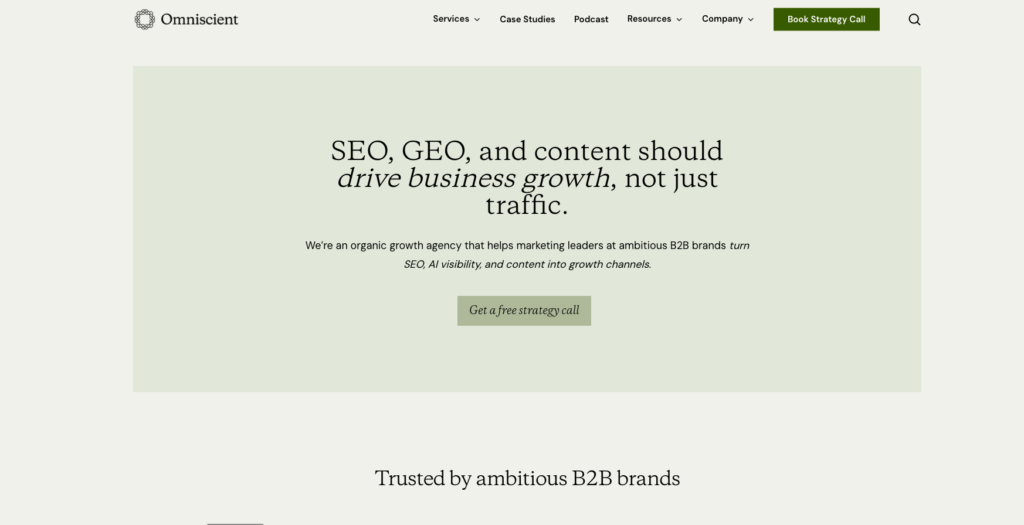
Content programs built around entity-building and structured production are exactly what Omniscient Digital delivers as its core offering. Founded by Alex Birkett and David Ly Khim, both former HubSpot growth leads, Omniscient has built its reputation on full-funnel content strategy for B2B SaaS companies, and that heritage translates directly into the type of long-form, data-rich content that LLMs preferentially cite.
What it is: Omniscient Digital is a B2B SaaS SEO agency specializing in content-led growth programs that combine topical authority building with AI search visibility, targeting Series A through Series C software companies that need organic and AI-engine presence simultaneously.
Key features:
See what Reddit & SEO can do for your pipeline — grab a time
A 30-minute working session. We'll map your top intent gaps and where the pipeline is leaking. No pitch deck.
- Full-funnel content strategy mapped to the entire buyer journey, from awareness through decision
- Content audits that identify which existing assets are structurally positioned to earn LLM citations versus which need restructuring
- Topical authority cluster frameworks that help AI engines recognize the brand as a definitive source in its niche
- AEO-informed editorial briefs that incorporate direct-answer formatting, data tables, and schema-ready structures
- Ongoing measurement of organic traffic alongside AI citation frequency using third-party tools including Profound and Perplexity API monitoring
Pricing: Retainers typically range from $5,000 to $15,000 per month (as of July 2026), reflecting the senior-led, strategy-heavy nature of their engagements.
According to a 2024 Omniscient Digital case study published on their blog, a SaaS client in the project management vertical saw organic traffic increase 3x over 18 months through a structured topical authority program, the same content architecture that now feeds AI citation pipelines.
Best for: B2B SaaS companies at Series A. C that need content programs engineered for both Google rankings and AI engine citations simultaneously.
Limitations:
- Vertical focus is narrow: primarily SaaS and B2B tech, making them a weak fit for ecommerce, local businesses, or non-technical brands
- Senior team involvement means capacity is limited; they are selective about client intake
Omniscient Digital’s core strength is that its LLM citation content strategy is not a new service add-on but a natural extension of the same long-form, authority-building methodology the agency has practiced since its founding.
4. Siege Media. Best LLM SEO Agency for Enterprise Content at Scale
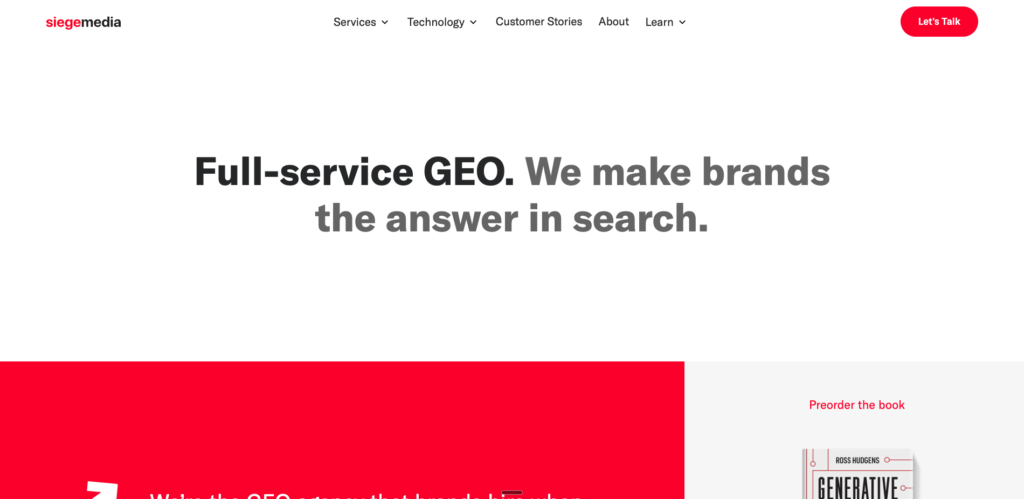
Producing structured, authoritative, linkable content at scale is the single most reliable way to earn consistent LLM citations, and Siege Media has made that exact capability its defining competitive advantage. Founded by Ross Hudgens, Siege Media operates as a premium content marketing agency built around editorial quality, link acquisition, and the kind of deeply researched long-form assets that generative engines treat as primary citation sources.
Price: Enterprise retainers typically range from $10,000 to $30,000/month (as of July 2026), reflecting a focus on large-brand engagements rather than SMB accounts.
What it is: Siege Media is a content-first SEO agency specializing in high-volume production of authoritative, link-earning content for competitive informational verticals, precisely the content categories that AI engines index and surface most frequently.
Key features:
- High-output editorial pipeline capable of producing dozens of research-backed, structured content pieces per month
- In-house link acquisition program built around genuinely linkable asset production, not outreach-only tactics
- Rigorous editorial quality standards including data verification, expert sourcing, and structured formatting aligned with how LLMs parse and cite content
- Content strategy rooted in informational query mapping, a direct overlap with how AI engines select citation sources
- Documented case studies showing organic traffic growth for brands including Chime, Intuit, and Casper
Standout detail: Siege Media’s content consistently earns editorial links from high-authority publishers, the same third-party citation density that drives LLM mention rates. According to Siege Media’s published case studies, multiple clients have achieved link acquisition rates exceeding 100 earned placements per content campaign.
Best for: Enterprise brands in finance, fintech, SaaS, and consumer categories with established domain authority that need to scale content production optimized for both traditional organic and AI citation visibility.
Limitations:
- Retainer-only model makes access cost-prohibitive for SMBs or early-stage companies
- No publicly documented standalone GEO audit offering; AI citation tracking is embedded within broader content retainers rather than sold as a discrete service
Note: Siege Media does not publicly market a named GEO or AEO practice, but its core output, authoritative, structured, link-earning content, maps directly to the content signals that ChatGPT, Perplexity, and Google AI Overviews preferentially cite.
Siege Media’s strongest argument for inclusion on any enterprise content SEO agency shortlist is that its methodology predates the GEO trend while being structurally aligned with what LLMs reward.
5. Go Fish Digital. Best LLM SEO Agency for Data-Driven AI Visibility
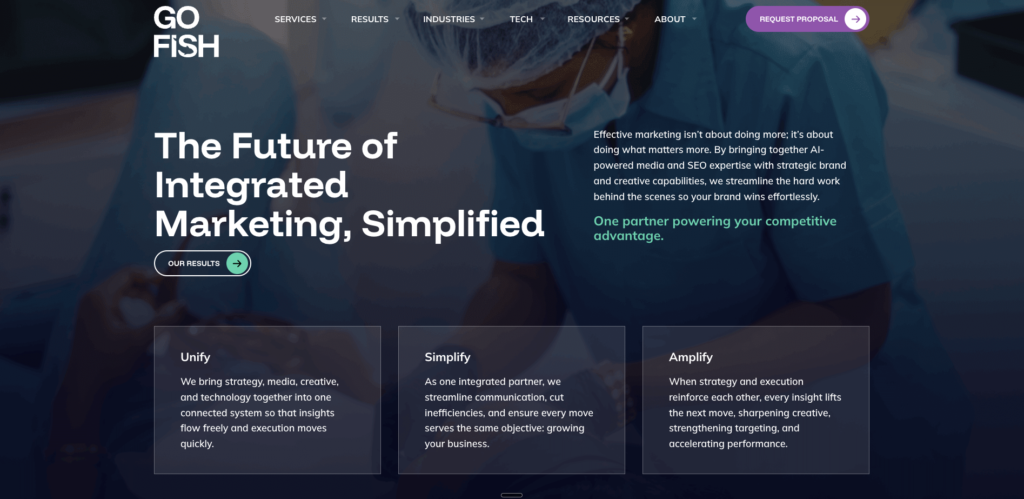
Agencies that can execute GEO strategy are one thing. Agencies that can measure it with precision are another. Go Fish Digital occupies a distinct position in this list by treating AI search visibility as a reporting and analytics problem first, an execution problem second.
What it is: Go Fish Digital is a Washington, D.C.-based digital marketing agency with deep roots in data analysis, online reputation management (ORM), and technical SEO. In 2026, that combination maps directly onto a core LLM visibility challenge: brands can’t improve what they can’t track.
Key features:
- LLM brand mention tracking: Go Fish Digital actively monitors brand appearances inside ChatGPT, Perplexity, Gemini, and Google AI Overviews, giving stakeholders a measurement baseline most agencies still lack
- Reputation management intersecting with GEO: Because ORM requires monitoring unstructured brand mentions across the web, the agency’s tooling transfers naturally to tracking LLM citation frequency and sentiment
- Structured data and schema expertise: Their technical team implements schema markup configurations that improve how AI crawlers parse and attribute brand content
- Custom reporting dashboards: Clients receive regular reports quantifying AI citation rates, not just traditional rank movement
According to BrightEdge’s AI Search Report, 62% of enterprise marketers currently cannot measure their AI citation rate, making Go Fish Digital’s measurement-first approach a material differentiator (as of 2026).
Best for: Brands and internal marketing teams that need to prove AI SEO ROI to leadership before expanding investment. Go Fish Digital is especially well-suited to organizations where measurement infrastructure must precede strategy, not follow it.
Important: Go Fish Digital’s content strategy depth is narrower than agencies like Omniscient Digital or Siege Media. Their GEO strength is analytics and technical optimization, not large-scale content production programs.
Pricing: Custom enterprise pricing based on scope. The agency does not publish fixed retainer tiers publicly (as of July 2026).
Go Fish Digital is the clearest choice for any brand that needs rigorous, defensible reporting on AI search presence before committing to a full content and entity-building program.
6. Grow and Convert. Best LLM SEO Agency for Bottom-of-Funnel AI Citations
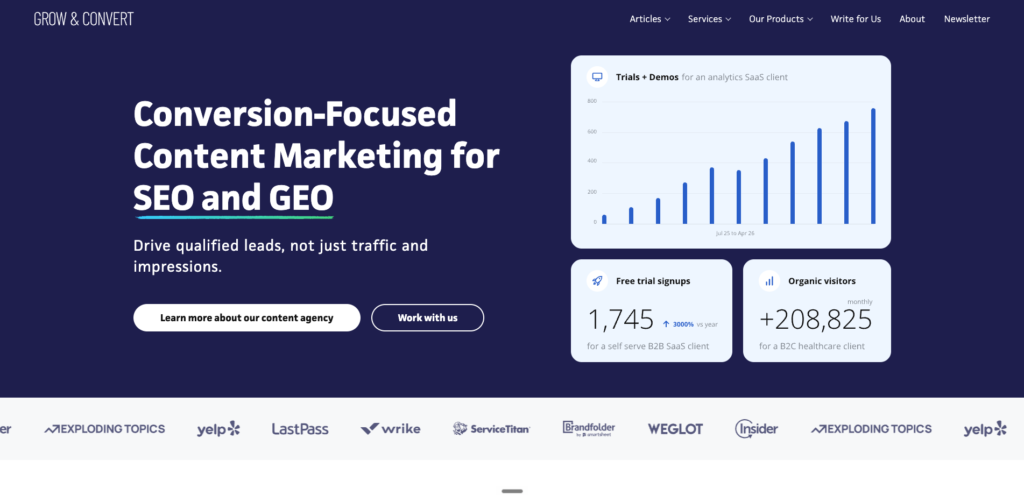
Agencies that build entity authority and structured content earn citations broadly, but the most commercially valuable AI citations happen at the decision stage, when a buyer asks an LLM “what’s the best [software] for [specific use case]?” Grow and Convert is purpose-built for exactly that query type, making it the strongest pick for brands that need AI visibility where purchase decisions are actually made.
Founded by Benji Hyam and Devesh Khanal, Grow and Convert developed the Pain Point SEO framework, a methodology that prioritizes content targeting buyer pain points over raw search volume. The framework maps content to the problems prospects are actively trying to solve at the decision stage, not just informational awareness. That structure, by design, produces exactly the kind of specific, use-case-driven content that LLMs surface for commercial queries.
According to Grow and Convert’s own documented case studies, Pain Point SEO consistently drives traffic that converts at two to three times the rate of top-of-funnel organic content, a conversion signal that correlates with the specificity AI engines reward when generating purchase-intent answers.
Key strengths for LLM SEO:
- Pain Point SEO framework naturally generates “best X for Y” content structures that match how LLMs answer commercial queries
- Deep B2B SaaS content expertise produces category-specific, entity-rich articles that AI engines treat as authoritative citation sources
- Bottom-of-funnel GEO focus means content is optimized for AEO content strategy signals, not just traditional keyword rankings
- Selective client intake keeps content quality high, which supports consistent AI citation for purchase-intent queries
Best for: B2B SaaS companies and service businesses that want AI citations specifically for high-intent, purchase-stage queries, not broad informational traffic.
Pricing: Grow and Convert operates on mid-market retainers; contact directly for current pricing (as of July 2026), as they work with a limited client roster.
Pros:
– Pain Point methodology structurally aligned with LLM commercial query patterns
– Proven conversion-focused content that earns B2B SaaS LLM visibility at decision stage
– High editorial standards across every engagement
Cons:
– Limited production capacity, less suited to enterprise brands needing large content volume
– Less emphasis on technical SEO or entity-schema implementation than iPullRank or Graphite
Grow and Convert’s core insight, that bottom-of-funnel content is more citable for purchase decisions than awareness content, makes Pain Point SEO one of the most transferable frameworks for AI citation strategy in 2026.
Which LLM SEO Signals Actually Drive Citations in ChatGPT, Perplexity, and Google AI Overviews?
Three signal categories determine whether an AI engine cites your brand: entity authority (how consistently your brand appears across authoritative third-party sources), content structure (listicles, data tables, and direct-answer formats are statistically over-represented in LLM citations), and off-site mention density (volume and quality of external references).
Each platform weights these differently:
- ChatGPT prioritizes established, high-authority domains and publication history over recency
- Perplexity favors structured, recently published content with clear sourcing
- Google AI Overviews heavily rewards strong E-E-A-T signals and schema markup
- Gemini shows a documented preference for YouTube-sourced content alongside long-form text
According to Profound’s 2026 AI Search Visibility Report, fewer than 8% of brands achieve citation overlap across all four platforms simultaneously, making cross-platform presence the highest-value, most defensible position in AI search.
Pro Tip: The agencies worth hiring are those whose service mix maps directly to these signal types, entity-building, structured content production, and third-party PR, not agencies that simply append “AI” to traditional SEO deliverables.
Last updated: July 2026
Frequently Asked Questions
What is LLM SEO and how is it different from traditional SEO?
LLM SEO focuses on optimizing content so that large language models like ChatGPT, Perplexity, and Google Gemini cite your brand in their AI-generated responses. Traditional SEO targets ranking positions in blue-link search results, while LLM SEO targets citation frequency, brand mentions, and topical authority signals that AI systems use to select sources. Both disciplines overlap but require distinct strategies, tools, and measurement frameworks.
How much do LLM SEO agencies typically charge in 2026?
Pricing varies widely depending on scope, agency size, and deliverables, but most specialized LLM SEO retainers in 2026 range from roughly $5,000 to $25,000 per month. Enterprise programs at agencies like Graphite or Siege Media can exceed that range for large-scale content and technical work. Smaller or more focused engagements, such as bottom-of-funnel citation programs, often sit at the lower end of that spectrum.
Can a small or mid-sized business benefit from LLM SEO, or is it only for enterprises?
LLM SEO is valuable for businesses of any size, especially because AI search visibility is still an emerging space where early movers have a real advantage. Agencies like Grow and Convert and Omniscient Digital work with focused content programs that are well suited to mid-market B2B companies, not just large enterprises. The key is selecting an agency whose specialization matches your audience, funnel stage, and content production capacity.
How do you measure success in LLM SEO?
Success in LLM SEO is measured by tracking how often your brand or content is cited in AI-generated answers across platforms like ChatGPT, Perplexity, and Google AI Overviews. Agencies use tools that monitor citation share, prompt coverage, and brand mention frequency alongside traditional metrics like organic traffic and keyword rankings. Because the measurement tooling is still maturing in 2026, look for agencies that have developed proprietary frameworks or use best-in-class AI visibility tracking platforms.
How long does it take to see results from an LLM SEO campaign?
Most LLM SEO campaigns begin showing measurable citation improvements within three to six months, depending on your domain authority, content volume, and competitive landscape. Technical fixes and structured data improvements can produce faster gains, while building the topical depth and backlink signals that AI models favor takes longer. Setting realistic expectations with your agency upfront, including clear milestone reviews at 90 and 180 days, is strongly recommended.
Conclusion
The agencies building real revenue through AI search visibility are not waiting for the landscape to stabilize. They are treating citations in ChatGPT, Perplexity, and Google AI Overviews as active acquisition channels right now, and the best LLM SEO agencies in 2026 are the ones that can prove it with data.
The most important factor in your decision is fit, not prestige. Enterprise content programs point toward Graphite or Siege Media, complex technical infrastructure toward iPullRank, B2B SaaS content toward Omniscient Digital, conversion-focused citations toward Grow and Convert, and data-driven AI visibility measurement toward Go Fish Digital.
Before signing any contract, request an AI visibility audit from at least two agencies on this list. Specifically, ask them to show your current citation rate across ChatGPT, Perplexity, and Google AI Overviews, and ask for case studies from your vertical. An agency that cannot produce those answers upfront is not ready to move the needle on LLM visibility in 2026.
47 checkpoints across technical, content, and conversion — the same list our strategists run on every new account.