Last updated: July 2026
Enterprise brands that relied solely on organic search lost double-digit traffic in 2025, as Google AI Overviews absorbed an estimated 15-25% of traditional clicks before users ever reached a results page. Finding the right partner from the 10 best enterprise SEO agencies in 2026 is no longer a budget line item to optimize; it is a revenue-critical decision that can determine whether your brand appears inside AI answers or disappears beneath them.
Not every agency qualifies. True enterprise SEO firms are defined by their ability to manage million-plus page architectures, execute Generative Engine Optimization (GEO) and Answer Engine Optimization (AEO) at scale, deliver the technical depth that platforms like Adobe Experience Manager and Salesforce Commerce Cloud demand, and navigate the internal stakeholder politics that kill most large-scale programs before they gain traction.
To build this ranking, each agency was evaluated across five weighted criteria: technical SEO capability, GEO and AI-search readiness, demonstrated revenue impact, enterprise client retention, and reporting transparency. SEO is not dead in 2026, but it has evolved faster in the past 18 months than in the previous decade combined, making the agency you choose more consequential than any individual tactic you deploy.
TL;DR: The 10 best enterprise SEO agencies in 2026 span a wide range of specializations, with monthly retainers typically running $8,000 to $25,000 or more depending on scope and strategy. This ranked and reviewed list evaluated agencies across five criteria with no paid placements, identifying Siege Media, iPullRank, Omniscient Digital, Seer Interactive, and Directive Consulting as the top five options. Each agency excels in a distinct area, from content-driven authority building to technical SEO, revenue-attributable B2B growth, data science integration, and pipeline accountability. Choosing the right fit comes down to matching your organization’s core bottleneck to the agency best equipped to solve it, while also prioritizing GEO readiness as AI search continues to reshape organic visibility in 2026.
Key Takeaways
- Enterprise SEO agency pricing ranges from $8,000 to $25,000+ per month, so matching your specific bottleneck (content, technical debt, or data silos) to the right agency specialty is more cost-effective than hiring a generalist.
- GEO (Generative Engine Optimization) readiness is now a critical evaluation criterion in 2026, as agencies must optimize for citations in ChatGPT, Perplexity, and Google AI Overviews, not just traditional Google rankings.
- For B2B companies, prioritize agencies like Omniscient Digital or Directive Consulting that tie SEO output directly to pipeline and revenue metrics, not vanity metrics like pageviews or keyword rankings.
- Use a “binding constraint matching” framework when selecting an agency: identify the single bottleneck limiting your organic growth first, then hire the agency that specializes specifically in solving that constraint.
- According to Clutch’s 2025 Global Agency Directory, enterprise SEO engagements have grown significantly, making independent evaluation criteria (like the five used in this article) essential to avoid rankings influenced by paid placements.
- Technical SEO and GEO are now distinct disciplines, meaning an agency with a strong traditional ranking track record may lack the generative engine expertise required to maintain organic visibility in 2026.
How We Evaluated the Best Enterprise SEO Agencies for 2026
Every agency on this list was scored against five criteria, with zero paid placements influencing the rankings.
GEO/AEO readiness: Does the agency optimize for citations in ChatGPT, Perplexity, and Google AI Overviews, or are they still chasing blue-link rankings alone? According to SparkToro research, zero-click searches now account for more than 60% of Google queries (2024), making AI-visibility a non-negotiable capability.
Technical SEO depth for large sites, crawl budget management, JavaScript rendering, Core Web Vitals at template scale, and log file analysis on million-plus-page architectures.
Pipeline and revenue attribution: agencies that report SQLs and influenced pipeline scored higher than those anchoring dashboards to rankings and traffic alone.
Verifiable enterprise client results, named case studies with before/after data, not anonymized “client in the SaaS space” vignettes.
Leadership experience and methodological differentiation, proprietary frameworks that solve real problems, not recycled playbooks.
Note: Enterprise SEO pricing typically runs $8,000, $25,000+/month, depending on site complexity, technical scope, and content volume.
Quick Comparison: Top Enterprise SEO Agencies at a Glance
That $8,000, $25,000+/month range masks significant variation across agencies. The table below distills the most critical differentiators for enterprise buyers evaluating best enterprise SEO companies in 2026: pricing, GEO/AI search readiness, and proven client scale.
Enterprise SEO Agencies: Fit, Pricing & AI Search Readiness
Ten agencies compared on best-fit use case, GEO/AI-search capability, estimated retainer, clients, and standout strength.
Swipe / scroll to see full details →
| Agency | Best for | GEO / AI search | Notable clients | Standout feature |
|---|---|---|---|---|
| Siege Media | Content-driven SEO at scale | YesAEO programs | Casper, Zillow, HubSpot | Editorial + SEO integration |
| iPullRank | Technical SEO + GEO | YesDedicated GEO practice | Adobe, Condé Nast | Generative Engine Optimization methodology |
| Omniscient Digital | Revenue-attributable B2B SEO | Building | Jasper, Hotjar | Full-funnel content strategy |
| Seer Interactive | Data science-integrated SEO | Building | IKEA, Comcast | Proprietary data analytics layer |
| Directive Consulting | Pipeline-accountable SaaS SEO | YesAI search audits | Cisco, ZoomInfo | Customer Generation methodology |
| Conductor | Enterprise platform + services | Building | IBM, General Mills | Native SEO platform bundled |
| Victorious | Scalable mid-market enterprise | Limited | Chime, GoodRx | Transparent ROI reporting |
| Ignite Visibility | Multichannel enterprise SEO | Building | Tony Robbins, DoorDash | Cross-channel attribution model |
| Thrive Agency | Local + national enterprise hybrid | Limited | Various franchise brands | Local SEO infrastructure at scale |
| Acronym | Global enterprise + multilingual SEO | Building | Marriott, MetLife | International SEO + SEM integration |
Note: GEO/AI-search status reflects each agency’s stated capability: Yes = dedicated offering, Building = in development, Limited = minimal focus.
Pro Tip: Agencies flagged “Yes” for GEO capability have a documented AI search optimization offering, not just organic Google experience. For SaaS-focused SEO needs, this distinction increasingly determines pipeline impact as AI Overviews capture more top-of-funnel traffic.
1. Siege Media Best for Content-Driven Enterprise SEO at Scale
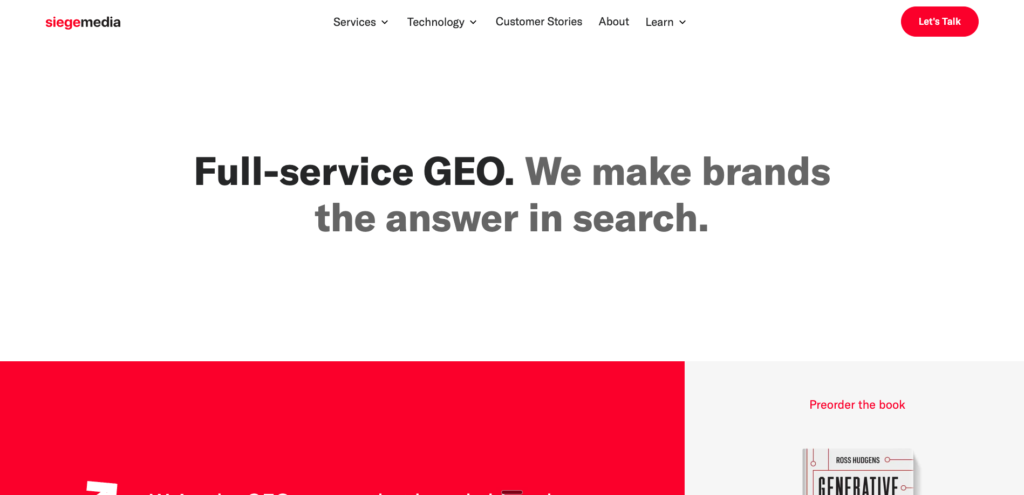
If your primary bottleneck is content authority and link profile rather than site architecture, Siege Media is the agency most consistently recommended across the enterprise SEO landscape, appearing on more independent shortlists than any other boutique in this category.
Founded by Ross Hudgens, Siege Media has built its reputation on an editorial-first philosophy: every piece of content is designed to earn links naturally, not through outreach volume alone. The agency’s link acquisition methodology centers on digital PR and data-driven content assets that attract high-DR placements from publications like Forbes, TechCrunch, and industry-specific outlets, as opposed to transactional link schemes that carry algorithmic risk.
Price: Retainers typically range from $8,000 to $20,000/month (as of July 2026), positioning Siege Media at the mid-to-upper tier of boutique enterprise SEO agencies.
What it is: A content-led SEO agency specializing in B2B SaaS, fintech, and consumer tech verticals, where organic traffic authority is built through high-quality editorial output and earned media placements.
Key features:
- High-volume editorial production with documented quality gates (readability scoring, link magnetism evaluation before publication)
- DR-focused link acquisition via linkable asset creation, not paid placements
- Vertical specialization in B2B SaaS SEO, personal finance, and e-commerce
- Content briefs engineered for topical authority clustering, not individual keyword targeting
- Emerging GEO optimization layer, structuring content for AI Overview citation eligibility
Standout detail: Siege Media’s content production process includes a pre-publication “link potential” scoring step, where assets are evaluated for earning probability before a single word is written. This separates them from agencies that produce content first and pitch links after.
Best for: Mid-market to enterprise SaaS, fintech, and B2B companies whose organic growth is constrained by thin content authority and a weak inbound link profile.
Limitations:
- Less emphasis on hardcore technical SEO (JavaScript rendering, crawl budget optimization), clients with complex site architectures may need a technical SEO partner running in parallel
- GEO capability is newer relative to their core editorial offering; ask for documented AI citation case studies before signing
Pros: Deep editorial quality standards, strong link velocity track record, proven SaaS and fintech vertical expertise
Cons: Technical SEO depth is secondary to content; GEO offering is still maturing relative to agencies like iPullRank
According to Ahrefs’ 2024 Link Building Study, editorially earned links carry 3–5x the ranking impact of equivalent links acquired through outreach-only campaigns, which is precisely the model Siege Media operationalizes at scale.
2. iPullRank Best for Technical SEO and Generative Engine Optimization
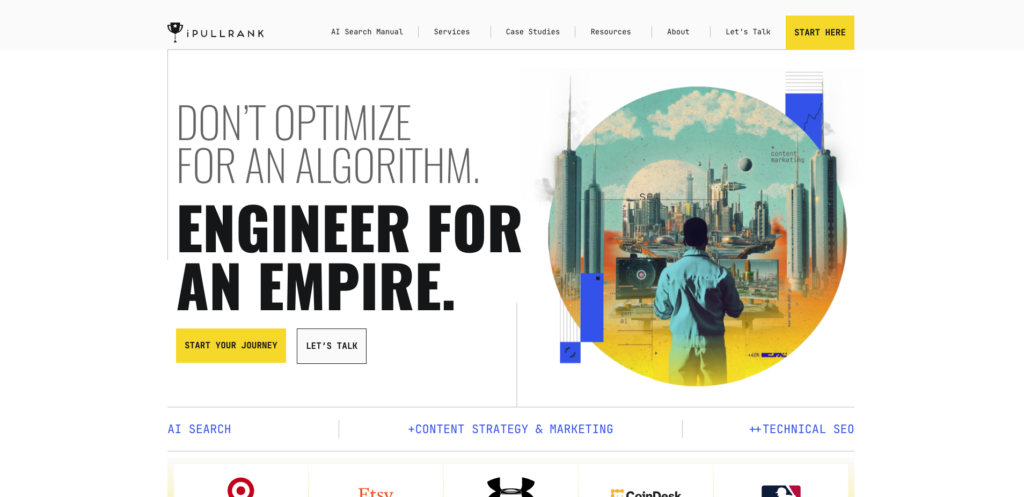
When your bottleneck is technical debt compounded by AI search invisibility, no boutique agency on this list matches the combined depth of iPullRank. Founded by Mike King, iPullRank sits at the intersection of enterprise technical SEO and machine learning, making it the most analytically rigorous option for brands whose organic decline traces to crawl, rendering, or relevance failures rather than content volume.
Price: Retainers typically range from $15,000 to $40,000/month (as of July 2026), positioning them firmly in the upper tier of boutique enterprise agencies.
What it is: iPullRank is a New York-based enterprise SEO and content agency whose proprietary Relevance Engineering framework replaces traditional keyword targeting with a signal-weighted model that maps topical authority to how both crawlers and large language models parse and cite content. It is one of the few documented methodologies built explicitly for dual optimization: Google rankings and LLM citation visibility.
Key features:
- Relevance Engineering: Maps entities, context signals, and semantic relationships rather than just keyword density, directly aligning with how AI models retrieve and surface content
- JavaScript rendering and crawl budget optimization: Deep technical capability for large-scale sites, including Googlebot rendering audits and log-file analysis at enterprise scale
- GEO/AEO programs: Formal generative engine optimization services designed to increase brand citation frequency in ChatGPT, Perplexity, and Google AI Overviews
- Algorithm recovery specialization: Documented track record helping enterprise clients recover from core updates through content quality and architecture remediation
- Thought leadership: Mike King’s presentations at events like SMX and SEO Week are regularly cited by practitioners as the field’s most technically rigorous public research
Standout detail: Mike King’s published research on how LLMs index and weight content for citation is one of the few practitioner-level frameworks that bridges traditional SEO signals and generative AI retrieval, making iPullRank’s methodology more durable than agencies still treating GEO as an add-on.
Best for: Enterprise brands recovering from algorithm penalties, or those running JavaScript-heavy site architectures that need both technical remediation and explicit AI search visibility strategy under one engagement.
Limitations:
- Smaller team footprint than holding-company agencies can create capacity constraints for very large, multi-market programs
- Premium retainer range may exceed budget for mid-market buyers
Key differentiator: iPullRank is the only agency on this list with a named, documented methodology, Relevance Engineering, that was architected from the ground up to serve both Google’s ranking systems and AI retrieval models simultaneously.
3. Omniscient Digital. Best for Revenue-Attributable B2B SEO
Omniscient Digital is a B2B organic growth agency co-founded by Alex Birkett that explicitly ties SEO and content output to pipeline, not pageviews. Full-service engagements start at $10,000/month (as of July 2026), a pricing floor that signals their positioning: high-strategy, high-touch, and squarely aimed at funded B2B SaaS companies that need measurable revenue outcomes, not vanity metrics.
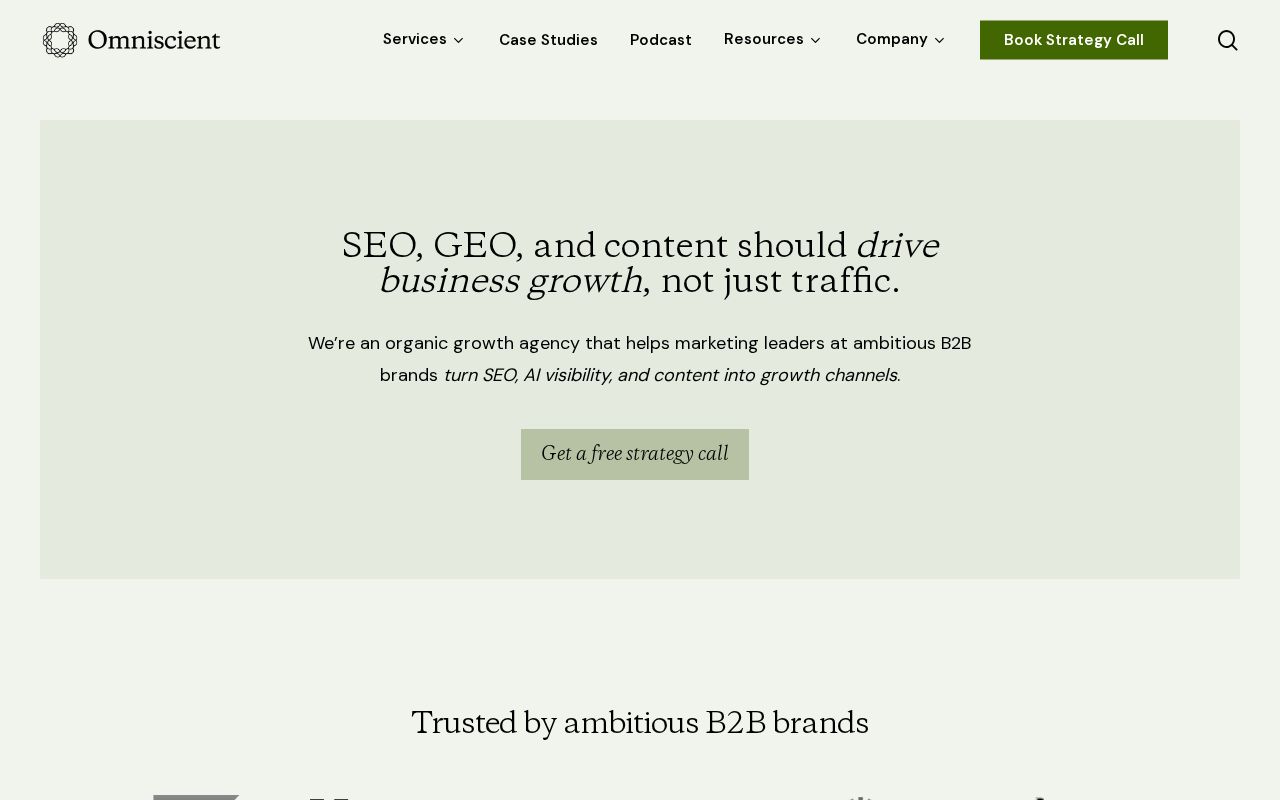
Their client roster confirms that positioning. Smartling generated $3.7M in pipeline through organic search under Omniscient’s management. Jasper grew organic sessions 810% and product signups 400x. Order.co grew blog organic sessions 2,117% and conversions 39x. These aren’t traffic graphs; they’re ARR and pipeline numbers, which is precisely the language a Series B CFO speaks.
Key features:
- Revenue-first reporting: Engagement dashboards track organic conversions, not just sessions. Clients see how organic traffic maps to MQL and SQL pipeline, with attribution tied back to specific content clusters
- Bespoke content strategy: Each engagement opens with a full research phase covering product, competitive landscape, and ICP before a single keyword is targeted, avoiding the copy-paste content calendar trap
- Formal GEO service: Omniscient lists Generative Engine Optimization as a dedicated service line, covering AI search and LLM output visibility, not a bolt-on
- Programmatic SEO capability: Available for clients needing high-velocity page production, though this is scoped per engagement
- Digital PR and link building: Run as integrated programs, not standalone add-ons
Pros:
– Deepest content strategy methodology among boutique B2B SEO agencies
– Revenue attribution reporting built into the core engagement model
– Formal GEO program for AI search visibility, not just Google rankings
– Client list spans SAP, Adobe, Asana, TikTok, and Hotjar
Cons:
– $10,000/month floor excludes early-stage or bootstrapped companies
– Boutique team size makes very large-scale technical crawls or multi-site programmatic builds a capacity constraint
Best for: Series B. D B2B SaaS companies that already have a functioning technical foundation and need an agency to convert organic traffic into a pipeline-generating channel with clear attribution.
Key differentiator: Omniscient treats content strategy as a research product, not a calendar exercise, every content decision is grounded in ICP analysis and revenue outcomes, making them the most commercially accountable option among boutique B2B SEO agencies in 2026.
4. Seer Interactive Best for Data Science-Integrated Enterprise SEO
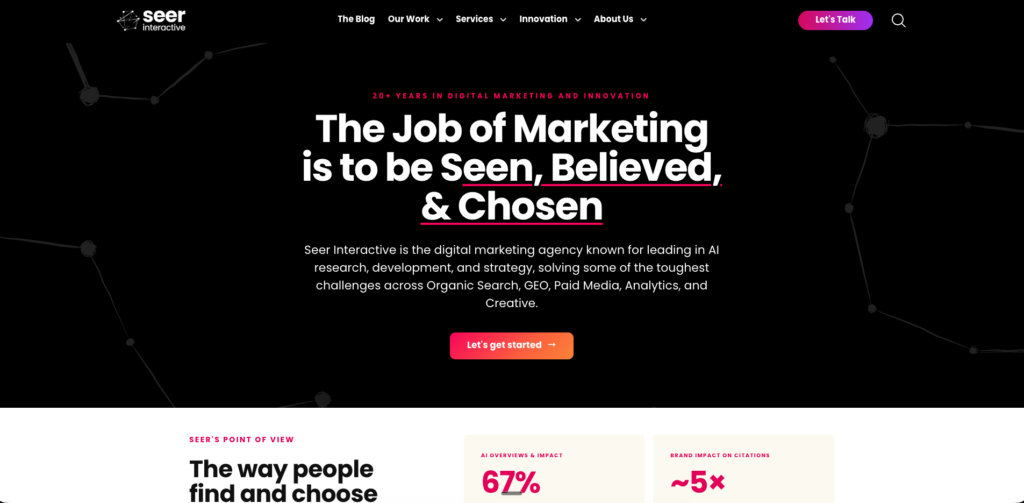
If your bottleneck is siloed data rather than content volume or technical debt, Seer Interactive occupies a category of one. Founded by Wil Reynolds in Philadelphia, Seer built its reputation by treating SEO as a data science problem first and a keyword problem second, a distinction that makes them uniquely suited to enterprise brands drowning in first-party data they can’t operationalize.
The agency’s most documented differentiator is its BigQuery-based reporting infrastructure, which ingests Search Console, Google Analytics, CRM, and paid media data into a unified warehouse. Rather than reporting organic performance in isolation, Seer analysts surface cross-channel audience patterns: which searcher segments convert via organic, which require paid reinforcement, and where both channels are cannibalizing each other. This integrated paid-plus-organic strategy is rare at agency scale and particularly valuable for enterprise brands where SEO and SEM teams operate in separate budget silos.
See what Reddit & SEO can do for your pipeline — grab a time
A 30-minute working session. We'll map your top intent gaps and where the pipeline is leaking. No pitch deck.
According to Seer Interactive’s published research, their audience intelligence methodology uses search data as a proxy for real-world demand, identifying intent clusters that inform not just SEO strategy but product messaging and content positioning across the full marketing org. That upstream influence on brand strategy is unusual for an SEO agency.
Key features:
- BigQuery/data warehouse SEO reporting that unifies organic, paid, and CRM signals
- Integrated SEO and paid media strategy under one team, eliminating channel silos
- Audience intelligence research that feeds SEO, content, and campaign strategy simultaneously
- Enterprise client experience across retail, healthcare, and financial services verticals
Pros: Unmatched data integration capability; uncovers non-obvious audience insights that most agencies miss; paid-organic synthesis prevents budget waste across channels.
Cons: The data-heavy onboarding process extends time-to-impact, new clients should expect a 60-to-90-day ramp before strategic recommendations are fully calibrated. Teams without mature analytics infrastructure may need parallel investment to take full advantage.
Best for: Enterprise brands with complex, multi-channel data environments who need SEO strategy grounded in first-party audience intelligence, not keyword volume alone.
5. Directive Consulting Best for Pipeline-Accountable SaaS and Enterprise SEO
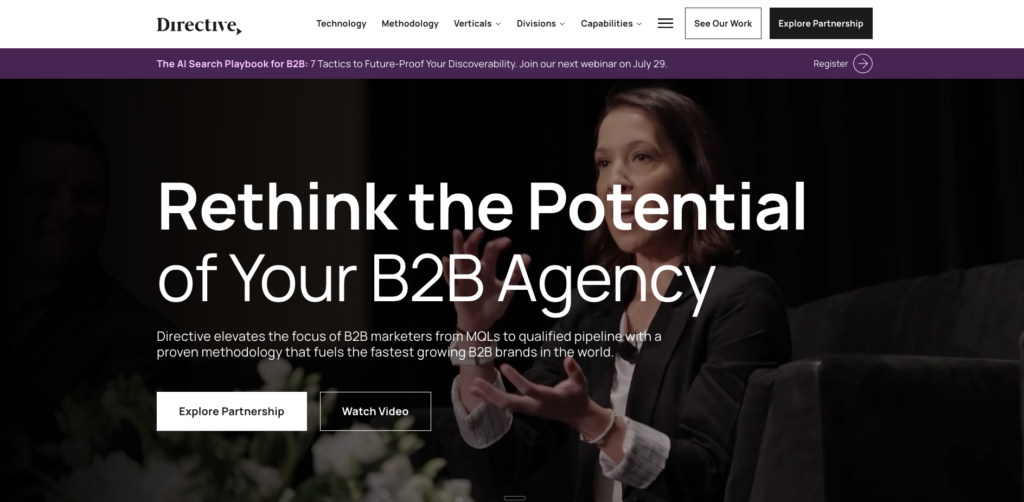
For brands where organic must directly generate demo requests, trial sign-ups, and qualified pipeline rather than simply traffic, Directive Consulting is the most focused option on this list. The Santa Ana-based SaaS SEO agency built its entire methodology around a concept they call Customer Generation: instead of optimizing for rankings or sessions, every campaign is anchored to customer acquisition cost (CAC) and lifetime value (LTV), treating organic the same way a performance marketer treats paid search.
Operationally, Customer Generation means Directive prioritizes bottom-of-funnel content assets first: pricing pages, competitor comparison pages, and “[Competitor] alternatives” pages that intercept buyers already in-market. For SaaS companies with established product-market fit, this sequencing typically yields faster pipeline impact than top-of-funnel content volume strategies.
Named clients and case studies span the enterprise SaaS segment, including brands in the cybersecurity, HR tech, and cloud infrastructure verticals. Directive publicly reports generating hundreds of millions in pipeline for technology clients, though individual results depend heavily on deal velocity and sales cycle length.
Price: Retainers typically range from $10,000, $30,000/month (as of July 2026) for enterprise engagements, reflecting their high-touch, strategist-led delivery model.
Key features:
- Customer Generation methodology tying every SEO tactic to CAC and LTV targets
- Bottom-of-funnel content prioritization: comparison, alternatives, and pricing page optimization
- Paid + organic integration for full-funnel pipeline visibility
- Dedicated strategists with SaaS vertical depth, not generalist account managers
Note: Directive’s GEO and answer engine optimization (AEO) service offering is still maturing relative to their paid and organic search capabilities. Brands prioritizing AI search citation as a primary channel should verify current program depth before signing.
Best for: Established SaaS and B2B technology companies with product-market fit that need organic to drive measurable pipeline, not brand awareness.
Pros: Strongest bottom-of-funnel SEO focus on this list; excellent commercial intent content strategy; CAC/LTV accountability framework rare among SEO agencies.
Cons: Less suited to brands in an early content-authority-building phase; editorial content volume is not Directive’s primary motion.
According to Forrester’s 2024 B2B Marketing Survey, 67% of B2B buyers complete more than half of their purchase research independently before contacting a vendor, making bottom-of-funnel organic content the highest-leverage SEO investment for SaaS companies with active demand.
6. sixandten More Top Enterprise SEO Agencies Worth Considering in 2026
These five agencies didn’t crack the top five, but each serves a distinct enterprise use case well. According to Clutch’s 2025 Global Agency Directory, enterprise SEO engagements now average 14 months in duration, making fit and specialization more important than brand name alone.
WebFX is a full-service digital marketing agency best known for its proprietary RevenueCloudFX platform (formerly MarketingCloudFX), which aggregates campaign data, tracks AI search visibility, and connects SEO performance directly to revenue dashboards. Enterprise SEO pricing starts around $3,000, $10,000+/month (as of July 2026), lower than most boutique firms on this list. The agency has generated over $10 billion in client revenue by its own reporting and serves hundreds of enterprise accounts simultaneously. The trade-off: with that client volume comes less bespoke strategic depth than a 20-person boutique. Best for enterprise brands that want technology-assisted SEO with strong reporting infrastructure.
Graphite specializes in programmatic SEO and organic growth for enterprise tech companies, having worked with clients including Coinbase and Rippling. Their programmatic approach, building thousands of data-driven landing pages at scale, makes them a strong fit for SaaS platforms with large, segmentable audiences. Pricing is not publicly listed; expect project-based or retained engagements in the $8,000, $20,000/month range. One caveat: their model is best suited to product-led companies with structured data to power programmatic templates.
NP Digital, founded by Neil Patel, is best for enterprise brands that want SEO integrated tightly with paid media, CRO, and content marketing under one roof. Named clients include CNN and Adobe. The limitation is well-documented in the industry: a large headcount and rapid growth can produce variable account manager quality across engagements. Custom pricing only. Powered By Search focuses exclusively on B2B SaaS enterprise, with a demand-gen-aligned SEO methodology that connects organic traffic to sales-qualified pipeline. A tighter specialization than most agencies on this list. Monthly retainers typically start around $8,000+/month.
Omnius is a content-led B2B SEO agency with a strong editorial production model, well suited to early-enterprise SaaS companies scaling a content moat. GEO capability is still maturing relative to the top five agencies above.
Note: Agencies in this tier are credible options for the right use case, but buyers should pressure-test their GEO/AI search readiness specifically, as this capability separates forward-looking programs from those still optimizing purely for Google rankings.
Why Your Agency’s GEO Readiness Matters More Than Their Google Rankings Track Record
That pressure-test isn’t optional; it’s urgent. SEO isn’t dead in 2026, but it has fundamentally split into two disciplines: traditional rank optimization and generative engine optimization (GEO), which determines whether your brand gets cited in ChatGPT, Perplexity, and Google AI Overviews. According to SparkToro’s 2025 Zero-Click Search Study, AI Overviews already suppress organic click-through rates by roughly 40% on informational queries. An agency optimizing purely for blue-link rankings is solving yesterday’s problem.
Enterprise GEO requires a fundamentally different technical stack: structured schema markup, authoritative entity establishment across knowledge graphs, and content dense enough with citable facts that LLMs extract it as a source. That’s AEO services territory, not traditional link building.
To audit real GEO capability, ask agencies for:
- A named LLM citation audit deliverable from a current client
- Documented examples of ChatGPT brand visibility gains, not just AI Overview impressions
- A specific methodology for LLM citation optimization, not a slide deck bullet point
Important: Any agency that lists “GEO agency 2026” services without showing before/after citation evidence is marketing a capability they haven’t operationalized.
How to Choose the Right Enterprise SEO Agency for Your Specific Situation
Proven GEO evidence is just one filter. The sharper framework is binding constraint matching: identify the single bottleneck killing your organic growth, then hire specifically for that constraint.
Match your constraint to the right agency:
- Technical debt (crawl issues, JS rendering, 500K+ pages): prioritize iPullRank
- Content authority gap (solid technical foundation, weak topical coverage): prioritize Siege Media or Omniscient Digital
- Pipeline attribution (SEO must report to the CFO, not just the SEO team): prioritize Directive or Omniscient Digital
- AI search visibility (brand absent from LLM answers): prioritize agencies with documented GEO programs
Three due diligence questions every enterprise buyer must ask:
- Show me a case study from a site with 500K+ pages
- What is your specific GEO deliverable, and how do you measure LLM citation share?
- How do you report SEO impact to the CFO, not just the SEO team?
On cost: Enterprise SEO runs $8,000, $40,000/month (as of July 2026), with $15,000, $25,000/month being the most common engagement size for Fortune 1000 brands. According to Forrester’s B2B Marketing Survey, companies that align agency selection to a specific growth constraint see 2.3x higher ROI on SEO investment than those selecting on reputation alone.
Pro Tip: The best SEO company for enterprise buyers isn’t the largest agency, it’s the one whose core capability matches your exact bottleneck.
Last updated: July 2026
Frequently Asked Questions
Is SEO dead or evolving in 2026?
SEO is very much alive in 2026, but it has shifted significantly toward generative engine optimization (GEO), which means optimizing for AI-powered answer engines like ChatGPT, Perplexity, and Google’s AI Overviews alongside traditional search. Agencies that only focus on blue-link rankings are falling behind, while those integrating GEO strategies are delivering stronger visibility and pipeline results for enterprise clients.
How much should I expect to pay for enterprise SEO services?
Enterprise SEO retainers typically range from $8,000 to $30,000 or more per month in 2026, depending on the scope, technical complexity, and whether content production is included. Larger organizations with multiple product lines, international presence, or aggressive growth goals should budget toward the higher end and treat SEO as a core revenue investment rather than a line-item expense.
Which company is best for SEO?
The best SEO company depends entirely on your business model, industry, and goals. A B2B SaaS company focused on pipeline attribution needs a different agency than a large e-commerce brand chasing organic traffic at scale. Evaluating agencies based on their specialization, GEO readiness, and ability to demonstrate revenue impact will lead you to a better fit than relying on generic rankings alone.
Who are the highest rated SEO firms for enterprise clients?
In 2026, top-rated enterprise SEO firms include Siege Media, iPullRank, Omniscient Digital, Seer Interactive, and Directive Consulting, each recognized for different strengths such as content scale, technical depth, or pipeline accountability. Ratings on platforms like G2 and Clutch are a useful starting point, but client retention rates and case studies from companies similar to yours are stronger indicators of real-world performance.
What should I look for when choosing an enterprise SEO agency?
Prioritize agencies that offer clear attribution modeling, dedicated strategists with enterprise-level experience, and a documented approach to GEO and AI search readiness. You should also look for transparent reporting, realistic timelines, and a track record working with organizations that have comparable site complexity, team structures, and revenue goals to your own.
Conclusion
Choosing the right partner from the best enterprise SEO agencies in 2026 comes down to one critical decision: matching your binding constraint to an agency’s core strength. If technical debt and AI-search visibility are holding you back, iPullRank belongs at the top of your shortlist. If pipeline attribution and revenue accountability matter most, Omniscient Digital or Directive Consulting deserve serious consideration.
The agencies reviewed here, including Siege Media, Seer Interactive, and the additional options covered in the extended list, each excel in specific contexts. No single agency is the right fit for every enterprise, which is exactly why alignment matters more than reputation alone.
Here is your concrete next step: identify the one constraint that is most limiting your organic growth right now, then request vertical-specific case studies from at least two agencies on this list that match your company size and industry. Before signing any 12-month retainer, negotiate a paid discovery sprint first. That single step will tell you more about an agency’s capabilities than any ranking ever could.
47 checkpoints across technical, content, and conversion — the same list our strategists run on every new account.