AI moves faster than courses, books, or blog posts can keep up with. A workflow that worked in January can be outdated by March. Communities are where people share what works this week.
The problem is choice. There are thousands of AI Discords, subreddits, Slack groups, and paid memberships. Most “best AI communities” lists are published by a paid community that ranks itself first.
This guide takes a different approach. It groups the best AI communities by what you want to achieve. It covers free and paid options and tells you who each one is not for.
Quick picks
| Your goal | Best community | Platform | Cost |
|---|---|---|---|
| Learn AI and ship real projects | AI Builder Club | Membership site | $37/month |
| Use AI to grow a business or make money | AI Profit Boardroom | Skool | $59/month |
| Build with LLMs as an engineer | Latent Space | Discord | Free |
| Build with Claude | Anthropic Discord and r/ClaudeAI | Discord, Reddit | Free |
| Work with open-source models | Hugging Face | Web, Discord | Free |
| Run models locally | r/LocalLLaMA | Free | |
| Grow as a product manager in AI | Lenny’s Newsletter Slack | Slack | Paid newsletter subscription |
| Meet builders in person | AI Tinkerers | Local meetups | Free |
| Build a data science portfolio | Kaggle | Web | Free |
| Work in AI security | AI Village | Events, online | Free, ticketed events |
How we chose these communities
Member count alone says little. A 200,000-member Discord full of self-promotion is less useful than a 2,000-member group where people post finished work. We looked for four things:
- Recency. Discussions cover current tools and models, not last year’s.
- Shipping culture. Members share what they built, with results, not just links to news.
- Access. Questions get answered by people who actually build with AI.
- Moderation. Spam, low-effort posts,sts and constant selling are kept under control.
Pricing is taken from each community’s own site as of September 2026 and may change.
Paid communities: structured learning and accountability
Paid communities are worth it when they give you three things free ones can’t: courses that stay up to date, live access to people who ship, and a member base filtered by the price.
1. AI Builder Club
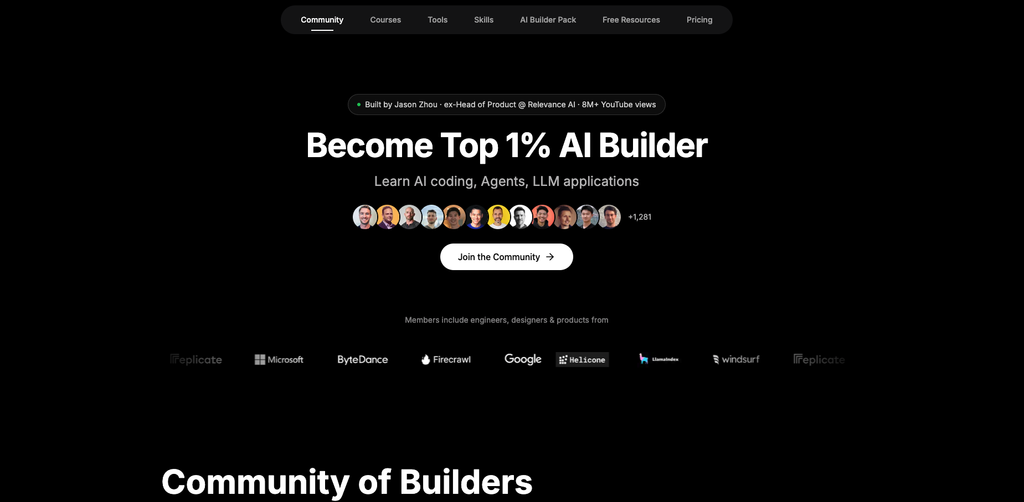
Best for: Developers and technical founders who want to build and ship AI products.
Platform: Membership site
Price: $37/month
Size: 1,000+ members
Run by AI Jason, AI Builder Club combines 65+ lessons, 22+ recorded workshops, weekly live sessions, and a shared prompt library. The focus is on building and launching, not on AI news.
Not for: Non-technical people who want business or marketing use cases.
2. AI Profit Boardroom
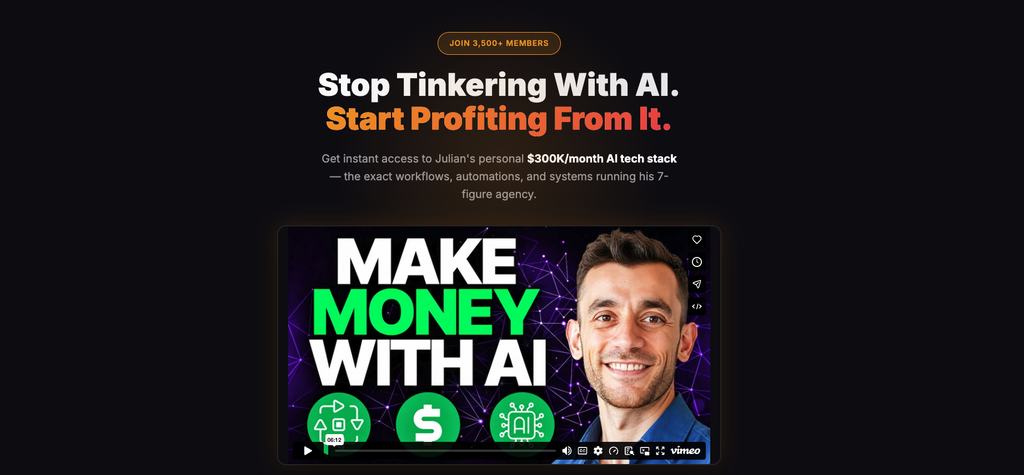
Best for: Business owners, marketers, creators, and freelancers who want to use AI to earn more.
Platform: Skool
Price: $59/month
Size: 3,600+ members
Founded by Julian Goldie, AI Profit Boardroom offers 1,000+ ready-made workflows and five live calls each week. It leans heavily on AI automation and AI SEO. The same founder runs a free Skool group, AI Money Lab, which is a good way to test the style before paying.
Not for: Engineers who want technical depth on models, evals, or infrastructure.
3. First Movers AI Labs
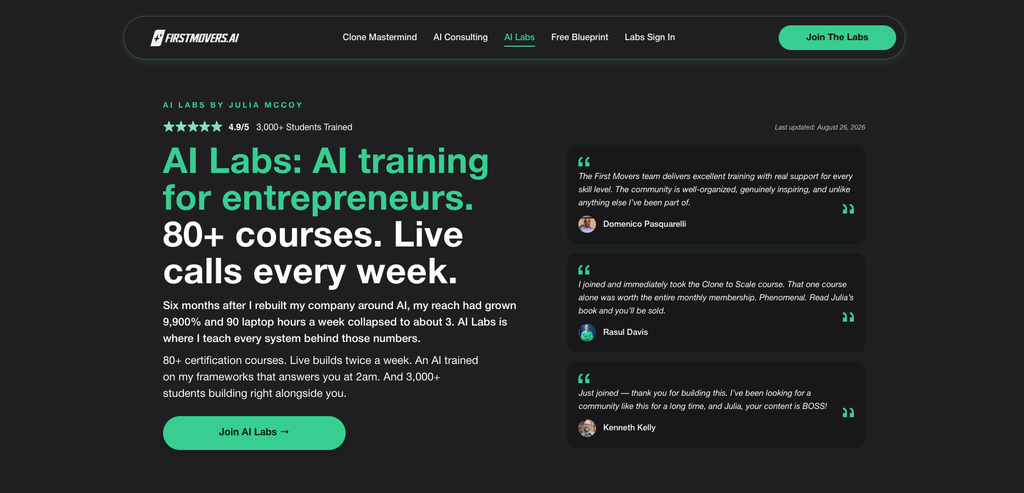
Best for: Business professionals who want structured training and custom AI tools.
Platform: Membership site
Price: About $200 to $250/month
Led by Julia McCoy, First Movers includes 65+ courses, weekly live sessions, and custom AI bots built for members. It’s one of the more expensive options, so it suits people who will use the live sessions every week.
Not for: Budget-conscious beginners. Try free communities first.
4. Lenny’s Newsletter Slack
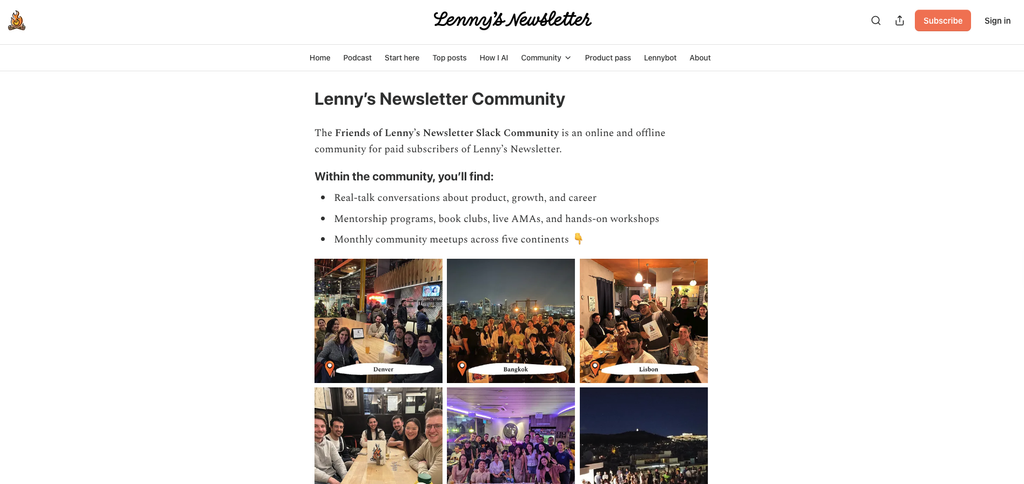
Best for: Product managers and operators moving into AI.
Platform: Slack
Price: Included with a paid Lenny’s Newsletter subscription
Lenny Rachitsky’s Slack is one of the most active communities for product people. Its AI channels include operators from leading AI companies, and it has strong hiring and career discussions.
Not for: People who want hands-on coding help.
Free communities for AI engineers and builders
Discord communities give you real-time help. They work best when you have a specific problem to solve.
5. Latent Space
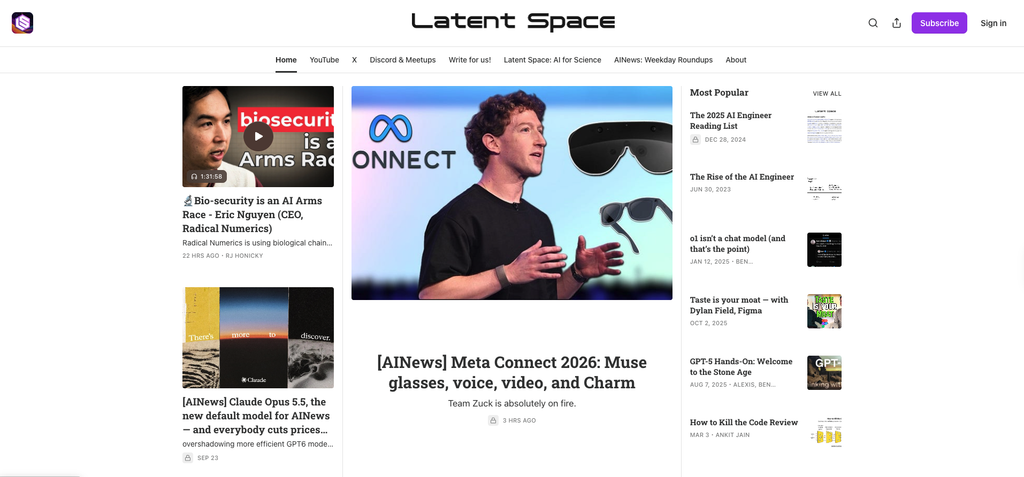
Best for: AI engineers building applications with LLMs.
Platform: Discord, podcast,st and newsletter
Price: Free
Started by swyx, Latent Space is the closest thing to a shared home for applied AI engineering. Discussions cover agents, RAG, evals,als and production lessons. It’s also connected to the AI Engineer conference community.
6. Anthropic Discord
Best for: Developers building with Claude and Claude Code.
Platform: Discord
Price: Free
The official Anthropic server has dedicated channels for Claude Code and API development. Discussions are more technical than most vendor communities.
7. OpenAI Developer Forum
Best for: Developers building on the OpenAI API.
Platform: Web forum
Price: Free
The official forum is the best place to troubleshoot API issues, find code examples,ples and follow platform announcements. Because it’s a searchable forum, many questions already have answers.
8. Hugging Face
Best for: ML engineers and anyone working with open-source models.
Platform: Web platform and Discord
Price: Free
Hugging Face is both the largest hub for open-source models, datasets, and demo apps (“Spaces”) and an active community. Model releases, benchmarks, and fine-tuning discussions happen here first.
9. LangChain Discord
Best for: Developers building AI agents.
Platform: Discord
Price: Free
A strong place for agent design patterns, observability, and evaluation. It’s useful even if you don’t use LangChain itself.
Reddit communities: searchable and honest
Subreddits are async and searchable. They’re known for blunt feedback. Many answers you need are already in old threads.
See what Reddit & SEO can do for your pipeline — grab a time
A 30-minute working session. We'll map your top intent gaps and where the pipeline is leaking. No pitch deck.
10. r/LocalLLaMA
Best for: Running and testing open-weight models on your own hardware.
Price: Free
r/LocalLLaMA has a strong benchmarking culture. It’s the best place for hardware costs, quantization,n and model comparisons. It also covers open models well beyond Llama.
11. r/ClaudeAI
Best for: Claude users and AI coding workflows.
Price: Free
Size: About 990,000 members
One of the most active AI subreddits. Members share prompts, Claude workflows,ws and frank reviews of new releases.
12. r/MachineLearning
Best for: Researchers and people who follow AI papers.
Price: Free
Focused on research papers and technical discussion, with less hype than general AI subreddits. For broader AI news and discussion, r/ArtificialIntelligence is the more casual alternative.
13. r/AI_Agents
Best for: People building or evaluating AI agents.
Price: Free
A focused subreddit for agent frameworks, use cases,ses and what works in production. Quality varies, so sort by top posts.
In-person, career and specialist communities
14. AI Tinkerers
Best for: Hands-on builders who want to meet people locally.
Platform: In-person meetups
Price: Free
AI Tinkerers runs demo-driven meetups in more than 260 cities. Events are built around live demos, not slide decks, so you meet people who are actually building. Online connections often turn into collaborations here.
15. Kaggle
Best for: Data scientists and ML learners building a portfolio.
Platform: Web
Price: Free
Size: 16 million+ registered users
Owned by Google, Kaggle combines competitions, public datasets, notebooks,ooks and discussion forums. Its ranking tiers give you a public record of your skills that employers recognize.
16. Learn Prompting
Best for: Beginners learning to use LLMs well.
Platform: Website and Discord
Price: Free, with paid certification
Learn Prompting offers 60+ free modules and a Discord community of 40,000+ members. It’s a good entry point if you use AI tools daily but have never learned prompting properly.
17. AI Village
Best for: Security professionals and AI red teamers.
Platform: Events and online community
Price: Free, some ticketed events
AI Village focuses on AI security and privacy. It’s best known for red-teaming exercises and hacking challenges at DEF CON.
Free vs paid AI communities
| Free communities | Paid communities | |
|---|---|---|
| Cost | $0 | About $37 to $250/month |
| Best for | News, quick answers, breadth | Structured learning, accountability, networking |
| Signal to noise | Varies, often noisy | Higher, because the price filters members |
| Access to experts | Occasional | Regular live calls |
| Risk | Time spent scrolling | Paying for content you never use |
How to choose the right AI community
Join fewer communities, not more. A good setup looks like this:
- One anchor community where you post your work and ask questions. This can be paid or free.
- One or two free feeds for staying current, such as a subreddit or Discord.
Beyond that, you spend more time reading than building.
Ask these questions before you join:
- What is my goal? Learning, building a product, making money, getting hired, or doing research — each points to a different community.
- Are members posting finished work? Look at the last 20 posts. If most are news links or promotions, move on.
- Do questions get good answers? Check a few recent questions and see who replied and how fast.
- Is there a free tier or trial? Test the culture before paying for a year.
How to get value from an AI community
- Show your work before asking for help. People respond to members who share what they built.
- Answer one question a week in your area of expertise. It builds your reputation faster than posting.
- Move good conversations to 1:1 calls. The most valuable connections happen outside the main feed.
- Review your memberships every quarter. Leave communities you haven’t used and mute noisy channels.
Red flags to avoid
- Huge, unmoderated Discord servers with 50,000+ members and no clear topic
- Paid communities with no refund policy, free trial, or clear curriculum
- Groups where most posts promote tools, courses,s or “income screenshots”
- Communities where the founder is the only one creating content
Frequently asked questions
What is the best AI community to join in 2026?
It depends on your goal. For builders, AI Builder Club (paid) or Latent Space (free). For business owners and marketers, AI Profit Boardroom. For product managers, Lenny’s Newsletter Slack. For open-source work, Hugging Face.
What is the best free AI community?
Hugging Face and Latent Space for technical users. r/ClaudeAI and r/LocalLLaMA for searchable, honest discussion. Kaggle if you want to build a portfolio.
Which AI community is best for beginners?
Start with free options such as Learn Prompting, r/Claude, or Hugging Face. Once you’re building something every week, a paid community with live sessions becomes worth the cost.
Are paid AI communities worth it?
Yes, if you’ll attend the live sessions and use the courses. The price usually brings better members and direct access to experts. If you won’t show up, a free community gives you most of the value.
How many AI communities should I join?
Two or three at most: one anchor community where you participate actively, plus one or two free feeds for news.
What are the best AI Discord servers?
Latent Space, the Anthropic Discord, Hugging Face and LangChain are among the most useful for builders.
Are there in-person AI communities?
Yes. AI Tinkerers runs free, demo-focused meetups in more than 260 cities worldwide.
Final thoughts
The best AI community is one you’ll actually take part in. Pick one based on your goal, add a free feed or two to keep up with news, and spend your time building and sharing your work. That’s how you get noticed, and it’s where the real learning happens.
47 checkpoints across technical, content, and conversion — the same list our strategists run on every new account.