The best AI visibility tools in 2026 are Profound for enterprise brands, Peec AI for marketing teams, Semrush and Ahrefs for teams already on those suites, SE Visible for agencies, Otterly.AI for small budgets, and AthenaHQ for the widest engine coverage.
AI visibility tools show how often ChatGPT, Gemini, Perplexity, Google AI Overviews, and other answer engines mention your brand. They also show which pages those engines cite and how you compare with competitors. This matters because more buyers now get their answer without clicking. Bain & Company found that about 80% of search users rely on AI summaries for at least 40% of their searches, and about 60% of searches end without a click.
Below, we compare seven tools on price, AI engine coverage, prompt limits, and how easily you can act on the data. All prices were checked in November 2026.
The best AI visibility tools at a glance
- Profound: best for enterprise brands that need deep data and compliance
- Peec AI: best for marketing teams that want unlimited seats and a clean dashboard
- Semrush AI Visibility Toolkit: best for teams already using Semrush
- Ahrefs Brand Radar: best for instant brand data without setting up prompts
- SE Visible: best for agencies and the most prompts per dollar
- Otterly.AI: best for small budgets and first-time trackers
- AthenaHQ: best for wide engine coverage and a free starting plan
AI visibility tools compared: price, engines and prompts
The right tool depends on which AI engines your buyers use and how many prompts you need to track. This table compares each tool’s entry plan.
| Tool | Best for | Starting price (USD/month) | Free option | AI engines on the entry plan | Prompts on the entry plan |
|---|---|---|---|---|---|
| Profound | Enterprise brands | Custom (Enterprise) | 7-day trial | ChatGPT, Gemini and AI Overviews on the trial; up to 9 engines on Enterprise | 50 daily (trial) |
| Peec AI | Marketing teams | $95 ($80 billed yearly) | Free trial | 3 of your choice from ChatGPT, AI Mode, AI Overviews, Copilot, Gemini and Naver AI | 50 daily |
| Semrush AI Visibility Toolkit | Semrush users | $99 per domain | None | ChatGPT, Google AI, Gemini, Perplexity | 25 daily |
| Ahrefs Brand Radar | Instant brand data | $199 per AI index; $699 for all | Free AI Visibility Checker | 1 index of your choice; all 6 (ChatGPT, Perplexity, Gemini, Copilot, AI Overviews, AI Mode) on the bundle | Ahrefs’ own prompt database, plus optional custom prompts |
| SE Visible | Agencies | $89 ($71 billed yearly) | 10-day trial | ChatGPT, AI Overviews, AI Mode, Gemini, Copilot | 75 daily |
| Otterly.AI | Small budgets | $29 ($25 billed yearly) | Free trial | ChatGPT, AI Overviews, Perplexity, Copilot | 15 daily |
| AthenaHQ | Wide engine coverage | Free; Starter $295 | Free Essential plan | 5 on the free plan; Starter adds AI Mode, Claude, Grok, DeepSeek and more | 300 credits free; 3,600 credits on Starter |
Prices change often in this category. Confirm the current plan on each vendor’s pricing page before you buy.
What do AI visibility tools track?
AI visibility tools run a set of prompts in AI engines on a schedule and record which brands each answer names and which sources it cites. You may also see them called AI search visibility tools, LLM monitoring tools or GEO tools. Most of them report the same core metrics:
- Mentions and mention rate: how often AI answers name your brand across your tracked prompts.
- Share of voice: your mentions compared with your competitors’ mentions for the same prompts.
- Average position: where your brand appears in the answer, with 1 meaning first.
- Citations and sources: which of your pages AI links to, and which third-party sites it cites when it talks about your category.
- Sentiment: whether AI describes your brand in a positive, neutral or negative way.
- Prompt tracking: the exact questions you monitor, with results for each prompt and each engine.
- AI crawler and referral traffic: how AI bots crawl your site and how many visits AI assistants send you. Only some tools offer this.
Mentions tell you that AI knows your brand. Citations tell you which pages earned that mention. A good tracker shows both.
How we chose these AI visibility tools
We started with the tools that appear most often across four of the most-read 2026 roundups, from Zapier, Surfer, Profound and SE Ranking. Three of those roundups come from vendors that rank their own product first, so we only kept tools that most of the lists agree on. Each tool below appears in at least three of the four.
We then checked every tool against five criteria:
- Engine coverage: does the entry plan cover ChatGPT, Gemini, Perplexity and Google’s AI features, or are they paid add-ons?
- Data collection: does the tool read answers from the real AI interfaces people use, or only from APIs? This matters more than it sounds. In Surfer’s comparison of scraped answers and API results, roughly 75% of the brands named did not overlap between the two methods.
- Citations: does it show the sources behind each answer, not just a visibility score?
- Next steps: does the data point to clear actions, such as pages to update or sites to pitch?
- Price per prompt: what does each tracked prompt cost on the entry plan?
1. Profound
Best for: enterprise brands that need deep AI search data, many engines, and compliance.
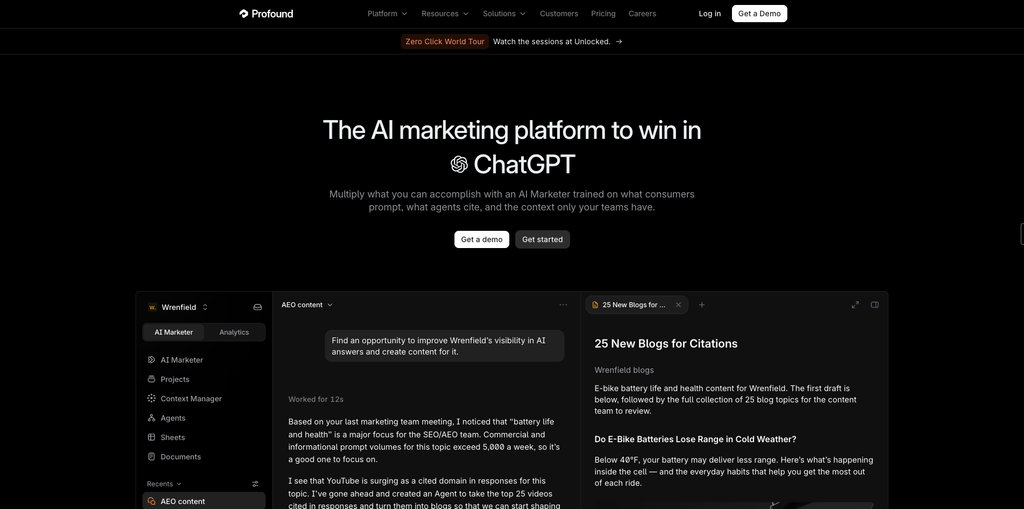
Profound is an enterprise AI visibility platform that tracks how answer engines describe your brand and then helps you act on it. Profound says it captures answers from each engine’s front-end interface rather than through API calls. Its Enterprise plan covers up to nine engines, including ChatGPT, Perplexity, Gemini, Google AI Overviews, AI Mode, Microsoft Copilot, Claude, and DeepSeek.
What sets Profound apart is how far it goes past monitoring. Prompt Volumes estimates which questions people actually ask AI in your category. Agent Analytics reads CDN data to show which AI crawlers visit your site, and a GA4 connection links that activity to human traffic. Built-in agents then turn the gaps into briefs, drafts, and content updates.
Key features
- Answer Engine Insights for visibility, citation share, sentiment and accuracy by engine and competitor
- Prompt Volumes for AI search demand by topic, intent and region
- Agent Analytics for AI crawler activity tied to traffic and conversions
- Content agents that create briefs and drafts based on what gets cited
- Agency Mode with client workspaces and pitch environments
- SSO/SAML, SOC 2 compliance and API access on Enterprise
Pricing: Profound removed its self-serve Starter ($99/month) and Growth ($399/month) plans for brands in September 2026. Brands can now choose a 7-day free trial, which tracks 50 prompts daily in ChatGPT, Gemini and AI Overviews, or a custom Enterprise contract. Agencies have separate plans.
Pros
- Some of the broadest engine coverage on this list, including Claude and Copilot
- Connects AI crawler visits, citations, and traffic in one place
- Content creation lives in the same platform as the tracking
Cons
- No public price for brands, which makes budgeting hard
- More platform than most small teams need
- The trial has no data history, exports or API access
2. Peec AI
Best for: marketing teams and agencies that want clean, daily tracking with unlimited seats.
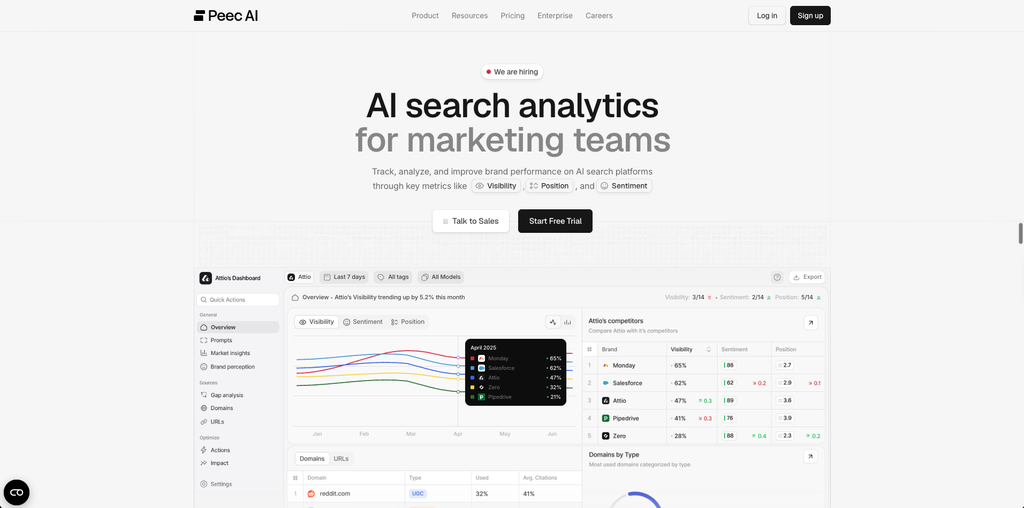
Peec AI is a Berlin-based AI search analytics tool built for marketing teams. It tracks your visibility, position, sentiment and share of voice against competitors, and it shows which domains and URLs AI engines cite for each prompt. Peec says it collects answers through each platform’s web interface, and every plan tracks prompts daily.
The interface is one of the easiest to read on this list, which makes it a good fit for client reporting. Peec also suggests prompts and competitors to track, and its recommended actions point to the prompts and sources where competitors appear and you do not.
Key features
- Visibility, position, sentiment and share of voice for every tracked prompt
- Source analytics at the domain and URL level
- Gap analysis and prioritized recommended actions
- Unlimited users on every plan
- MCP access on all plans, an API from Pro and a Looker Studio connector on Advanced
Pricing: Starter costs $95/month ($80/month billed yearly) for 50 prompts and one project. Pro costs $245/month ($205 yearly) for 150 prompts, and Advanced costs $495/month ($420 yearly) for 350 prompts with multi-country tracking. Each plan lets you pick three models; a fourth costs $35, $85 or $165 a month, depending on the plan. A free trial is available.
Pros
- Unlimited seats, even on the entry plan
- Clear citation and source data for every prompt
- Simple setup with suggested prompts and competitors
Cons
- Only three AI engines per plan unless you pay for more
- Perplexity and Claude sit outside the standard model list
- No built-in content creation, so fixes happen in other tools
3. Semrush AI Visibility Toolkit
Best for: SEO teams and agencies that already run their work in Semrush.
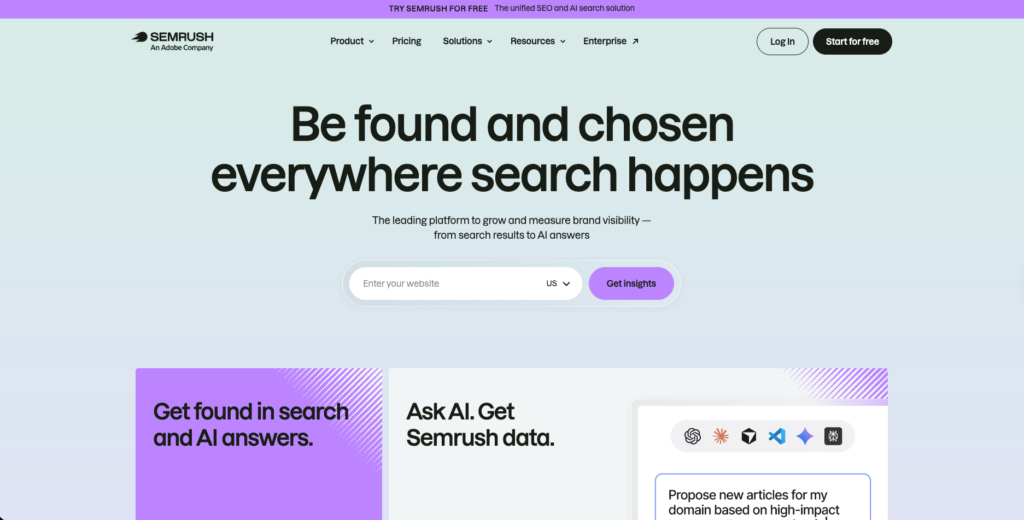
The Semrush AI Visibility Toolkit adds AI search tracking to the SEO platform many teams already use every day. You add a domain and competitors, and Semrush shows an AI visibility score out of 100, brand mentions and the pages AI engines cite. Its pricing page lists brand mentions from ChatGPT, Google AI, Gemini and Perplexity.
The biggest advantage is what happens after you find a gap. If a competitor shows up more often in AI answers, you can move straight into Semrush’s content, backlink and site audit tools to work out why. Prompt Research also helps you choose prompts the way you would choose keywords, with volume and difficulty signals.
Key features
- AI visibility score, mentions and cited pages in one overview
- Prompt Research with topic-level volume and difficulty
- Brand Performance reports for share of voice, sentiment and the sources shaping AI answers
- Daily Prompt Tracking for your own prompt set
- AI search checks in Site Audit, including whether you block AI crawlers such as OAI-SearchBot and PerplexityBot
Pricing: The toolkit costs $99/month per domain and tracks 25 prompts daily. Another 50 prompts cost $60/month, and extra domains and users add to the bill. There is no free trial for the toolkit. Semrush One, which bundles SEO and AI visibility, starts at $199/month with 50 prompts.
Pros
- AI visibility data sits next to your keyword, backlink and audit data
- Prompt Research makes it easier to pick the right prompts
- Strong brand and competitor reports for client presentations
Cons
- At $3.96 per prompt, it costs the most per prompt of the fixed-prompt plans on this list
- No Claude or Copilot tracking
- No free trial, so you pay before you can test it
4. Ahrefs Brand Radar
Best for: brands that want large-scale AI visibility data from day one, without writing prompts first.
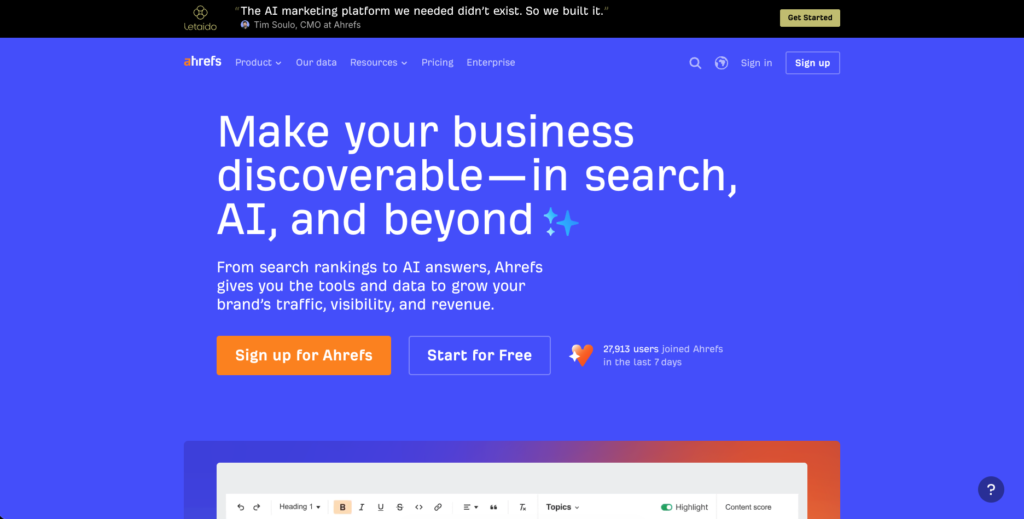
Ahrefs Brand Radar takes a different approach from most AI visibility tools. Instead of tracking only the prompts you set up, it draws on Ahrefs’ own database of hundreds of millions of prompts built from real search data. You enter your brand and competitors, and the AI share of voice, mentions and citations are there almost immediately.
Brand Radar covers ChatGPT, Perplexity, Gemini, Copilot, Google AI Overviews and AI Mode. Its filters are its strongest feature. You can find prompts where your brand is mentioned but not cited, or the third-party sites that shape how AI describes your category. It also shows mentions across YouTube, TikTok and Reddit.
See what Reddit & SEO can do for your pipeline — grab a time
A 30-minute working session. We'll map your top intent gaps and where the pipeline is leaking. No pitch deck.
Key features
- AI share of voice, mentions, citations and estimated impressions
- A very large prompt index, with historical data
- Filters for gaps, such as mentions without citations
- Benchmarking against any brand, not only your own
- Custom prompt tracking for the questions you care about most
Pricing: Brand Radar AI starts at $199/month for a single AI index, or $699/month for all indexes. Custom prompt packs start at $50/month. Many teams pair it with a paid Ahrefs plan, which starts at $129/month, to get the SEO data alongside it. Ahrefs also offers a free AI Visibility Checker.
Pros
- Instant data with no prompt setup
- Powerful filters for analyzing thousands of AI answers
- Easy to adopt if your team already uses Ahrefs
Cons
- One of the most expensive options once you add every engine
- Most chatbot indexes refresh monthly, so it suits trend analysis better than daily monitoring
- Measurement only, with no content optimization built in
5. SE Visible
Best for: agencies and teams that want the most tracked prompts for their budget.
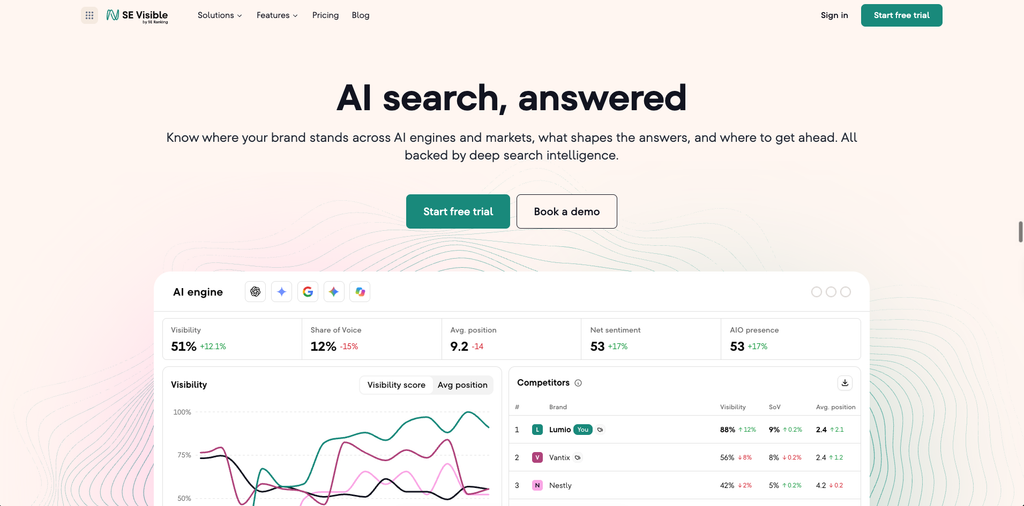
SE Visible is SE Ranking’s standalone AI visibility platform. It checks answers the way a real user sees them, in the chat app or on Google Search, including the links AI cites. Every plan covers ChatGPT, Google AI Overviews, AI Mode, Gemini and Copilot. One tracked prompt is checked in all five engines at no extra cost.
The dashboard puts your visibility, share of voice, average position and net sentiment at the top, with competitors beside you. Citation reports go deep. They show the domains and pages AI cites, classify each source and list citation gaps where competitors are cited and you are not. Agencies get client access, so each client can log in and see only their own brand.
Key features
- Five AI engines on every plan, collected from real user interfaces
- Share of voice, average position and net sentiment by prompt, topic and engine
- Citation gaps, cited domains and source classification
- Prompt research with intent and funnel-stage classification
- Unlimited seats and competitors, plus API, MCP and Data Studio access on every plan
Pricing: Basic costs $89/month ($71/month billed yearly) for 75 prompts, five projects and one location per project. Core costs $189/month ($151 yearly) for 200 prompts, 10 projects and unlimited locations. Agency costs $399/month ($319 yearly) for 1,000 prompts and 30 projects, and it adds a customer success manager. Claude tracking is listed as coming soon. Every plan comes with a 10-day free trial.
Pros
- Low cost per prompt: $1.19 on Basic and $0.95 on Core
- Five engines included, with no add-on fees
- Unlimited seats and client logins suit agency reporting
Cons
- No Perplexity tracking
- Each extra location counts as a separate prompt
- Content creation and fixes live in SE Ranking, not in SE Visible
6. Otterly.AI
Best for: freelancers, small teams and anyone tracking AI visibility for the first time.
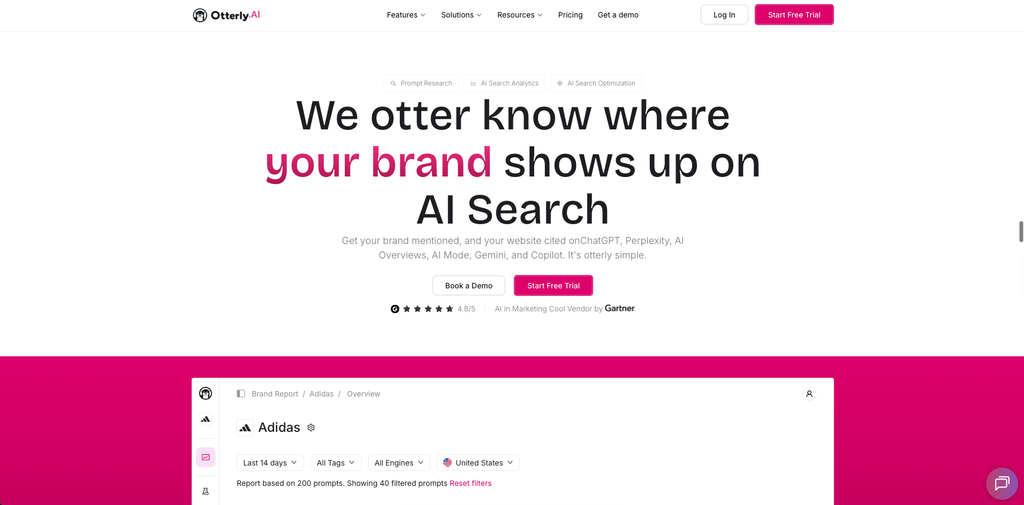
Otterly.AI is one of the most affordable AI visibility tracking tools, and it is quick to set up. It tracks brand mentions, sentiment and cited sources across ChatGPT, Google AI Overviews, Perplexity and Microsoft Copilot. Google AI Mode, Gemini and Claude are available as add-ons.
Otterly is useful for SEO teams because it can turn your target keywords into related AI prompts. It also runs GEO audits, which check your pages for technical and content issues that can stop AI engines from using them. Every plan includes unlimited team members, and Semrush users can add Otterly from the Semrush App Center.
Key features
- Brand visibility, sentiment and citation tracking across four core engines
- Prompt research that turns SEO keywords into AI prompts
- GEO audits for pages, with optimization recommendations
- Tracking in more than 50 countries
- Looker Studio connector, API and MCP server on Standard and Premium
Pricing: Lite costs $29/month ($25/month billed yearly) for 15 prompts. Standard costs $189/month for 100 prompts, and Premium costs $489/month for 400 prompts. On Lite, AI Mode and Gemini cost $9/month each, and Claude costs $29/month. A free trial is available.
Pros
- The lowest paid entry price on this list
- Copilot is included on the base plan
- GEO audits give you clear next steps
Cons
- Only 15 prompts on Lite, which is a small sample
- A steep jump from $29 to $189 when you need more prompts
- Add-on engine prices rise with each plan tier
7. AthenaHQ
Best for: teams that want to track many AI engines and start with a free plan.
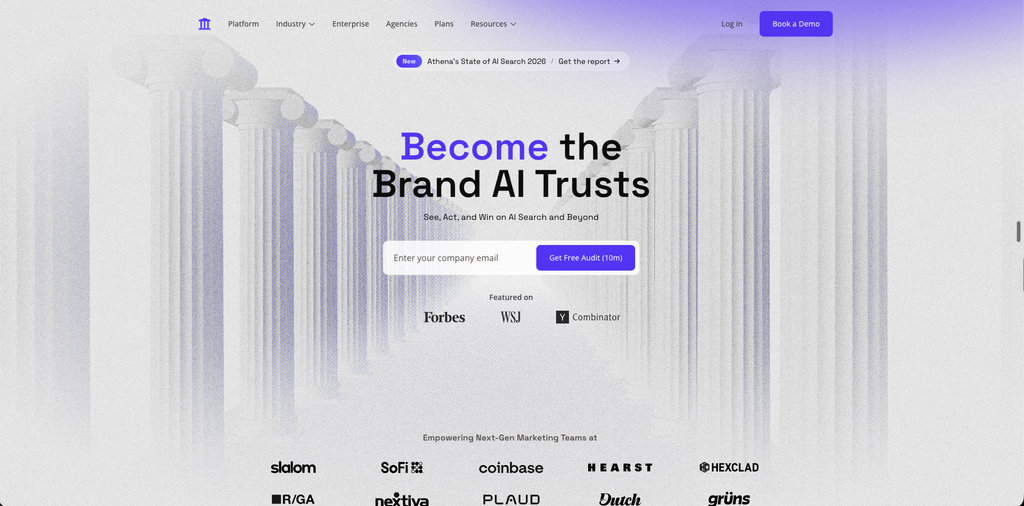
AthenaHQ is a GEO and AEO platform that measures your visibility across AI assistants and then turns the gaps into content and outreach work. Its free Essential plan covers ChatGPT, Perplexity, Google AI Overviews, Gemini, and Copilot. The paid Starter plan adds Google AI Mode, Claude, Grok, DeepSeek, and other models, which gives it one of the widest engine lists in this category.
AthenaHQ prices by credits instead of prompts, and one credit buys one AI response. For example, 50 prompts checked in four engines use 200 credits per run. That means the 3,600 credits on Starter cover about 18 full runs a month. Its Action Center then turns visibility gaps into on-page and off-page tasks, and source reports flag the cited pages worth pitching.
Key features
- At least nine AI models on the Starter plan
- Credit-based tracking that you can spread across prompts and engines
- Action Center with on-page and off-page recommendations
- A content optimization agent and outreach suggestions
- Unlimited seats with role-based access, plus GA4 and Google Search Console integrations
Pricing: Essential is free and includes 300 credits. Starter costs $295/month for 3,600 credits, with 17% off on annual billing. API access and extra credits are paid add-ons with no published price, and multi-region tracking is only on the custom Enterprise plan.
Pros
- A free plan that covers five engines
- Covers Claude, Grok and DeepSeek without an Enterprise contract
- Tracking and action steps live in one platform
Cons
- Credits are harder to budget for than a fixed prompt count
- A big jump from free to $295/month, with nothing in between
- Starter tracks a single region and language
How to choose the right AI visibility tool
Choose the tool that covers the AI engines your buyers use, shows citations as well as mentions, and fits your prompt count and budget. These five questions will narrow your shortlist quickly:
- Which AI engines does your audience use? Most tools cover ChatGPT, Gemini and Google’s AI features. Claude, Copilot and Perplexity are often add-ons or Enterprise-only, so check the entry plan.
- Does the tool read real AI answers? Tools that collect answers from the interfaces people use are closer to what your buyers actually see than API-only tools.
- Does it show citations? Source data tells you which pages to improve and which sites to pitch.
- Can your team act on the data? Prompt-level detail, competitor gaps and clear recommendations matter more than a single visibility score.
- Does the price fit your prompt count? Compare the cost per tracked prompt, not just the monthly price.
Here is what each tracked prompt costs on the plans with a fixed prompt count, at monthly billing:
| Plan | Price (USD/month) | Tracked prompts | Cost per prompt | AI engines included |
|---|---|---|---|---|
| SE Visible Core | $189 | 200 | $0.95 | 5 |
| SE Visible Basic | $89 | 75 | $1.19 | 5 |
| Peec AI Starter | $95 | 50 | $1.90 | 3 |
| Otterly.AI Lite | $29 | 15 | $1.93 | 4 |
| Semrush AI Visibility Toolkit | $99 | 25 | $3.96 | 4 |
Once you have a shortlist, test your top two tools on the same prompts for two to three weeks. AI answers change from one run to the next, so judge each tool on trends, not single results.
FAQ
What is an AI visibility tool?
An AI visibility tool tracks how often your brand appears in answers from ChatGPT, Gemini, Perplexity, Google AI Overviews, and other AI engines. It shows the prompts that trigger mentions, your position in each answer, the sources AI cites, and how you compare with competitors.
What is the best AI visibility tool?
It depends on your team and budget. Profound is the strongest choice for enterprise brands, and Peec AI suits marketing teams that want a clean dashboard. Semrush and Ahrefs make sense if you already pay for their SEO suites. SE Visible gives agencies the most prompts per dollar, Otterly.AI is the cheapest paid start, and AthenaHQ covers the most engines on a self-serve plan.
Can I check my AI visibility for free?
Yes. AthenaHQ has a free Essential plan, and Ahrefs offers a free AI Visibility Checker. Profound, Peec AI, SE Visible, and Otterly.AI all offer free trials.
Are AI visibility tools the same as GEO tools and LLM trackers?
Mostly, yes. AI visibility tools, LLM monitoring tools, and GEO tools usually describe the same kind of software. Some GEO tools, such as Profound and AthenaHQ, also help you create or optimize content.
Why do AI visibility tools show different results for the same prompt?
AI answers change between runs, engines, locations, and dates. Tools also collect answers in different ways, since some read the real interfaces and others use APIs. Track the same prompts over several weeks and compare trends rather than single answers.
How many prompts do I need to track?
Start with the questions that matter most to your sales. SE Visible suggests building prompts from your product lines, audiences, and buying stages. A company with three product lines, two audiences, and three buying stages already needs 18 prompts per market.
Final verdict: which AI visibility tool should you pick?
There is no single best AI visibility tool for every team. Pick by the job you need done:
- Enterprise brand with a large budget: Profound
- Marketing team that wants simple daily tracking: Peec AI
- Already paying for an SEO suite: Semrush AI Visibility Toolkit or Ahrefs Brand Radar
- Agency tracking many clients: SE Visible
- Testing AI visibility on a small budget: Otterly.AI
- Need Claude, Grok, or DeepSeek coverage: AthenaHQ
Remember that a tracker only shows you the gap. Closing it takes pages that answer buyer questions clearly, mentions on the sites AI already cites, and strong organic rankings, because AI engines still pull heavily from search results.
Want help turning AI visibility data into citations? Angleout runs GEO and AEO programs for B2B SaaS brands, from prompt research to content and digital PR. Talk to our team to see where your brand stands in AI search today.
47 checkpoints across technical, content, and conversion — the same list our strategists run on every new account.