
The best rank tracking tools in 2026 are SE Ranking, Semrush, AccuRanker, Nightwatch and Wincher. Each one wins in a different situation, so the right pick depends on your keyword volume, your budget, and how you report to clients or leadership.
Rank tracking has changed in the last 12 months. Most serious trackers now check AI Overviews and AI answers alongside the classic blue links, and several vendors reworked their plans this year. Older roundups quote prices and limits that no longer exist.
We checked every price, keyword limit,t and update schedule in this guide against each vendor’s own pricing page in November 2026. At Angleout, rank data sits next to Google Search Console in every client report we build, so we judged these tools on what matters in daily SEO work: accurate positions, daily updates, clean exports,ts and a fair cost per keyword.
Quick picks:
- Best overall value: SE Ranking. 2,000 keywords tracked daily for $103.20/month on annual billing, with AI visibility tracking included.
- Best if you already use an SEO suite: Semrush. Position Tracking is excellent, but only worth it if you use the rest of the platform.
- Best for large keyword sets and fresh data: AccuRanker. Built for agencies that track thousands of keywords and need on-demand refreshes.
- Best for local tracking and unlimited seats: Nightwatch. 107,000+ locations and no per-seat fees.
- Best budget daily tracker: Wincher. Simple, Google-focused,sed and daily on every plan.
Best rank tracking tools at a glance
Use this table to shortlist two tools, then run both on a free trial with your own keyword list.
5 Best Rank Tracking Tools at a Glance
| # | Tool | Best for | Starting price | Keywords on entry plan | Updates | AI visibility | Free trial |
|---|---|---|---|---|---|---|---|
| 1 | SE Ranking Top pick |
Best overall value | $103.20/mobilled annually ($129 monthly) | 2,000 | Daily | Included25 prompts, 5 AI engines | 14 days |
| 2 | Semrush | Teams already using the full suite | $117.33/mobilled annually ($139 monthly) | 500 | Daily | Included50 daily prompts from Starter | 7 days |
| 3 | AccuRanker | Large keyword sets and on-demand data | €229/mosave up to 15% yearly | 2,000 | Daily On-demand | Separate productAccuLLM | Demo on request |
| 4 | Nightwatch | Local tracking and unlimited seats | €79/mobilled annually | 500 | Daily On-demand | Included50 prompts on Starter | 14 days |
| 5 | Wincher | Budget daily tracking | €49/mocheaper on yearly billing | 500 | Daily | Not offered | Yes |
Prices checked on each vendor’s pricing page on 10 November 2026. AccuRanker, Nightwatch and Wincher list prices in euros.
Prices were checked on each vendor’s pricing page on 10 November 2026. AccuRanker, Nightwatch and Wincher list prices in euros.
How we picked these rank tracking tools
We scored each tool on six criteria that decide whether a rank tracker is useful day to day. Feature count was not one of them.
- Update frequency. Daily updates on the entry plan, plus the option to refresh rankings on demand after a site change.
- Cost per keyword. What you pay to track your real keyword list, not the headline price.
- Location and device control. Separate desktop and mobile data, plus city or ZIP-level targeting for local campaigns.
- AI search visibility. Whether the tool tracks AI Overviews, AI Mode, and answers in ChatGPT, Gemini, Gemini, and Perplexity, and what that costs.
- Reporting and integrations. White-label reports, Looker Studio connectors, API access, and Google Search Console integration.
- Team access. How many users each plan includes and what extra seats cost.
We also left out two popular options. Ahrefs’ Rank Tracker updates weekly on every plan, from Lite to Enterprise, which is too slow for active campaigns. Desktop-only trackers make shared client reporting hard. Both can still work, but they did not make our top five.
1. SE Ranking: Best rank tracking tool for overall value
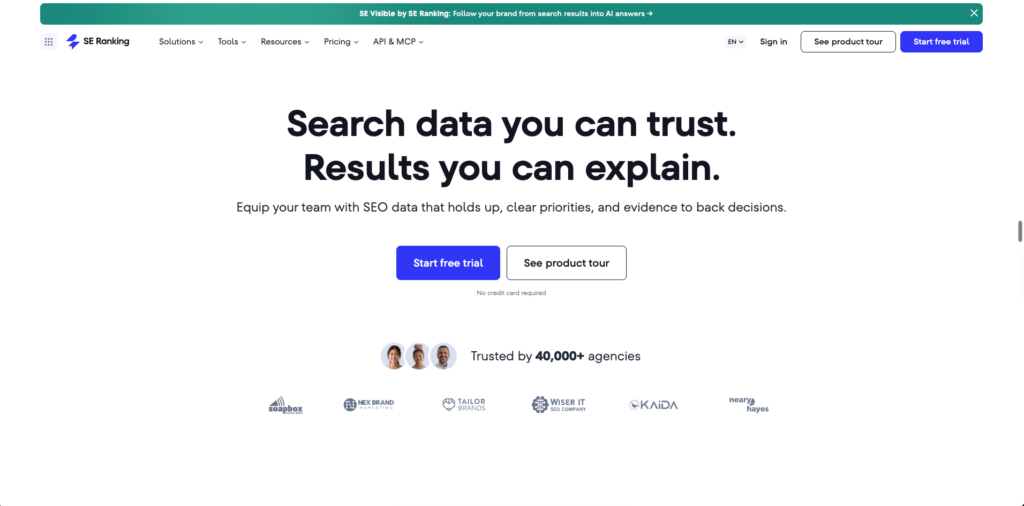
SE Ranking is an all-in-one SEO platform with one of the most generous rank trackers at its price. The Core plan tracks 2,000 keywords every day across major search engines, on desktop and mobile, with location targeting down to city level.
The biggest change this year is AI visibility. SE Ranking now includes AI tracking on both Core and Growth: 25 prompts a day across 5 AI engines. Until recently, this was a paid add-on, so many older reviews still list it as an extra cost.
The platform also covers keyword research, backlink monitoring, site audits, and Looker Studio, GA, and GSC integrations. That makes it a strong choice if you want one tool instead of three.
Pros:
- 2,000 daily-tracked keywords on the entry plan, four times Semrush’s entry allowance
- AI visibility tracking included on every plan, with no add-on needed
- Google top 100 tracking and Share of Voice on all plans
- Free assisted migration of your ranking history with an annual plan
- 14-day free trial with no credit card
Cons:
- White-label reporting and client seats need the Agency Pack, at +$69/month on annual billing
- Core includes only 1 manager seat. Extra seats start at $16/month.
- Historical data is limited to 6 months on Core. Full history needs the Growth plan.
- The wide feature set takes time to learn for beginners
Pricing:
- Core: $129/month, or $103.20/month billed annually. 2,000 keywords daily, 10 projects, 1 seat.
- Growth: $279/month, or $223.20/month billed annually. 5,000 keywords daily, 30 projects, 3 seats.
- Enterprise: custom pricing.
Best for: SaaS teams and agencies that want daily tracking, AI visibility,y and a full SEO toolkit without paying suite-level prices.
2. Semrush: Best rank tracker inside a full SEO suite
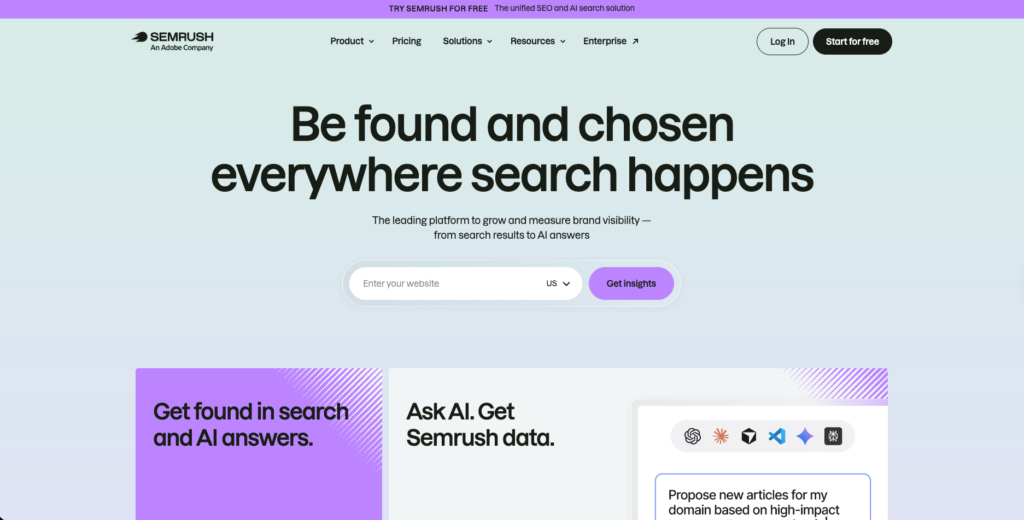
Semrush Position Tracking is one of the most complete rank trackers available. It gives you daily updates, desktop and mobile data, SERP feature tracking including AI Overviews, and competitor visibility in the same report.
Semrush also reworked its plans in 2026. The old Pro, Gu,ru and Business names are gone. The current SEO + AI Search family has four tiers: SEO, Starter, Pro+ and Advanced.
The catch is cost per keyword. The SEO plan tracks 500 keywords a day for $117.33/month on annual billing. SE Ranking gives you 2,000 for less. Semrush makes sense when you use its keyword research, competitor data,ata and site audits every week. If rank tracking is the only job, you are paying for tools you will not open.
Pros:
- Accurate daily Position Tracking with SERP feature and AI Overview detection
- Deep competitor and keyword data in the same platform
- AI visibility, sentiment, and custom prompt monitoring included from the SEO plan
- Multi-location and multi-device tracking on Pro+
- 7-day free trial and a free plan for testing
Cons:
- Only 500 tracked keywords on the SEO and Starter plans
- Extra users start at $45/month each
- White-label reports need the Pro Report add-on at $20/month
- Advanced is now custom-priced, so large keyword sets need a sales call
Pricing:
- SEO: $139/month, or $117.33/month billed annually. 5 websites, 500 keywords daily.
- Starter: $199/month, or $165.17/month billed annually. Adds 50 AI prompts tracked daily and MCP access.
- Pro+: $299/month, or $248.17/month billed annually. 15 websites, 1,500 keywords daily.
- Advanced: custom pricing. 40+ websites, 5,000+ keywords daily, and Share of Voice.
Best for: Marketing teams that already use Semrush for research and competitive analysis. Not the right first purchase if you only need rankings.
3. AccuRanker: Best for large keyword sets and on-demand data
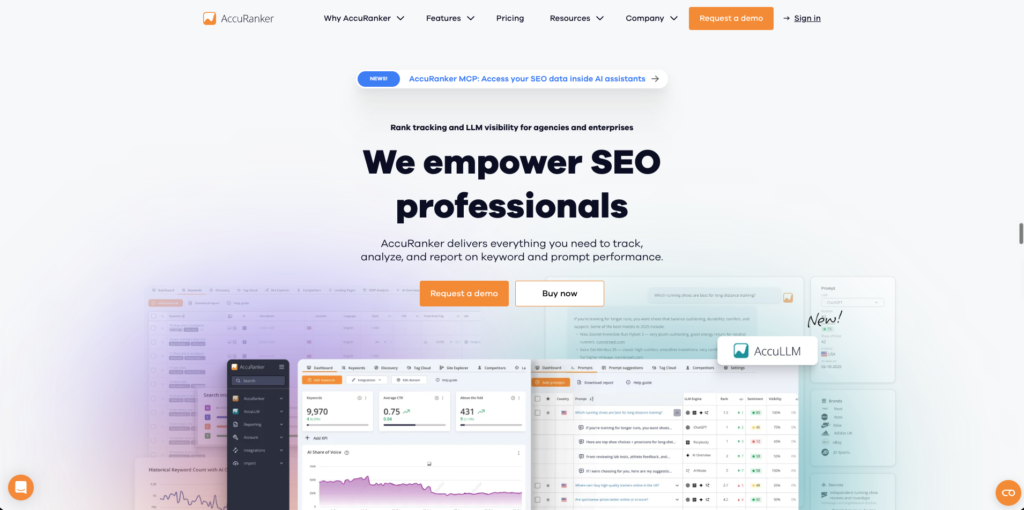
AccuRanker is a dedicated rank tracker built for speed and scale. Rankings update daily. When you need fresh data, you can refresh a single keyword or update your whole domain every two hours.
That on-demand refresh is the reason agencies pick AccuRanker. You can check the impact of a fix, a migration,n or a competitor’s move the same day, instead of waiting for tomorrow’s update. It also tracks pixel position, so you can see whether a result sits above or below the fold.
The trade-off is price. The entry plan starts at €229/month for 2,000 keywords. If you track fewer than 1,000 keywords, Nightwatch or SE Ranking will cost you less.
Pros:
- On-demand refresh for single keywords or full domains
- Pixel position, CTR estimates,es and AI Share of Voice per keyword
- Rule-based tagging that keeps large keyword sets organized
- Scales to millions of keywords without slowing down
- Unlimited read API and Looker Studio connector on Expert
Cons:
- Expensive for small keyword sets
- A pure tracker with a lighter research toolkit than the all-in-one suites
- AI answer tracking sits in a separate product, AccuLLM
- No published free trial on the pricing page
Pricing:
- Professional: from €229/month for 2,000 keywords, with daily updates, GSC and GA integration, and reporting.
- Expert: from €809/month for 10,000 keywords. Adds dynamic tagging, Looker Studio, and an unlimited read API.
- Enterprise: custom pricing for 20,000+ keywords, with BigQuery, raw SERP HTML, and unlimited users.
Annual billing saves up to 15%.
Best for: Agencies and in-house teams tracking thousands of keywords who need same-day data for client reporting.
4. Nightwatch: Best for local rank tracking and unlimited seats
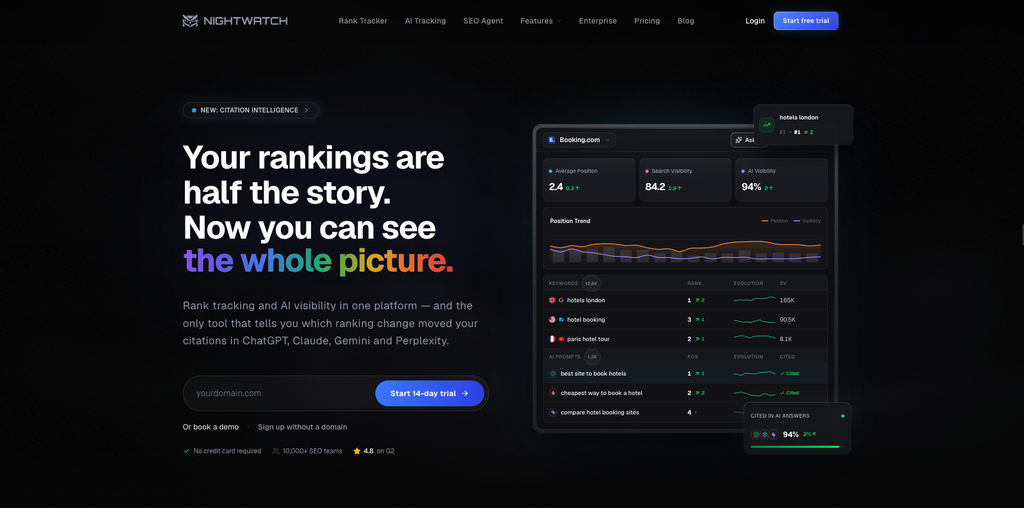
Nightwatch combines rank tracking and AI visibility in one tool, and it prices by keywords instead of users. Every plan includes unlimited team seats, which is rare in this category.
Local precision is its standout feature. Nightwatch tracks rankings in 107,000+ locations across 190+ countries, in any language. It covers Google, Bing, Yahoo, DuckDuckGo, YouTube, and Google Maps on every plan.
Every plan also tracks AI answers in ChatGPT, Gemini, Perplexity, Google AI Mode, and AI Overviews. You get daily automated updates plus on-demand checks, and SERP archives are kept for 3 years.
See what Reddit & SEO can do for your pipeline — grab a time
A 30-minute working session. We'll map your top intent gaps and where the pipeline is leaking. No pitch deck.
Pros:
- Unlimited user seats with no per-seat fees
- 107,000+ tracking locations for city and ZIP-level local SEO
- AI visibility tracking included on every plan, with sentiment and citation analysis
- Six search engines, including YouTube and Google Maps
- 14-day free trial with no credit card
Cons:
- White-label reports, Looker Studio, API access,s and unlimited seats start on Professional, not Starter
- The Starter plan covers only 5 websites
- The full feature set has a learning curve for new users
Pricing (billed annually):
- Starter: €79/month (€948/year). 500 keywords, 5 websites, 50 AI prompts.
- Professional: €159/month (€1,908/year). 2,500 keywords, 25 websites, 150 AI prompts.
- Agency: €399/month (€4,788/year). 7,500 keywords, 100 websites, 500 AI prompts.
- Enterprise: custom pricing for 20,000+ keywords.
Nightwatch says yearly billing saves 20% compared with paying monthly.
Best for: Local SEO campaigns, multi-location brands and agencies that want the whole team in one account without paying per seat.
5. Wincher: Best budget daily rank tracker
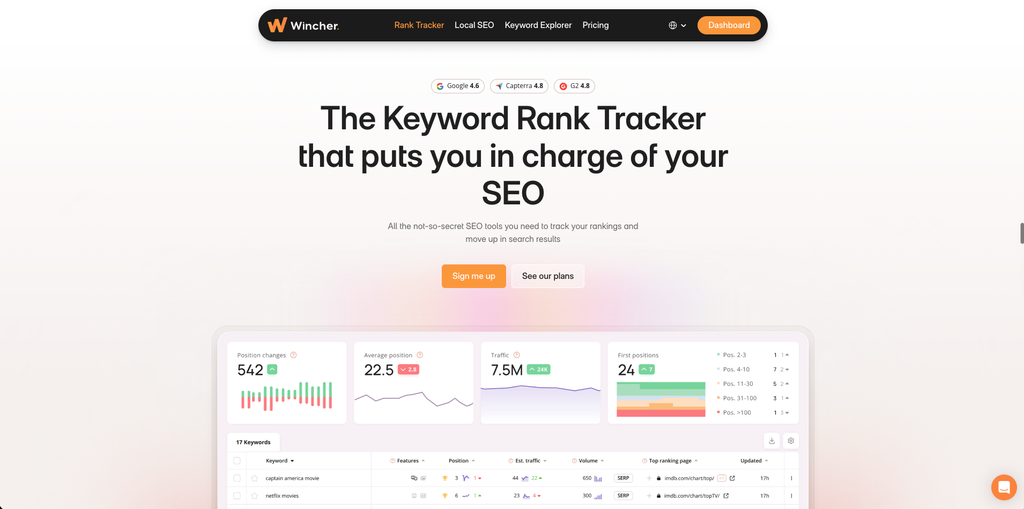
Wincher is a simple rank tracker built around Google. It is the easiest tool on this list to set up: add your domain, paste your keywords, pick a location, and you are done.
Every plan includes daily ranking updates, competitor tracking, SERP features, device and geo tracking, and a Google Search Console integration. Wincher also bundles a Keyword Explorer, an on-page SEO checker,ker and a local rank tracker for Google Maps.
The limits sit in the entry plan. On-demand updates, white-label reports, Looker Studio, API access, and multiple users are only available from the second tier up.
Pros:
- Daily updates on every plan, starting at 500 keywords
- Fast setup with a clean, beginner-friendly interface
- Google Search Console integration on all plans
- Keyword research and on-page checks included
Cons:
- Focused on Google, so it is not the right fit if you need other engines
- No AI search visibility tracking
- The entry plan has 1 user, no on-demand updates, and no white-label reports
- Local map rankings update weekly, not daily
Pricing:
- Basic: from €49/month for 500 keywords, up to 10 websites and 1 user.
- Standard: from €89/month for 1,000 keywords, unlimited websites and multiple users.
- Professional: from €319/month for 5,000 keywords, with external users and project permissions.
Wincher prices scale with your keyword count, and yearly billing is cheaper.
Best for: Freelancers, founders, and small teams who want clean daily Google rankings without paying for a full SEO suite.
Start with Google Search Console: the free baseline
Before you pay for any rank tracker, set up Google Search Console. It is free, and it shows clicks, impressions, CT,R and average position for every query your site appears for.
GSC and a paid tracker measure different things. GSC reports an average position across every searcher, location,n and device over a date range. A rank tracker records your exact position for one keyword, in one location, on one device, on one day. A GSC average of 5 can hide position 2 in one city and position 9 in another.
That is why we use both. GSC shows the real trend and surfaces queries you never thought to track. The paid tool shows the precise position in the market that matters to you, plus what your competitors are doing. If a tracker number and a GSC number disagree, check location and device settings first.
Rank tracking tools compared: pricing and features
SE Ranking is the cheapest way to track keywords daily at scale, at about $52 per 1,000 keywords a month on its entry plan. Semrush is the most expensive per keyword because you pay for the full suite.
Cost per 1,000 tracked keywords
Headline prices are misleading because every tool includes a different number of keywords. This table divides each entry price by its keyword allowance.
[Insert Table 2 HTML block here: “Rank Tracker Pricing Compared”]
| Tool | Entry plan | Price | Keywords tracked daily | Cost per 1,000 keywords | Next plan up |
|---|---|---|---|---|---|
| SE Ranking | Core | $103.20/mo (annual) | 2,000 | $51.60 | Growth: $223.20/mo for 5,000 |
| Wincher | Basic | €49/mo | 500 | €98 | Standard: €89/mo for 1,000 |
| AccuRanker | Professional | €229/mo | 2,000 | €114.50 | Expert: €809/mo for 10,000 |
| Nightwatch | Starter | €79/mo (annual) | 500 | €158 | Professional: €159/mo for 2,500 |
| Semrush | SEO | $117.33/mo (annual) | 500 | $234.66 | Pro+: $248.17/mo for 1,500 |
The gap narrows on bigger plans. Nightwatch Professional works out to €63.60 per 1,000 keywords, close to SE Ranking. If you track desktop and mobile separately, check whether each device counts as a separate keyword before you compare.
Feature comparison
[Insert Table 3 HTML block here: “Rank Tracker Features Compared”]
| Tool | Daily updates on entry plan | AI visibility tracking | Client reporting | API access | Users |
|---|---|---|---|---|---|
| SE Ranking | Yes | Included on all plans | White label via Agency Pack (+$69/mo) | Included (25K credits on Core) | 1 on Core, extra from $16/mo |
| Semrush | Yes | Basic on SEO, 50 daily prompts from Starter | White label via Pro Report add-on ($20/mo) | Advanced plan | 1, extra from $45/mo |
| AccuRanker | Yes, plus on-demand refresh | Separate product (AccuLLM) | Reports and exports on all plans | Unlimited read API from Expert | Unlimited on Enterprise |
| Nightwatch | Yes, plus on-demand checks | Included on all plans | White label from Professional | From Professional | Unlimited from Professional |
| Wincher | Yes | Not offered | White label from Standard | From Standard | 1 on Basic, multiple from Standard |
How to choose the right rank tracker
Pick the tool that solves your most expensive problem, not the one with the longest feature list. Answer these five questions before you start a trial.
1. Do you need a tracker or a full SEO platform?
If your team runs keyword research, audits and competitor analysis every week, start with the tracking allowance inside an SEO suite such as SE Ranking or Semrush. If another tool already covers that work, buy a dedicated tracker like AccuRanker, Nightwatch or Wincher. Paying for two suites that overlap is the most common waste we see.
2. How many keywords will you track in 12 months?
Price your future keyword list, not today’s. Multiply keywords by devices and locations, then check how each vendor counts them. A 500-keyword plan fills up fast once you add mobile and a second city.
3. How fresh does the data need to be?
Daily updates are the minimum for active campaigns, migrations and new launches. If you need to confirm a change the same day, choose a tool with on-demand refresh, such as AccuRanker or Nightwatch.
4. Who sees the reports?
Agencies should test the full client workflow during the trial. Build a real project, group the keywords, and send a report. Check the white-label options, client logins and what each extra seat costs.
5. Do you need AI search visibility?
If buyers in your category ask ChatGPT or Perplexity for recommendations, track AI answers alongside rankings. SE Ranking and Nightwatch include it on every plan. Remember that an AI mention, a cited URL and an organic ranking are three different results, so compare tools on what they actually measure.
Our recommendation: run your top two picks side by side for one week. Use the same 25 keywords, location and device in both. Compare the results against a manual search and your GSC data. The tool whose numbers you can explain is the one to keep.
Turn ranking data into a pipeline with Angleout
A rank tracker tells you where you stand. It does not tell you what to fix first, which pages to refresh, or how to win the keywords that bring in demos.
That is the work we do at Angleout. We are a B2B SaaS SEO and link building agency, and we turn ranking and Search Console data into a clear plan: content that targets buying-intent keywords, refreshes for pages that are slipping, and links that move the needle.
If your rank tracker keeps showing opportunities your team cannot act on, book a free strategy call,l and we will show you where your quickest wins are.
47 checkpoints across technical, content, and conversion — the same list our strategists run on every new account.
Frequently asked questions about rank tracking tools
What is the best rank tracking tool in 2026?
SE Ranking is the best rank tracking tool for most teams in 2026. It tracks 2,000 keywords daily for $103.20/month on annual billing and includes AI visibility tracking. Agencies with large keyword sets should also look at AccuRanker, and local businesses at Nightwatch.
What is the best free rank tracker?
Google Search Console is the best free option. It shows average position, clicks, and impressions for every query your site ranks for. It does not give exact positions by location or show competitor data, so most teams add a paid tracker once SEO becomes a priority.
Why do rank trackers and Google Search Console show different positions?
They measure different things. GSC averages your position across all searchers, locations,s and devices over a date range. A rank tracker checks one keyword from one location on one device at one moment. Both numbers can be correct at the same time.
How often should I check keyword rankings?
Track your most important commercial keywords daily, especially after publishing, updating pages,es or migrating a site. For stable, long-tail keywords, a weekly review of the trend is enough. Reacting to every daily movement creates noise.
Do I need a rank tracker if I already use Semrush or Ahrefs?
Check your current plan first. Semrush tracks 500 keywords daily on its SEO plan. Ahrefs updates tracked keywords weekly on every plan. Add a dedicated tracker only if you need more keywords, daily data,ata or better client reporting.
Can rank trackers track AI Overviews and ChatGPT?
Yes, several can. SE Ranking and Nightwatch include AI visibility tracking on every plan, and Semrush adds daily prompt tracking from its Starter plan. AccuRanker offers it through a separate product called AccuLLM. Wincher does not track AI answers.
How much does a rank tracker cost?
Entry plans range from about €49 to $139 a month. The real cost depends on how many keywords, locations, and devices you track. Compare tools on cost per 1,000 keywords, not on the headline price.