TL;DR
TL;DR · ~30 sec read
Run the seven steps below and you’ll know where AI answers include you, where they skip you, and which fixes to make first.
- Audit, then monitor: an AI visibility audit is a one-off baseline of how ChatGPT, Google’s AI answers and Perplexity describe you; tracking comes after.
- Use about 20 buyer prompts: split them across category, comparison, pricing and branded questions, and run each one several times, because answers change between runs.
- Score rates, not rankings: mention rate, citation rate, share of voice and accuracy tell you more than where you appear in a single answer.
- Check access before content: a CDN or robots.txt rule can quietly hide your site from AI search, and the first-party reports from Google, Bing and OpenAI fill in some of what manual checks miss.
An AI visibility audit is a structured check of whether AI assistants name your brand, link to your site and describe you correctly when buyers ask about your category. For B2B SaaS it’s no longer optional. In G2’s March 2026 survey of 1,076 software buyers, 51% said they start research with an AI chatbot more often than with Google, up from 29% in G2’s 2025 report.
This guide is written for SaaS marketing teams. It gives you a prompt set built around how software gets bought, a scorecard you can copy, a source map, the crawler checks that trip up SaaS sites, and a worked example with the arithmetic shown.
What is an AI visibility audit?
It’s a one-off, documented check of how ChatGPT, Google’s AI answers and Perplexity present your brand across a fixed set of buyer questions, so that someone else could repeat it next quarter and get comparable numbers. It records whether you’re mentioned, whether your site is cited, how accurately you’re described, which competitors appear instead, and which sources the answers rely on.
It’s different from the ongoing tracking you do afterwards. The audit sets the baseline and explains it; tracking brand mentions in AI search tells you whether that baseline moves.
| Check | Question it answers | When | What you get |
|---|---|---|---|
| AI visibility audit | Where do we appear in AI answers, and why? | Once, then every quarter or two | A scored baseline, a source map and a fix list |
| Ongoing AI tracking | Is our presence going up or down? | Weekly or monthly | Trends by prompt and engine |
| Technical SEO audit | Can search engines crawl and index the site? | Before and after big site changes | Crawl, index and speed fixes |
What you need before you start
You need less than most vendors suggest: a spreadsheet, a few logins and time to run the prompts.
- A spreadsheet for the prompt set and scorecard (the templates below).
- Access to Google Search Console, GA4 and Bing Webmaster Tools for your site.
- Logged-out or temporary sessions in ChatGPT, Google and Perplexity, so your history has less influence on the answers.
- Your competitor list: the three to five companies that show up in deals.
A paid tracker can speed up collection later. Our list of AI visibility tools compares them, but for a first audit, the manual method gives you evidence you understand line by line.
How to run an AI visibility audit in 7 steps
Step 1: Pick your competitors and the engines your buyers use
Start by deciding which AI engines to test. ChatGPT, Google’s AI Overviews and AI Mode, and Perplexity are a sensible default set; add Copilot or Claude if your buyers live in Microsoft 365 or developer tools.
Your own analytics settle the question faster than any industry survey, because the engines that already send you visits are the ones your buyers are using today. Since May 2026, GA4 has a default “AI Assistant” channel for visits from sources like ChatGPT, Gemini, Deepseek, Copilot and Grok. It excludes Google’s AI Overviews and AI Mode, which GA4 counts as Organic Search.

Open Acquisition > Traffic acquisition, look at the AI Assistant row, and test the engines that already send you visits. Then write down the competitors you lose deals to; you’ll count their mentions in every answer too.
Step 2: Build a prompt set from real buyer questions
The prompt set decides whether the audit means anything. Write about 20 prompts that mirror how SaaS buyers move from “what tools exist” to “which one do we pick”, and keep a handful of branded ones.
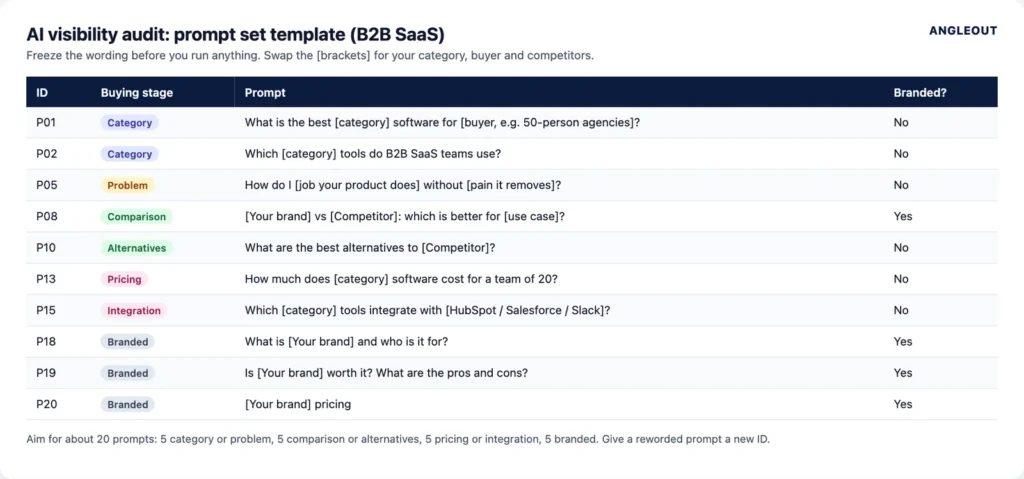
Split them evenly across four groups:
- Category and problem: “What is the best [category] software for [buyer]?” These show whether AI recommends you to people who haven’t heard of you.
- Comparison and alternatives: “[You] vs [competitor]” and “alternatives to [competitor]”. These are where shortlists get made.
- Pricing and integration: “How much does [category] software cost?” and “Which tools integrate with HubSpot?”
- Branded: “What is [you] and who is it for?” and “[You] pricing”. These test accuracy.
Pull wording from sales call notes, G2 reviews and the questions your SaaS SEO keyword research turned up. Freeze the wording before you run anything, and give any reworded prompt a new ID, or you’ll compare two different questions later.
Step 3: Collect answers in clean, repeated sessions
AI answers change from one run to the next, so a single screenshot proves very little. In SparkToro’s study, 600 volunteers ran 12 prompts through ChatGPT, Claude and Google’s AI a combined 2,961 times. ChatGPT or Google’s AI gave the same list of brands in any two of 100 responses less than 1 in 100 times.
The same study found that how often a brand appears is far steadier than where it appears. That’s why you run each prompt several times and score the rate.
For each prompt, engine and run, save:
- the full answer text and the order of brands named
- every cited URL
- a screenshot taken before you click anything
- the date, engine, session mode and the prompt ID
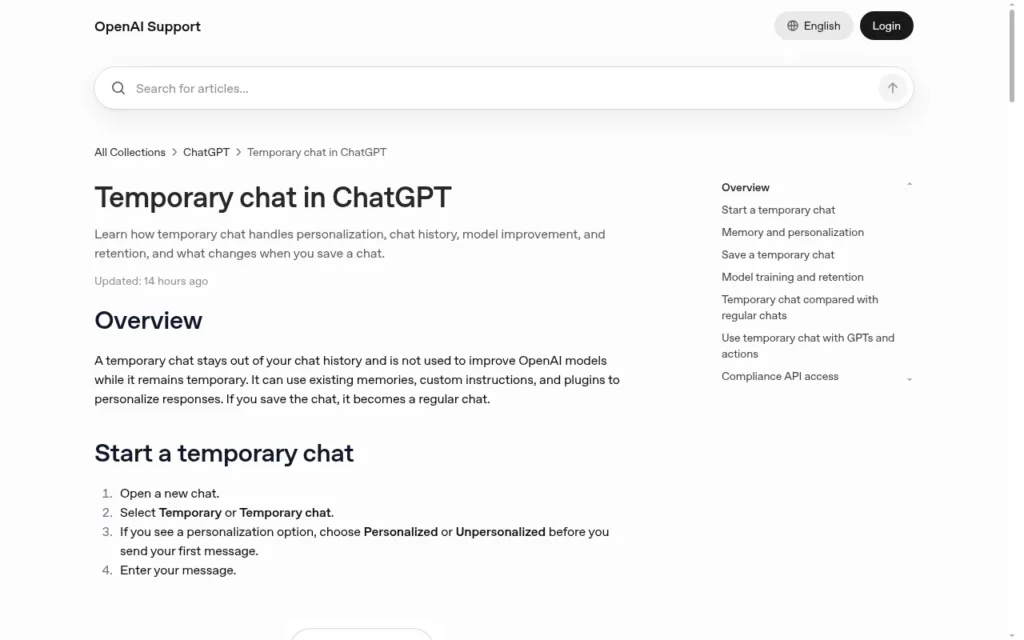
In ChatGPT, use a Temporary Chat and choose Unpersonalized before the first message, because the setting can’t be changed once the chat starts. Three runs per prompt per engine is a budget compromise that gives a rough read, not a precise one; SparkToro says a stable read on one prompt usually takes 60 to 100 runs, which is what paid trackers are for.
Record “no AI answer” when Google shows none. It counts. Google says AI Overviews often don’t trigger, and a missing answer is a result, not a failed test.
Step 4: Score mentions, citations and accuracy
Score every saved answer on one row of a scorecard. Keep scoring separate from collecting, and score from the saved text, not from memory.
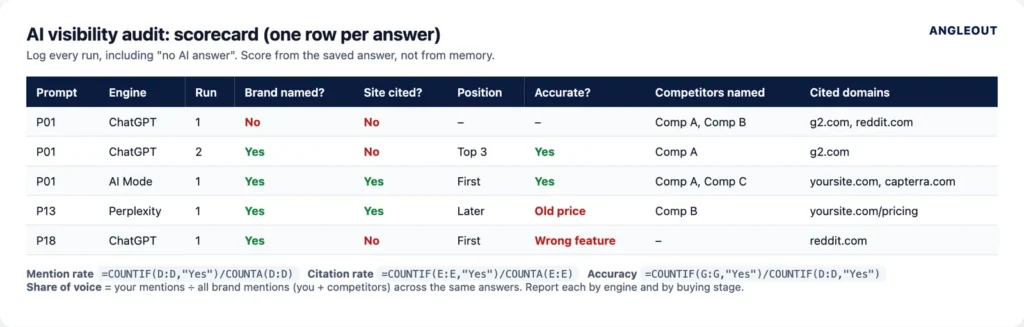
Five numbers come out of the sheet:
- Mention rate: answers that name you ÷ all answers.
- Citation rate: answers that link to your site ÷ all answers.
- Share of voice: your mentions ÷ all brand mentions (you plus competitors) in the same answers.
- Accuracy: correct descriptions ÷ answers that mention you. Wrong prices, missing integrations and outdated positioning all count as errors.
- First-mention rate: answers where you’re named first ÷ answers that name you. Treat it as a weak signal; position moves the most between runs.
Report each number by engine and by buying stage. Totals hide too much. A brand that’s strong on branded prompts and invisible on category prompts has a very different problem from one that’s misdescribed everywhere.
Step 5: Map the sources AI cites
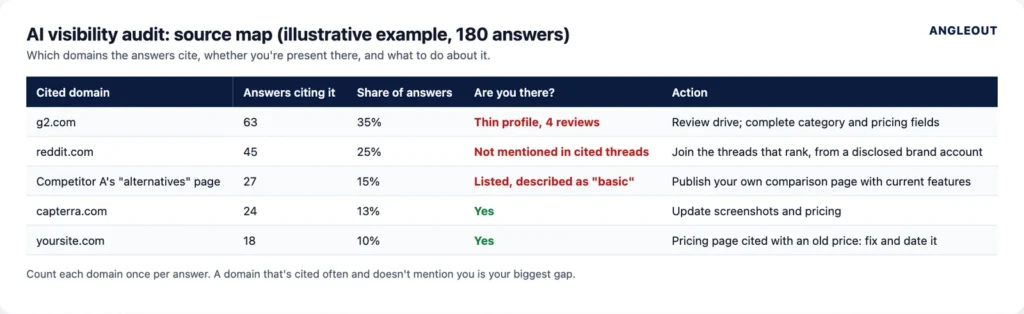
Next, list every domain the answers cite and count how many answers cite each one. This source map shows where AI engines get their view of your category, and it usually points to the fixes with the widest reach.
Don’t rely on industry benchmarks here, because they disagree.
A G2-published study of about 35,000 ChatGPT citations put review platforms at 8.6% of citations. Growfusely’s July 2026 study of B2B SaaS queries put all review sites at 7.3%, and a smaller 500-citation study put review aggregators at 42.0%. Query stage, engine and category change the mix, so your own map is the only one that counts. Build it.
See what Reddit & SEO can do for your pipeline — grab a time
A 30-minute working session. We'll map your top intent gaps and where the pipeline is leaking. No pitch deck.
For each frequently cited domain, ask two questions: are you mentioned there, and is the information current? A review site that’s cited in a third of answers but holds four reviews of your product is likely a bigger gap than most pages on your own site.
Third-party mentions matter too. Ahrefs’ November 2026 study of 10,000 US brands found Reddit mentions in Google-ranking threads had the strongest correlation with AI visibility, followed by mentions on other webpages. Ahrefs has said in earlier studies that correlation isn’t causation, and which mention type ranks first has changed between its studies, but off-site mentions keep coming out ahead of backlinks. Earn mentions on the pages AI already cites, then strengthen your own comparison and bottom-of-funnel pages.
Step 6: Check that AI crawlers can reach your site
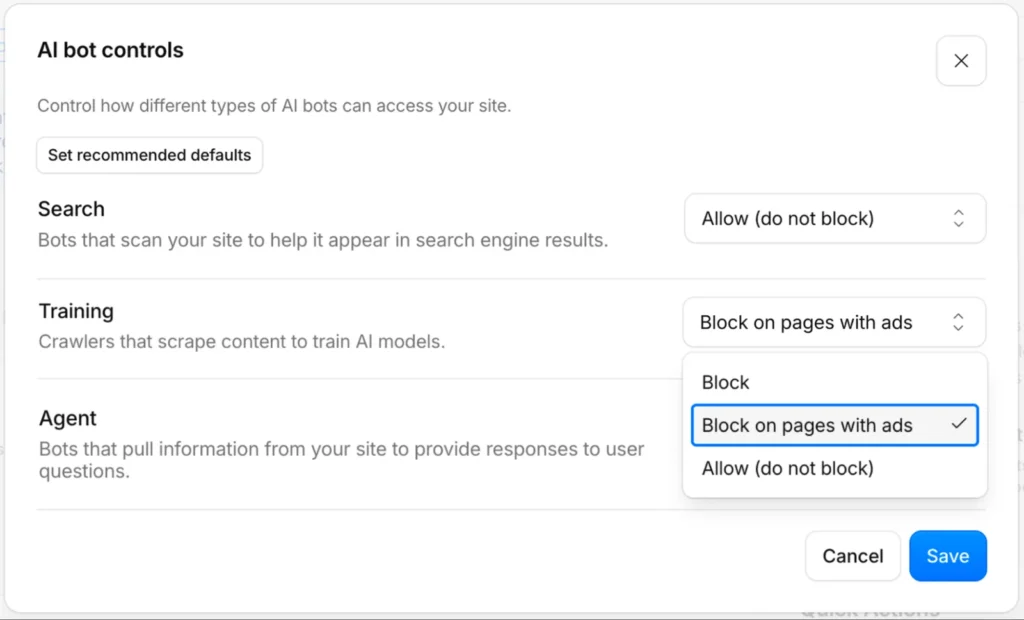
A blanket “block AI bots” setting at the CDN can block AI search crawlers along with training crawlers, and it’s easy to switch on and forget: more than one million Cloudflare customers had chosen its one-click AI crawler block by July 2025. Check three layers: robots.txt, your CDN or firewall, and page-level snippet controls.
robots.txt. Most engines separate search from training, so you can allow one and block the other:
- OpenAI: OAI-SearchBot surfaces sites in ChatGPT search, and sites that opt out won’t be shown in ChatGPT search answers. GPTBot is for training.
- Perplexity: PerplexityBot surfaces and links sites in Perplexity results and isn’t used for training.
- Anthropic: Claude-SearchBot indexes content for search, and Anthropic says blocking it may reduce visibility.
- Google: AI Overviews and AI Mode use normal Googlebot access. Google-Extended doesn’t affect inclusion in Google Search.
User-triggered fetchers are different: Perplexity-User generally ignores robots.txt, and OpenAI says ChatGPT-User may not follow it, because a person asked for the page.
Your CDN. Cloudflare split its AI settings into Search, Training and Agent in July 2026. It said that from September 15, 2026, customers who block Training would also block multi-purpose crawlers such as Googlebot and BingBot. Open Security > Settings, filter by bot traffic and check the AI crawler policies yourself, because Cloudflare’s announced defaults and its current docs don’t match.
Snippet controls. Google says nosnippet stops content being used as a direct input for AI Overviews and AI Mode. Microsoft’s new AI Grounding preference, which takes effect from February 1, 2027, will “significantly reduce” visibility in AI answers if you set it to disallow. Check that nobody added either to your key pages.
Step 7: Pull what Google, Bing and OpenAI report
Finish with the first-party data. None of these reports shows prompts or full answers, and some are samples, but together they show whether your manual sample is roughly in line.
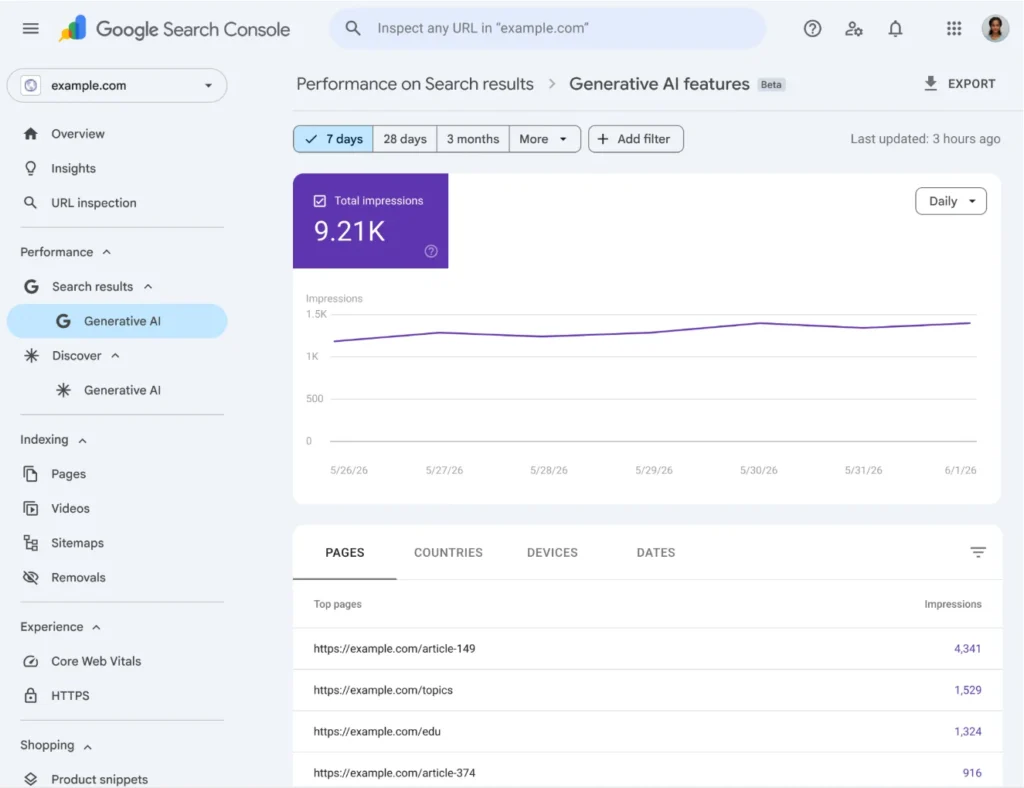
- Google Search Console: the Generative AI performance report shows impressions in AI Overviews and AI Mode by page, country, date and device. Google says it rolled out to all sites by August 31, 2026, and it reports impressions only, with no clicks metric.
- Bing Webmaster Tools: AI Performance shows how often your pages are cited in Copilot and Bing’s AI summaries, plus the grounding queries behind those citations. Microsoft says citations aren’t clicks and the data is a sample.
- ChatGPT Business Hub (in beta; eligibility depends on business type and location): once your business is claimed and verified, Insights shows mentions and website clicks over the past 28 days. A mention counts only when ChatGPT references your website.
- GA4: the AI Assistant channel from Step 1 shows visits from assistants such as ChatGPT and Copilot (not Google’s AI features).
If Search Console shows AI impressions on pages your prompt set never surfaced, add prompts for those topics. If Bing shows citations your manual Copilot checks didn’t find, remember its report also counts Bing’s AI summaries and partner integrations, then run more samples.
Worked example: auditing a SaaS brand across 180 answers
Here’s how the numbers come together. This is an illustrative example with made-up figures, not client data.
A SaaS company runs 20 prompts across ChatGPT, Google AI Mode and Perplexity, three times each: 20 × 3 × 3 = 180 answers.
- Mention rate: the brand is named in 45 of 180 answers, or 25%. Competitor A is named in 117, or 65%.
- Citation rate: the brand’s site is linked in 18 answers, or 10%.
- Share of voice: across 300 brand mentions in total, the brand holds 45, or 15%, against Competitor A’s 39%.
- Accuracy: 36 of the 45 mentions are accurate (80%). Six quote an old price and three list an integration the product doesn’t have.
The stage split tells the real story:
- branded prompts: 80% mention rate
- comparison and alternatives: 13%
- pricing and integration: 7%
- category prompts: 0%
AI knows the brand when asked about it by name, but never names it in answers to open category questions, and rarely elsewhere. By engine, AI Mode names it in 35% of answers, against 20% for ChatGPT and 20% for Perplexity.
The source map explains why. g2.com is cited in 63 answers (35%), and the brand’s G2 profile is thin, with 4 reviews. reddit.com is cited in 45 (25%), and the cited threads don’t mention the brand. Competitor A’s own “alternatives” page is cited in 27 answers and calls the brand “basic”. The brand’s own site is cited in 18 answers, 12 of them the pricing page, which still shows the old price.
How to turn the findings into a 90-day plan
Rank fixes by how many answers they could change, then pull cheap accuracy fixes forward. In the example above, that looks like this:
| Finding | Answers affected | Fix | When |
|---|---|---|---|
| AI search crawlers blocked (only if Step 6 found it) | All | Allow Search crawlers at the CDN and in robots.txt | Day 1 |
| Old price and a missing integration in AI answers; pricing page cited in 12 | 9 | Update and date the pricing and integrations pages; correct the same details on G2 and Capterra | Week 1 |
| 0% mention rate on category prompts; g2.com cited in 63 answers, capterra.com in 24 | 45 | Build up reviews and complete the category and pricing fields on both profiles | Weeks 1-8 |
| reddit.com cited in 45 answers; the threads don’t mention you | 45 | Join the ranking threads from a disclosed brand account | Weeks 2-12 |
| Competitor A’s alternatives page cited in 27 answers, calling you “basic” | 27 | Publish your own comparison and alternatives pages with current features | Weeks 2-6 |
Seer Interactive’s experience shows why a fix has to reach the sources AI cites. One negative review from 2018, copied across directories, led AI answers to say Seer had “high account manager turnover”, and the phrase appeared 67 times in its tracked branded prompts.
A blog post with its real retention rate fixed it for a while, but Seer concluded one post isn’t a durable fix, and plans a citable brand-facts page and fresh reviews on the sites AI pulls from.
AngleOut’s own company facts page lists our plans, prices and team in one place for the same reason.
Mistakes that skew an audit
- Testing only prompts you already win. Branded prompts flatter you; category prompts are the ones that bring new buyers.
- Changing prompt wording mid-audit. A reworded prompt is a new prompt with a new ID.
- Trusting one run. Answers vary too much; score rates across repeated runs.
- Mixing API results with the consumer apps. Keep to a single collection method and note it in the report, so later audits compare like with like.
- Fixing only your own pages. If AI cites G2, Reddit or a competitor’s comparison page for your category, those pages need work too.
- Blocking “AI” wholesale at the CDN. Since Cloudflare’s 2026 change, a Training block can also stop Googlebot and BingBot.
How often to rerun the audit
Rerun the full audit every quarter, or after a launch, a pricing change, a rebrand or a site migration. Between audits, track the same prompt set weekly or monthly with a tool or a lighter manual check; the brand-mentions tracking guide linked near the top lists the free and paid options. If you’d rather hand the whole job to a specialist, start with our shortlist of AI SEO agencies.
Keep the prompt IDs stable across audits so the trend lines mean something. Retire a prompt only when buyers stop asking it, and add new prompts under new IDs.
FAQs
How do you audit AI visibility?
Build a fixed set of about 20 buyer prompts and run each one several times in ChatGPT, Google’s AI answers and Perplexity. Then score whether you’re mentioned, cited and described correctly. Add a map of the domains the answers cite, a check that AI crawlers can reach your site, and the first-party reports in Search Console, Bing Webmaster Tools and ChatGPT Business Hub.
How do you measure AI visibility?
Measure it as rates across many answers:
- mention rate (answers that name you)
- citation rate (answers that link to you)
- share of voice (your mentions against competitors’)
- accuracy
Avoid treating your position in a single answer as a metric. SparkToro found brand lists rarely repeat between runs, while appearance rates stay far steadier.
What is an AI search visibility audit?
It’s a one-off baseline of how AI search engines answer your buyers’ questions, and where your brand fits in those answers. Unlike a free checker’s score, it uses prompts you chose, a documented method and saved evidence someone else can review, so you can rerun it later and compare.
How often should you run an AI visibility audit?
Run a full audit every quarter, and again after a pricing change, product launch or site migration. In between, track the same prompts weekly or monthly. AI answers and the sources they cite shift often; Seer saw Perplexity change its sourcing within months, so an old baseline goes stale quickly.
Can ChatGPT do an AI visibility or SEO audit?
ChatGPT can help draft prompts or summarize answers, but it can’t audit itself reliably. Its answers vary from run to run, it doesn’t show you every source it consulted, and asking one session about your brand tests only that session. Collect answers across engines and repeated runs, then score them yourself.
How do you improve AI visibility after the audit?
Fix what the audit found, in order of reach:
- Correct wrong facts at their source.
- Make sure AI search crawlers can reach you.
- Earn mentions on the review sites, communities and listicles AI already cites.
- Publish clear comparison, pricing and integration pages.
Then rerun the same prompts to see what changed.
Where to start this week
Copy the prompt set, pick 20 prompts, and run them three times in ChatGPT, AI Mode and Perplexity. Score the answers, list the cited domains, and check your Cloudflare and robots.txt settings before you touch any content. That alone will tell you whether you have an access problem, an accuracy problem or a category-visibility problem.
At AngleOut, a SaaS SEO and GEO agency, at onboarding we agree a list of money keywords and AI prompts with each client, then track rankings and AI mentions for each one, with prompts included on every plan. If you’d like help running your first audit, book a free 30-minute call.
47 checkpoints across technical, content, and conversion — the same list our strategists run on every new account.
Sources
- G2: The Answer Economy, B2B buyer research (March 2026 survey)
- SparkToro: AIs are highly inconsistent when recommending brands
- OpenAI: Overview of OpenAI crawlers
- Perplexity: Perplexity crawlers
- Anthropic: Does Anthropic crawl data from the web?
- Google Search Central: AI features and your website
- Google: Google-Extended
- Cloudflare: Content Independence Day, new AI options (July 2026)
- Microsoft: Clearer preferences for training and grounding (October 2026)
- Google Search Console: Generative AI performance report
- Bing Webmaster Tools: AI Performance
- OpenAI: Setting up your business on ChatGPT
- Google Analytics: default channel group
- G2 / Kevin Indig: Review platforms in ChatGPT citations
- Growfusely: AI citation analysis for B2B software
- Ahrefs: Which mention types drive AI visibility
- Seer Interactive: How AI highlighted the one bad review we got in 24 years